Event Safety Journey spans Street, Station and Venue Door
Event safety is increasingly being defined not just by what happens inside a venue, but by how secure people feel from the moment they leave home until they return after the event has finished.
Within the events and live entertainment sector, that shift is placing greater emphasis on journeys to and from venues, public transport hubs and surrounding public spaces, alongside security at entrances and inside buildings.
Event Safety Journey covers More than Venue Door
Traditional event security planning has focused heavily on what happens at the point of entry and within the ticketed footprint of an event. However, experience on the ground in security operations suggests that attendees assess their sense of safety much earlier in their journey.
An attendee may already be forming opinions about an event's safety as they walk from a car park or public transport stop, navigate poorly lit streets, or encounter groups of people around the venue. That perception can be heightened for people who feel more vulnerable, including many women travelling alone or leaving late at night.
The distance between the theoretical safety of a well-documented plan and the lived reality of moving through public space can therefore be significant, even when an event is formally compliant with regulations.
Attendee Experience highlights Safety Gap
Security practitioners working in the events sector report a clear gap between how secure an environment may appear on risk assessments and how secure it feels to those using it. This difference is often most visible away from the primary event footprint.
Attendees passing through transport hubs, queuing areas and streets surrounding a venue may face dim lighting, limited staff visibility or a lack of clear wayfinding. Even in the absence of a specific incident or threat, these factors can undermine a sense of safety.
This experience is not limited to any one demographic, but some groups are more acutely aware of it in everyday life and bring that perspective with them to events. Their feedback is contributing to a more holistic view of event safety that extends beyond barriers, bag checks and in-venue patrols.
Pre-Event Planning includes Journey Assessment
The widening focus on end-to-end safety is encouraging organisers and security teams to review how attendees will move to and from venues, not just how they will behave once inside. That involves scrutinising approaches, transport links and adjoining public spaces that may fall outside the strict legal control of the organiser but are part of the attendee experience.
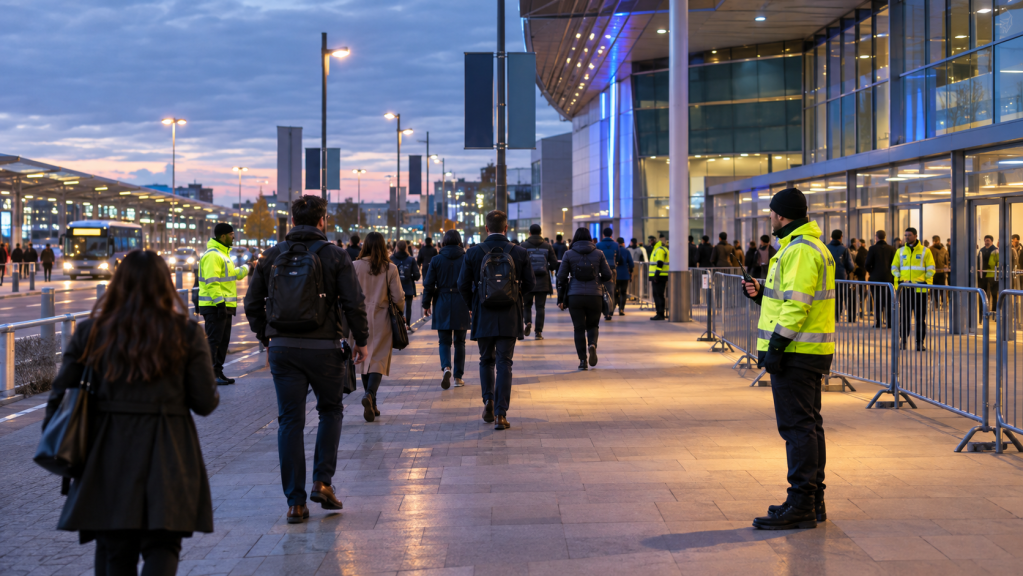
Event plans can take into account factors such as lighting levels on approach routes, the positioning of stewards near access points and the provision of clear signage around entrances and exits. Coordination with local authorities, transport providers and venue neighbours can also play a role in identifying pinch points and areas where people may congregate before or after an event.
By integrating these considerations into early planning, organisers are better positioned to close the gap between paperwork and the reality on the ground.
Technology and Presence support Perceived Safety
Visible measures such as uniformed staff, security technology and managed access points are often used to reassure attendees that their safety is being taken seriously. These elements can contribute to a stronger perceived level of security when deployed thoughtfully along the entire event journey.
For example, security screening equipment and controlled entry lanes near doors can be complemented by stewarding at nearby walkways, station exits or car park routes. The aim is not purely deterrence or incident response, but also to make people feel that they are being looked after as they transition between public space and the event boundary.
Such measures can also help security teams identify issues earlier, whether related to crowding, lost attendees or individuals who feel unsafe before reaching the entrance.
Communication shapes Attendee Confidence
Information provided before, during and after an event is emerging as another important factor in how safe attendees feel. Advance communication about travel options, recommended routes, meeting points and closing times can help people plan their movements and reduce uncertainty.
On site, clear directions, announcements and signage help guide crowds and prevent confusion, particularly at the end of a show when large numbers of people exit simultaneously. When attendees know what to expect and where to go, they are more likely to feel in control of their surroundings.
Post-event communication, such as guidance on safe routes back to transport and confirmation of service updates, can extend that sense of support beyond the venue doors.
Security Perspective informs Event Design
First-hand experience from security professionals is increasingly feeding into the way events are conceived and delivered. Those working directly with attendees, including many women in security roles, bring insight into daily safety concerns that can influence design choices.
This perspective highlights issues that may not always appear on formal risk matrices but significantly affect comfort and confidence, such as the visibility of staff, the design of queuing systems and the positioning of quiet or poorly overlooked areas.
By incorporating these operational insights into planning, event organisers can better align safety documentation with the actual conditions their audiences encounter.
Event Safety continues after Doors close
Security responsibilities do not end when the last attendee leaves the main hall or arena. The period immediately after an event, when crowds disperse, is often one of the most sensitive stages of the entire operation.
Attendees are moving into public spaces, sometimes late at night, potentially tired and unfamiliar with the area. The monitoring of exit routes, coordination with transport providers and the availability of staff to respond to issues can all influence how safe people feel as they depart.
Some security approaches therefore look at the complete timeline of audience movement, from arrival at the wider location through to their departure from the surrounding area, treating the journey home as part of the same safety continuum as bag checks and in-venue patrols.
Holistic View reshapes Event Security Practice
The concept of event safety is steadily broadening from a narrow focus on controlled spaces to a more comprehensive view that includes approach routes, external environments and exit journeys. This reflects both operational learning and the voices of those who regularly navigate public spaces with heightened awareness of risk.
For organisers, venues and security providers, this holistic view is prompting more collaboration across disciplines and stakeholders, covering everything from infrastructure and staffing to communication and technology deployment. As a result, the definition of a "safe event" is moving toward one that considers the full attendee journey before arrival and after the doors close, not just what happens within the venue walls.