Interactive catching games emerge as a trending activity at corporate and live events
Background and context
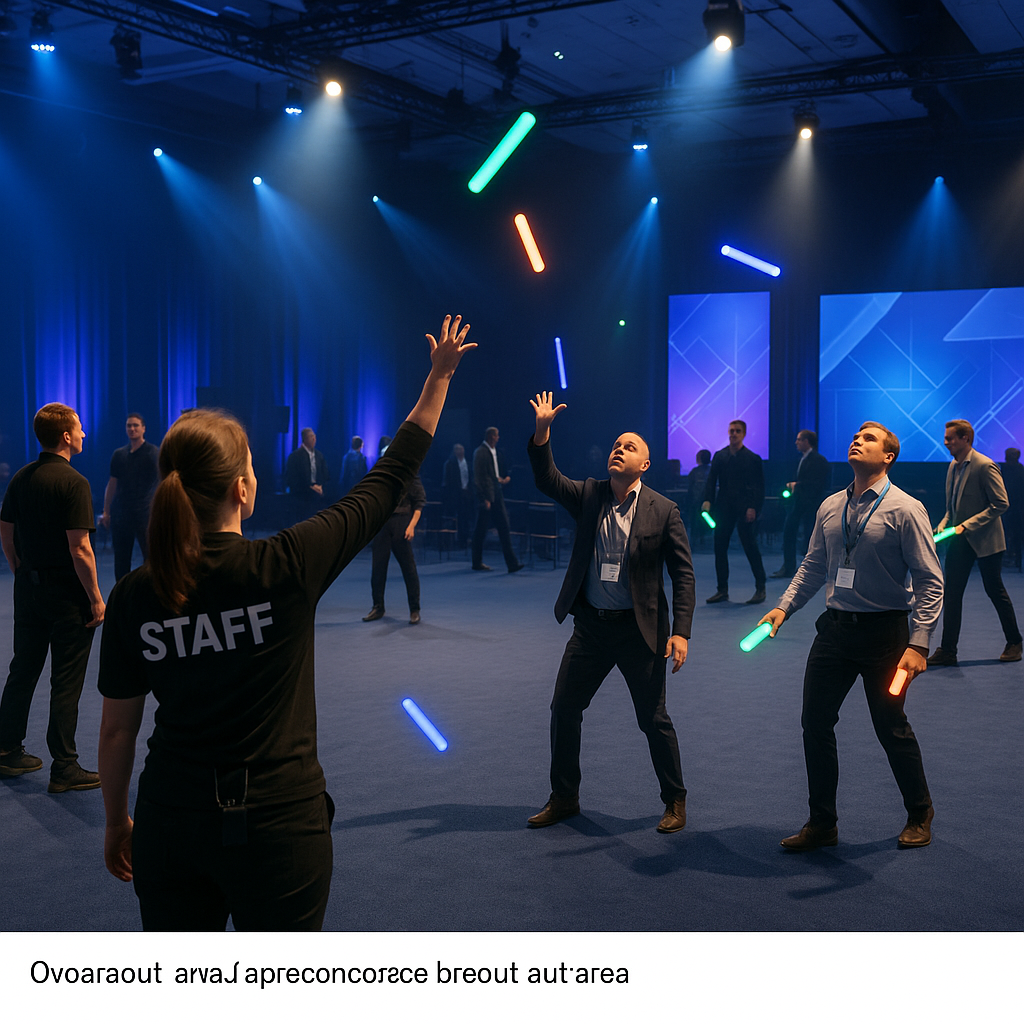
Event planners are increasingly turning to fast-paced, physical games to keep audiences engaged, and one particular format—catching and tossing illuminated sticks or batons—has started to appear at a wide range of live and corporate events.
These activities, which often combine simple physical movement with light effects and basic scoring or tracking, are being used as icebreakers, team-building tools, and branded experiences. They are designed to be easy to understand, require minimal instruction, and appeal to a broad demographic of attendees.
Unlike more complex VR or AR installations, catching games typically rely on lightweight hardware and straightforward rules, allowing large groups to participate in quick rotations. This simplicity has helped the concept spread into conferences, brand activations, trade shows, and internal company meetings.
Key announcement
The manufacturer behind one of the more visible versions of this concept has formalized its catching-game platform for event use, positioning it as a turnkey activity that can be rapidly deployed at venues. The system generally involves a set of illuminated sticks or batons that can be thrown and caught by participants, sometimes with integrated sensors or timing elements.
Depending on the configuration, the technology can track basic performance metrics such as number of successful catches, speed, or reaction time. Organizers can display live results on screens or incorporate the data into larger gamification frameworks, such as team competitions or prize draws.
The company is offering the setup with options for customization, including color schemes to match event branding, variable difficulty levels, and different game modes for individual or group play. Details about configurations, rental options, and technical specifications are available on the manufacturer’s official website.
Industry impact
The rise of catching-style games reflects a broader shift in event design toward activities that are interactive, social, and lightly physical without being overly demanding. For event professionals, these games can fill gaps in programming by offering short, repeatable experiences that work in breakout areas, expo floors, or pre-function spaces.
From an operations perspective, the hardware footprint is relatively small compared with larger experiential installations. Staff can be trained quickly, and the activity can run continuously with rotating participants, maximizing throughput at busy events.
There is also a data angle. When paired with simple sensors or timing systems, the activity can generate quantifiable engagement metrics—such as number of participants, average play time, and performance scores—that can be tied to lead capture or used to demonstrate ROI to sponsors.
Why this matters
For planners seeking alternatives to standard photo booths, lounge areas, or passive brand displays, catching games offer a way to get attendees moving and interacting with each other in a low-pressure format. The barrier to entry is low: participants do not need prior experience, and the rules can be explained in seconds.
This kind of activity also aligns with growing interest in wellness and movement at events. Light physical engagement can help break up long periods of sitting in sessions, which may contribute to better attention and energy levels throughout the day.
Finally, because the format is visually striking—especially when illuminated equipment is used in a dimmed environment—it lends itself well to social media sharing and visual documentation. For brands and organizers, that can extend the reach of an event beyond the venue and provide additional content for post-event marketing.