


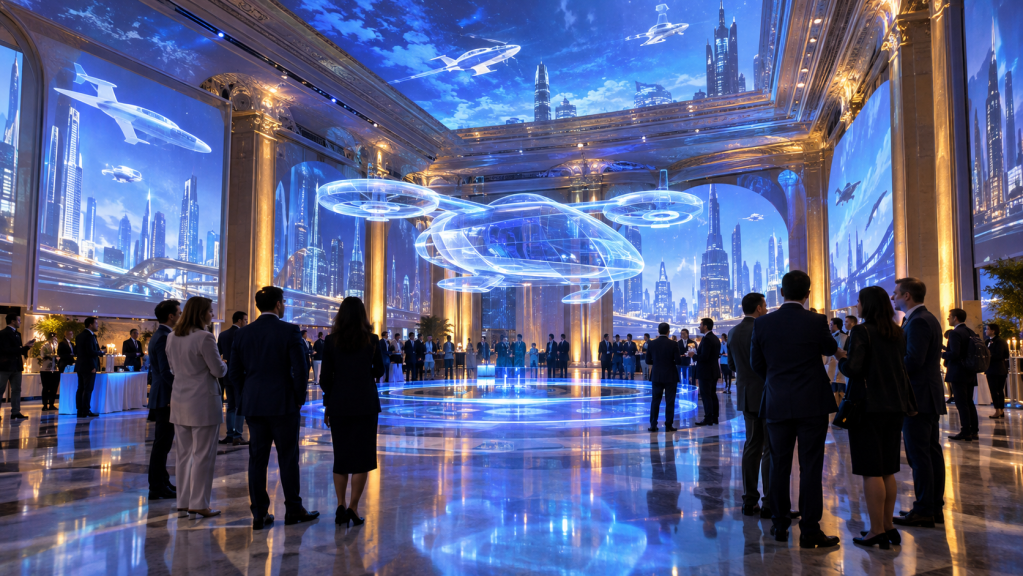
The United Arab Emirates used advanced immersive technology to turn a diplomatic reception at the 42nd Session of the ICAO General Assembly into a narrative journey through aviation history and its future. The experience blended visual storytelling, holographic content, and architectural projections to highlight developments in air travel, from its early days to emerging concepts like flying taxis.
Event Objective And Audience Engagement Strategy
The reception was designed for international delegates gathered for the ICAO General Assembly, reframing a traditional diplomatic function as an experiential showcase. Instead of relying solely on formal speeches and static displays, the UAE focused on immersive storytelling to keep guests engaged while reinforcing its position in global aviation.
The creative direction centered on connecting the past, present, and future of flight in a single integrated environment. Delegates were invited to move through the space as if traveling along a timeline, with each phase supported by different layers of visual and experiential technology.
Technology Integration Across Aviation Timeline
The event concept combined multiple technologies to illustrate key milestones and future possibilities in aviation. These elements were orchestrated to work together rather than as isolated attractions, creating a cohesive narrative arc.
Immersive Architectural Projection Mapping
Architectural projection was used to transform the reception environment into an evolving aviation canvas. Large-scale projections depicted historic aircraft, contemporary aviation hubs, and conceptual future skylines. The content was synchronized to build a sense of progression, helping guests feel as though the venue itself was shifting through different eras of flight.
This projection approach allowed the host to repurpose existing architecture without structural changes, using light and motion to create a dynamic setting that supported the diplomatic program while elevating the visual impact.
Hologram Content For Future Mobility
Hologram technology featured prominently in the future-focused segment of the experience. Three-dimensional holographic content presented advanced mobility concepts, with flying taxis used as a symbolic representation of the next phase of urban and regional air transport.
By placing holograms within the reception space, the organizers created a focal point that visually contrasted with the historic imagery in the projections. This helped underscore the leap from conventional air travel to new models of on-demand, technology-driven mobility.
Narrative Design Of Past, Present, And Future Aviation
The event narrative was structured around three temporal phases, each supported by different combinations of content and technology.
-
Past aviation era: Historic imagery and motion graphics emphasized early breakthroughs in flight and the development of international air routes.
-
Present aviation landscape: Visuals highlighted modern aviation infrastructure and contemporary air travel, aligning with the current policy and regulatory focus of the ICAO General Assembly.
-
Future aviation vision: Conceptual content, including holograms and futuristic projections, pointed to topics such as advanced air mobility and new forms of passenger and cargo movement.
This structure allowed the reception to function as both a networking environment and an informal educational platform, giving delegates a clear narrative thread that paralleled broader conversations about the evolution of global air transport.
Implications For Meeting And Event Producers
The UAE reception demonstrates how governmental and diplomatic events can adopt techniques more commonly seen in large-scale brand activations and experiential marketing. For meeting and event producers, several strategic takeaways emerge:
-
Immersive storytelling can reinforce policy messages and national positioning when carefully aligned with event objectives.
-
Architectural projection and hologram technology can be used to transform formal venues without permanent modification, which is particularly relevant for gatherings in institutional or historic spaces.
-
Concepts like flying taxis offer a powerful visual shorthand for complex innovation themes, helping nontechnical audiences grasp the scale of change in sectors such as aviation.
By integrating these tools in a tightly curated narrative, the reception offered a template for other hosts seeking to differentiate their official functions at international assemblies, summits, and high-level meetings.
Positioning Of UAE Within Global Aviation Discourse
Through this immersive reception, the UAE underscored its interest in both the heritage and the future of aviation. By framing the event as a journey through past, present, and future, the host country positioned itself as a participant in long-term industry transformation rather than a sponsor of a single meeting.
For the wider events and venue technology sector, the reception illustrates how immersive tools can be embedded into the fabric of high-level policy gatherings, expanding expectations for what a diplomatic or institutional reception can deliver in terms of experience design.

