


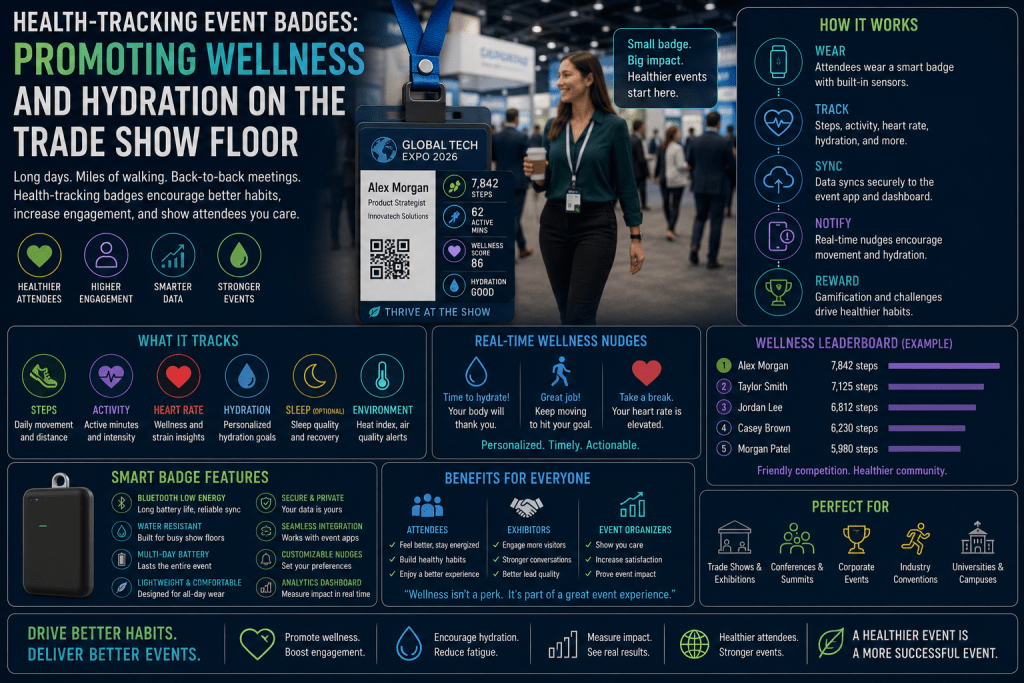
Trade shows are among the most physically demanding environments in the event industry. Attendees routinely walk several miles each day while navigating expansive exhibition halls, attending educational sessions, participating in networking meetings, and engaging with exhibitors. Long hours, crowded venues, irregular meal schedules, and constant movement often lead to fatigue, dehydration, reduced concentration, and lower overall attendee satisfaction.
While event organizers have traditionally focused on logistics, networking, and content delivery, attendee wellness is emerging as an equally important component of event success. Organizations increasingly recognize that healthier, more energized attendees spend more time engaging with exhibitors, attend more educational sessions, and report higher satisfaction levels.
One of the latest innovations supporting this shift is the health-tracking event badge. Combining wearable sensors, Bluetooth Low Energy (BLE), artificial intelligence, cloud analytics, and mobile event platforms, these smart credentials extend beyond identification to become real-time wellness companions.
In 2026, health-tracking badges are helping event organizers encourage hydration, reduce fatigue, promote movement, and create healthier trade show experiences without disrupting attendee participation.
Why Wellness Matters at Trade Shows
Large exhibitions create unique physical challenges.
Attendees often experience:
- Extended periods of walking
- Standing for hours
- Limited hydration
- Missed meals
- Mental fatigue
- Information overload
Many participants prioritize meetings over personal wellbeing, only recognizing fatigue after it begins affecting their productivity.
For exhibitors, diminished attendee energy often translates into shorter booth visits, reduced engagement, and lower-quality business conversations.
Improving attendee wellness therefore creates measurable value for both organizers and exhibitors.
What Are Health-Tracking Event Badges?
Health-tracking event badges combine traditional event credentials with embedded sensors and wireless connectivity.
Unlike standard identification badges, smart badges continuously collect selected wellness-related information while integrating with event management platforms.
Depending on deployment, badges may monitor:
- Step count
- Walking distance
- Activity duration
- Standing time
- Heart rate
- Ambient temperature
- Indoor air quality
- Hydration reminders
- Movement patterns
Data is securely synchronized with mobile applications and event dashboards, allowing attendees to receive personalized wellness insights throughout the event.
How Smart Wellness Badges Work
Several technologies work together to create intelligent event badges.
Embedded Sensors
Modern badges may include miniature sensors capable of measuring physical activity and environmental conditions.
These devices consume minimal power while operating throughout multi-day events.
Bluetooth Low Energy Connectivity
BLE enables continuous communication between badges, smartphones, and venue infrastructure.
The technology supports:
- Indoor positioning
- Data synchronization
- Location awareness
- Proximity services
without significantly affecting battery life.
AI-Powered Wellness Analytics
Artificial intelligence analyzes activity data in real time.
Rather than simply counting steps, AI evaluates attendee behavior to identify patterns such as prolonged inactivity, excessive walking, or potential fatigue.
Based on these insights, personalized wellness recommendations can be generated automatically.
Encouraging Hydration Through Intelligent Notifications
Dehydration is one of the most common wellness issues during conferences and trade shows.
Busy schedules often cause attendees to overlook hydration for extended periods.
Personalized Hydration Reminders
Smart badges can trigger reminders based on:
- Activity level
- Walking distance
- Ambient temperature
- Event duration
- Individual preferences
Rather than relying on fixed schedules, reminders adapt to attendee behavior.
Location-Aware Guidance
Integration with indoor navigation systems allows badges to direct attendees toward nearby hydration stations.
This reduces the effort required to maintain healthy habits.
Gamified Wellness Challenges
Many events incorporate hydration goals into broader engagement programs.
Participants may earn:
- Digital badges
- Reward points
- Leaderboard recognition
- Sponsor incentives
for maintaining healthy behaviors throughout the event.
Supporting Physical Wellness Beyond Hydration
Health-tracking badges encourage multiple aspects of attendee wellbeing.
Movement Optimization
While trade shows involve extensive walking, attendees also experience prolonged periods of sitting during educational sessions.
Badges can recommend:
- Stretch breaks
- Walking intervals
- Route adjustments
- Recovery periods
based on individual activity patterns.
Fatigue Monitoring
Some advanced wearables estimate fatigue by analyzing:
- Activity intensity
- Heart rate trends
- Session duration
- Recovery periods
This enables attendees to manage their schedules more effectively.
Environmental Awareness
Smart badges connected to venue sensors can notify attendees about:
- High indoor temperatures
- Poor air quality
- Crowded areas
- Excessive noise levels
allowing them to make more comfortable navigation decisions.
Benefits for Exhibitors
Wellness technologies create measurable business advantages.
Longer Booth Engagement
Attendees who remain hydrated and energized typically spend more time exploring exhibition floors.
This increases opportunities for meaningful conversations.
Higher-Quality Interactions
Reduced fatigue supports better concentration during:
- Product demonstrations
- Technical discussions
- Sales meetings
resulting in more productive exhibitor engagements.
Sponsored Wellness Programs
Health-tracking badges create new sponsorship opportunities.
Brands can sponsor:
- Hydration challenges
- Walking competitions
- Wellness rewards
- Healthy break reminders
creating positive brand associations.
Operational Benefits for Event Organizers
Smart badges generate valuable operational intelligence.
Crowd Flow Analysis
Aggregated movement data helps organizers understand:
- Traffic patterns
- Congestion points
- Popular exhibits
- Session attendance
This supports better venue planning for future events.
Wellness Performance Metrics
Organizers can evaluate:
- Average attendee activity
- Hydration engagement
- Break participation
- Wellness program effectiveness
These insights help improve future event design.
Enhanced Attendee Satisfaction
Wellness initiatives demonstrate that organizers value attendee experience beyond traditional event logistics.
This contributes to stronger satisfaction scores and higher return attendance.
Privacy and Data Governance
Because health-related information is sensitive, responsible implementation is essential.
Attendee Consent
Participation should always be voluntary.
Attendees must understand:
- What data is collected
- How it will be used
- Who can access it
- How long it is retained
Transparent communication builds trust.
Secure Data Management
Event platforms should implement:
- Encryption
- Role-based access controls
- Secure cloud storage
- Regulatory compliance
to protect participant information.
Aggregated Analytics
Operational insights should rely primarily on anonymized and aggregated data rather than individual monitoring.
This balances business intelligence with personal privacy.
Challenges and Implementation Considerations
Despite their advantages, health-tracking badges require thoughtful deployment.
Hardware Costs
Sensor-enabled badges are more expensive than conventional credentials.
Organizers should evaluate return on investment based on event objectives.
Battery Management
Multi-day events require reliable battery performance.
Low-power hardware and efficient communication protocols are essential.
User Adoption
Attendees are more likely to engage when wellness features are simple, optional, and clearly beneficial.
Complex interfaces may reduce participation.
The Future of Wellness Wearables at Events
Several innovations are expected to expand smart badge capabilities.
Emerging developments include:
- AI-powered fatigue prediction
- Personalized nutrition recommendations
- Stress monitoring
- Environmental health analytics
- Digital twin wellness optimization
- Smart hydration stations
- Integration with personal wearable ecosystems
Rather than functioning as isolated devices, future badges will become intelligent nodes within connected event wellness platforms.
Conclusion
Health-tracking event badges are redefining what attendee credentials can accomplish. By combining wearable sensors, AI-powered analytics, indoor positioning, and personalized wellness guidance, these smart badges promote healthier behaviors while enhancing engagement across trade shows and conferences.
Their value extends beyond hydration reminders. They improve attendee satisfaction, support exhibitor success, generate operational insights, and contribute to safer, more inclusive event environments.
As wellness becomes an increasingly important measure of event quality, health-tracking badges are positioned to become a standard component of modern event technology. The future of trade shows is not simply smarter—it is healthier, more personalized, and designed to help attendees perform at their best from registration through the closing session.