


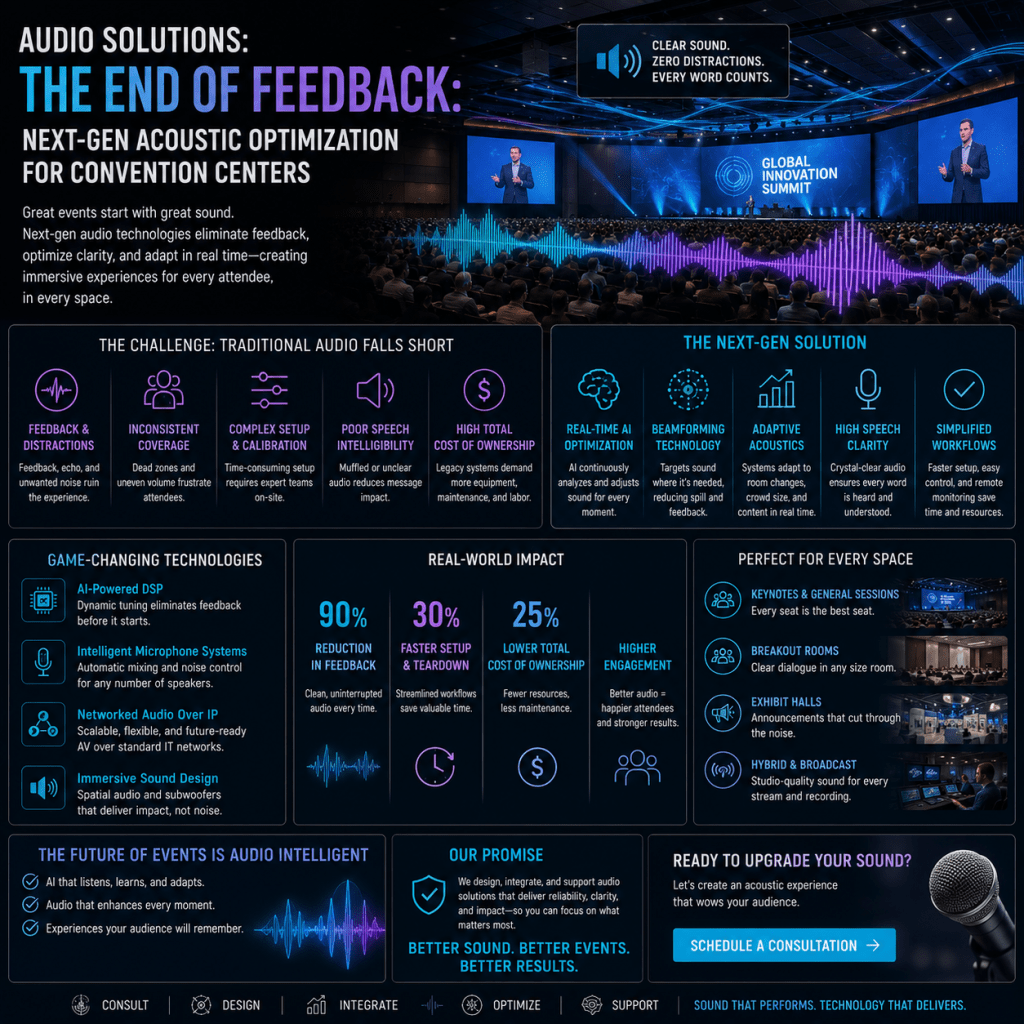
For decades, audio feedback has been one of the most persistent challenges in live events. The familiar high-pitched squeal caused by microphones feeding back into loudspeaker systems remains one of the quickest ways to disrupt presentations, distract audiences, and diminish the professionalism of an event. Despite significant advances in AV technology, convention centers continue to face complex acoustic challenges due to large spaces, reflective surfaces, multiple presentation zones, and increasingly sophisticated hybrid event requirements.
However, a new generation of acoustic optimization technologies is changing the landscape. Advances in artificial intelligence, real-time digital signal processing, beamforming audio systems, acoustic modeling, networked audio infrastructure, and adaptive sound management are enabling venues to achieve levels of audio clarity and control that were previously impossible.
In 2026, convention centers are moving beyond simply reacting to audio problems. They are increasingly deploying intelligent acoustic ecosystems capable of predicting, preventing, and continuously optimizing sound conditions before feedback and other audio issues occur.
For venue operators, event organizers, and AV professionals, these technologies promise more than just cleaner sound. They offer operational efficiency, improved attendee experiences, reduced setup complexity, and stronger support for hybrid and multi-purpose event environments.
Why Feedback Remains a Challenge in Convention Centers
Convention centers present some of the most difficult acoustic environments in the event industry.
Several factors contribute to audio challenges:
- Large open spaces
- High ceilings
- Reflective surfaces
- Movable room configurations
- Multiple simultaneous events
- Temporary AV installations
- Variable audience sizes
Traditional audio systems often require extensive manual tuning to adapt to changing conditions.
Even experienced sound engineers must constantly balance microphone gain, speaker placement, room acoustics, and audience noise levels to maintain optimal performance.
As event environments become more complex, manual approaches alone are becoming increasingly insufficient.
Understanding How Audio Feedback Occurs
Audio feedback occurs when sound from a loudspeaker is picked up by a microphone and re-amplified repeatedly.
This creates a loop that rapidly increases in volume until a distinct ringing or squealing sound becomes audible.
Several conditions increase feedback risk:
- Excessive microphone gain
- Poor speaker positioning
- Reflective room surfaces
- High microphone sensitivity
- Inadequate acoustic treatment
Traditional solutions often involve reducing gain levels, repositioning equipment, or manually applying equalization filters.
While effective to a degree, these methods can compromise overall sound quality.
The Rise of AI-Powered Acoustic Optimization
Artificial intelligence is transforming how convention centers manage audio environments.
Real-Time Acoustic Analysis
Modern AI systems continuously monitor:
- Sound pressure levels
- Frequency responses
- Microphone activity
- Speaker output
- Audience noise
- Room occupancy
Using machine learning algorithms, these systems can identify acoustic risks before audible feedback occurs.
Rather than reacting to problems, the system proactively adjusts audio parameters.
Predictive Feedback Prevention
Advanced platforms now analyze acoustic patterns in real time.
When conditions indicate an increased likelihood of feedback, the system can automatically modify:
- Gain structure
- Frequency response
- Speaker routing
- Microphone sensitivity
These adjustments occur within milliseconds, often preventing issues before attendees notice any change.
Continuous Learning
AI-powered systems become more effective over time.
As they collect data from repeated events, they learn how specific rooms behave under different configurations and audience conditions.
This creates increasingly accurate acoustic optimization models.
Beamforming Microphones and Intelligent Sound Capture
One of the most significant innovations in event audio involves beamforming technology.
How Beamforming Works
Traditional microphones capture sound from broad areas.
Beamforming systems use multiple microphone elements to create highly focused pickup patterns.
This allows microphones to target specific speakers while rejecting unwanted noise from surrounding areas.
Benefits for Convention Centers
Beamforming microphones reduce:
- Ambient noise pickup
- Reverberation effects
- Audience distractions
- Feedback risk
They are particularly valuable in:
- Panel discussions
- Hybrid meetings
- Conference sessions
- Executive presentations
where multiple participants share a space.
Improved Remote Participation
For hybrid events, beamforming improves speech clarity for remote attendees by isolating voices more effectively than traditional microphones.
Adaptive Loudspeaker Systems
Speaker technology is also becoming more intelligent.
Digital Beam Steering
Modern loudspeaker arrays can direct sound precisely toward audience areas.
Rather than flooding entire rooms with audio, beam-steering systems focus sound where it is needed most.
This improves:
- Speech intelligibility
- Coverage consistency
- Feedback resistance
while reducing unnecessary sound reflections.
Dynamic Coverage Adjustment
Some systems can automatically adapt coverage patterns based on:
- Audience size
- Room layouts
- Seating configurations
- Occupancy levels
This flexibility is particularly valuable in multipurpose convention centers where room configurations change frequently.
Digital Twins and Acoustic Simulation
Convention centers are increasingly adopting digital twin technology.
Virtual Acoustic Modeling
Digital twins create detailed virtual representations of physical spaces.
Audio engineers can simulate:
- Speaker placement
- Microphone positioning
- Audience occupancy
- Room configurations
before an event begins.
This allows optimization decisions to occur during planning rather than during live production.
Faster Event Setup
Acoustic simulations reduce the need for lengthy on-site tuning sessions.
Teams can arrive with optimized configurations already developed through virtual testing.
Improved Predictability
Digital twins help identify potential acoustic issues before they impact live audiences.
This reduces operational risk significantly.
Networked Audio Infrastructure
Convention centers are increasingly transitioning from traditional analog systems to network-based audio platforms.
Audio Over IP
Modern infrastructures distribute audio using standard network protocols.
Benefits include:
- Centralized management
- Flexible routing
- Simplified scalability
- Remote monitoring
- Reduced cabling requirements
These systems support more sophisticated acoustic optimization strategies.
Centralized Control
Venue operators can monitor and manage multiple event spaces simultaneously from centralized control platforms.
This improves operational efficiency while reducing staffing requirements.
Acoustic Sensors and Environmental Awareness
IoT technology is expanding the amount of real-time data available to audio systems.
Smart Acoustic Sensors
Sensors throughout a venue can monitor:
- Noise levels
- Reverberation characteristics
- Occupancy changes
- Environmental conditions
This information allows audio systems to adapt dynamically.
Occupancy-Based Optimization
As audience sizes fluctuate, acoustic conditions change.
Smart systems can automatically adjust audio settings based on real-time occupancy data.
This helps maintain consistent listening experiences throughout events.
Operational and Business Benefits
Advanced acoustic optimization delivers advantages beyond technical performance.
Improved Attendee Satisfaction
Clear, intelligible audio directly affects:
- Session engagement
- Knowledge retention
- Audience comfort
- Overall event perception
Better sound quality often translates into stronger attendee feedback.
Reduced Technical Staffing Pressure
Automated optimization tools reduce the need for constant manual adjustments.
This allows technical teams to focus on higher-value production tasks.
Faster Turnaround Between Events
Convention centers hosting multiple events benefit from quicker setup and reconfiguration processes.
Enhanced Venue Competitiveness
As hybrid and technology-intensive events become more common, advanced audio capabilities are increasingly influencing venue selection decisions.
Challenges and Implementation Considerations
Despite its advantages, next-generation acoustic optimization requires careful planning.
Infrastructure Investment
Upgrading legacy audio systems may require significant investment in:
- Network infrastructure
- DSP platforms
- Sensors
- AI software
- New hardware
Integration Complexity
Convention centers often operate with diverse equipment from multiple manufacturers.
Achieving seamless interoperability remains a challenge.
Data Management
AI-driven systems generate substantial operational data.
Venues must develop appropriate strategies for data security, governance, and performance monitoring.
The Future of Intelligent Venue Acoustics
Several emerging innovations are expected to further transform event audio.
These include:
- AI-generated sound field optimization
- Autonomous audio mixing
- Spatial audio environments
- Personalized listening experiences
- Voice-tracking presentation systems
- Mixed-reality acoustic integration
- Self-healing networked audio infrastructure
As these technologies mature, audio systems will become increasingly autonomous and adaptive.
The role of human engineers will shift toward strategic oversight rather than continuous manual control.
Conclusion
The battle against audio feedback is entering a new era. Advances in artificial intelligence, beamforming technology, digital twins, networked audio systems, and adaptive acoustics are enabling convention centers to move beyond reactive troubleshooting and toward intelligent, predictive optimization.
These technologies improve sound quality, reduce operational complexity, support hybrid event experiences, and enhance attendee satisfaction. Most importantly, they address one of the event industry’s longest-standing technical challenges by preventing feedback before it occurs.
As convention centers continue investing in smart infrastructure, next-generation acoustic optimization will become a defining characteristic of modern venues. The future of event audio is not simply louder or clearer—it is intelligent, adaptive, and increasingly invisible to audiences who can focus entirely on the content rather than the technology delivering it.