


The event industry has always operated under conditions that challenge human endurance. Large-scale conferences, exhibitions, festivals, sports productions, and hybrid corporate events require compressed timelines, extended working hours, rapid problem-solving, and constant operational vigilance. Behind every seamless attendee experience is a workforce managing logistical complexity under significant psychological and physical pressure.
As events become more technology-driven and operationally sophisticated, workforce expectations have also intensified. Event teams are now expected to coordinate real-time attendee analytics, hybrid broadcasting systems, cybersecurity protocols, RFID ecosystems, crowd management platforms, AI-driven personalization engines, and sustainability reporting — often simultaneously and under strict delivery windows.
This operational acceleration has created a growing but under-addressed problem: burnout among event staff.
Traditional approaches to workforce wellness in events have largely been reactive. Human resources interventions, counseling access, and post-event recovery periods are typically implemented after stress symptoms become visible. However, recent advances in artificial intelligence, wearable computing, behavioral analytics, and predictive health modeling are enabling a fundamentally different approach: predictive burnout detection.
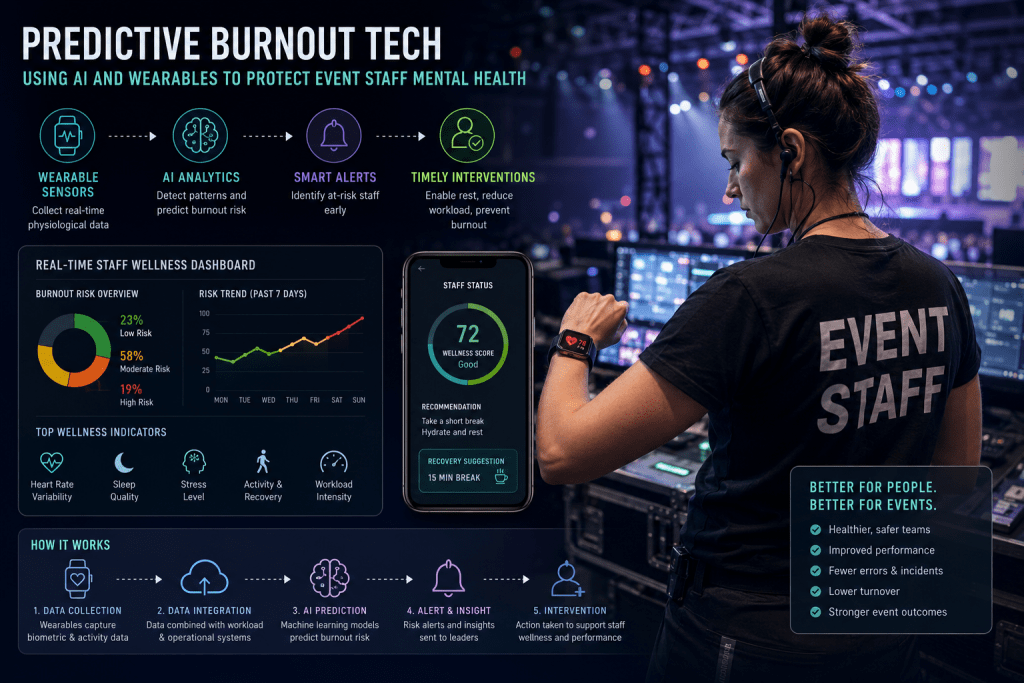
Predictive burnout technology uses continuous physiological, behavioral, and operational data to identify early indicators of cognitive overload, fatigue, emotional stress, and declining resilience before severe burnout occurs. In the context of event operations, these systems are increasingly becoming part of workforce risk management infrastructure.
Why Burnout Is a Critical Operational Risk in Events
Burnout in event operations is not merely an employee wellness issue. It directly affects execution quality, attendee safety, vendor coordination, cybersecurity readiness, and crisis response capability.
High-pressure event environments produce several overlapping stress factors:
- Irregular sleep cycles during setup and teardown
- High mobility across venues
- Continuous decision-making under uncertainty
- Excessive communication load across channels
- Crowd-related stress exposure
- Real-time technical troubleshooting
- Long shifts with limited recovery periods
- Cross-functional dependency pressure
Unlike conventional office environments, event operations teams often function in temporary, decentralized, high-noise ecosystems with constantly shifting priorities. This creates ideal conditions for cognitive fatigue accumulation.
Operationally, burnout can manifest through:
- Increased incident response delays
- Communication breakdowns
- Higher configuration error rates
- Reduced situational awareness
- Elevated safety risks
- Poor vendor coordination
- Reduced attendee support quality
- Increased employee turnover
For large-scale event organizations, predictive burnout systems are becoming comparable to predictive maintenance systems used in industrial operations: tools designed to prevent human system failure before it disrupts critical operations.
The Technology Stack Behind Predictive Burnout Systems
Predictive burnout platforms rely on a multi-layered architecture that combines wearable hardware, AI analytics engines, workforce management systems, and operational telemetry.
Wearable Sensor Infrastructure
Wearable devices form the primary data collection layer. Modern systems typically integrate:
- Smartwatches
- Biometric wristbands
- Smart rings
- ECG-enabled wearables
- Sleep-tracking devices
- Stress-monitoring patches
These devices collect continuous physiological signals including:
- Heart rate variability (HRV)
- Resting heart rate
- Skin temperature
- Electrodermal activity
- Sleep quality metrics
- Blood oxygen saturation
- Movement and activity patterns
- Recovery indicators
Among these, heart rate variability has emerged as one of the most important predictive markers for chronic stress and nervous system overload. Declining HRV over sustained periods often correlates with reduced stress resilience and fatigue accumulation.
In event operations, wearable deployment is increasingly being tested among:
- Production managers
- Venue operations teams
- Security supervisors
- Broadcast crews
- Technical directors
- Event logistics coordinators
- Overnight setup personnel
The objective is not medical diagnosis but operational risk monitoring.
AI-Based Behavioral Analytics
Raw biometric data alone has limited value without contextual interpretation. This is where machine learning models become central.
AI systems correlate physiological indicators with operational behaviors and workload conditions. Common data inputs include:
- Shift duration
- Communication frequency
- Task-switching rates
- Ticketing system activity
- Incident escalation volume
- Device usage patterns
- GPS mobility patterns within venues
- Meeting density
- Response latency trends
Machine learning algorithms identify behavioral deviations that may indicate rising burnout risk.
For example, an event operations manager whose HRV is declining while simultaneously showing increased communication delays, prolonged active hours, and elevated incident loads may trigger a medium-risk burnout alert.
More advanced systems use longitudinal modeling, comparing current patterns against individual baselines rather than generalized population averages. This improves predictive accuracy because stress tolerance varies significantly between individuals.
Architecture of an Event Burnout Monitoring Ecosystem
A mature predictive burnout ecosystem within an event organization typically consists of five integrated layers.
Data Acquisition Layer
This layer collects data from:
- Wearables
- Scheduling systems
- Event management platforms
- Workforce management software
- Communication platforms
- Access control systems
- Incident management tools
API interoperability is essential. Modern event technology environments already contain fragmented operational systems, and burnout analytics must aggregate cross-platform signals in near real time.
Data Processing and Normalization
Incoming data is cleaned, anonymized where required, normalized, and contextualized.
This stage addresses several technical challenges:
- Inconsistent wearable data quality
- Sensor drift
- Missing biometric intervals
- Cross-platform timestamp alignment
- Noise filtering
- Edge-device synchronization
Event environments are particularly difficult because wireless interference, high-density crowds, and unstable connectivity can disrupt continuous data transmission.
Predictive Analytics Engine
The AI engine applies:
- Anomaly detection models
- Stress prediction algorithms
- Fatigue trend analysis
- Behavioral deviation scoring
- Cognitive load estimation
- Recovery deficit modeling
Some advanced platforms incorporate reinforcement learning to improve recommendations over time based on intervention effectiveness.
For instance, if short recovery breaks consistently improve stress metrics among overnight AV teams, the system can dynamically recommend schedule adjustments for similar future deployments.
Alerting and Intervention Layer
The intervention layer determines how burnout risks are operationally managed.
Possible interventions include:
- Mandatory micro-break notifications
- Automated shift redistribution
- Fatigue escalation alerts to supervisors
- Recovery scheduling recommendations
- Reduced overnight assignment allocation
- Temporary workload balancing
The most effective systems avoid punitive or surveillance-oriented implementation. Instead, they position predictive analytics as workforce protection infrastructure.
Reporting and Strategic Workforce Analytics
At the organizational level, predictive burnout systems generate workforce intelligence that supports:
- Staffing optimization
- Shift redesign
- Resource allocation planning
- Event scheduling strategy
- Venue staffing models
- Contractor utilization planning
This transforms workforce wellness into a measurable operational metric rather than a subjective HR concern.
Integration with Event Operations Technology
One of the most important developments in predictive burnout technology is its integration with broader event operations systems.
Integration with Event Command Centers
Modern event command centers already aggregate operational data streams including:
- Crowd analytics
- Security monitoring
- Venue occupancy
- Environmental sensors
- Network health
- Incident reporting
Adding workforce stress analytics creates a more complete operational visibility layer.
For example, command center dashboards may correlate:
- High crowd density
- Elevated security incidents
- Extended supervisor shift duration
- Increasing fatigue indicators
This enables leadership teams to identify workforce strain before operational degradation becomes visible.
Integration with Scheduling Systems
AI burnout models are increasingly integrated into workforce scheduling platforms.
These systems can:
- Detect unsustainable shift patterns
- Recommend staffing redundancy
- Prevent excessive consecutive work hours
- Predict high-risk staffing configurations
- Simulate workload impact during event planning
For multi-day conventions or festivals, predictive scheduling can significantly reduce cumulative fatigue exposure.
Integration with Communication Platforms
Communication overload is a major contributor to burnout in event environments.
Some AI systems analyze collaboration tool usage patterns across:
- Slack
- Microsoft Teams
- Radio systems
- Incident escalation channels
- Email activity
Indicators such as message spikes, response delays, and after-hours communication density can become part of burnout prediction models.
Privacy, Ethics, and Workforce Trust Challenges
Despite its operational benefits, predictive burnout technology introduces substantial ethical and governance concerns.
Data Privacy Risks
Biometric data is highly sensitive. Event organizations deploying wearable-based burnout systems must address:
- Consent management
- Data ownership
- Data retention policies
- Health information protection
- Cross-border data compliance
- Vendor access restrictions
International events complicate compliance because regulations vary across jurisdictions, particularly under GDPR and emerging biometric privacy laws.
Surveillance Concerns
Employees may perceive predictive monitoring as workplace surveillance rather than wellness support.
Poorly implemented systems risk:
- Reduced employee trust
- Increased anxiety
- Resistance to wearable adoption
- Legal disputes
- Union opposition
Transparency is essential. Organizations must clearly define:
- What data is collected
- How data is used
- Who can access risk scores
- Whether data affects performance reviews
- Whether participation is voluntary
Algorithmic Bias
AI burnout systems may produce biased outcomes if training data lacks workforce diversity.
Stress expression varies across:
- Age groups
- Gender identities
- Cultural backgrounds
- Neurodivergent individuals
- Physical fitness profiles
Without careful calibration, models may incorrectly classify risk levels or overlook vulnerable employees.
Operational and Business Impact
The business case for predictive burnout systems is strengthening as event organizations face increasing staffing shortages and retention challenges.
Reduced Workforce Attrition
Burnout is a major driver of turnover in event production and operations roles. Predictive systems help organizations identify unsustainable operational patterns before employees disengage or resign.
Improved Incident Management
Cognitive fatigue directly affects situational awareness and decision-making quality during live events.
Early intervention improves:
- Incident response consistency
- Safety coordination
- Technical troubleshooting accuracy
- Crisis communication reliability
Better Staffing Economics
AI-driven fatigue analytics enables more efficient workforce deployment.
Rather than uniformly increasing staffing costs, organizations can optimize recovery scheduling and workload balancing based on predictive risk patterns.
Enhanced Reputation and Employer Branding
As workforce well-being becomes a larger industry issue, event companies that implement ethical predictive wellness systems may gain competitive advantages in talent recruitment and retention.
The Future of Predictive Burnout Technology in Events
Several emerging technologies are expected to expand predictive burnout capabilities over the next five years.
Digital Twin Workforce Modeling
Some event technology providers are exploring digital twin systems for workforce simulation.
These platforms model operational scenarios to predict how staffing plans may affect fatigue accumulation during large-scale events.
Emotion AI Integration
Advanced systems may incorporate voice analysis, facial expression recognition, and communication sentiment analysis to improve stress detection accuracy.
However, these technologies raise even greater privacy and ethical concerns.
Context-Aware Adaptive Scheduling
Future systems are likely to dynamically adjust schedules in real time based on:
- Venue conditions
- Crowd intensity
- Weather disruptions
- Incident frequency
- Individual recovery status
This creates adaptive workforce orchestration models that respond continuously to operational conditions.
Integration with Smart Venue Infrastructure
As smart venues become more connected, environmental conditions such as lighting, temperature, noise exposure, and crowd pressure may become integrated into burnout prediction engines.
This would allow organizations to analyze how venue conditions themselves contribute to workforce stress.
Conclusion
The event industry is entering a period where workforce resilience must be managed with the same technological sophistication applied to attendee engagement, venue security, and operational analytics.
Predictive burnout technology represents a major shift from reactive wellness programs toward proactive workforce risk management. By combining wearable sensors, AI-driven behavioral analytics, operational telemetry, and intelligent scheduling systems, event organizations can identify stress accumulation before it escalates into severe burnout or operational failure.
However, the success of these systems will depend less on technical capability and more on ethical implementation. Organizations that treat predictive monitoring as a surveillance mechanism risk undermining workforce trust and creating new psychological pressures. Those that position it as protective infrastructure — focused on sustainability, recovery, and operational safety — are more likely to achieve meaningful outcomes.
As events continue to scale in complexity, predictive burnout systems may become a standard component of event operations technology stacks, helping protect not only productivity and execution quality, but also the long-term mental health of the people responsible for delivering modern live experiences.