


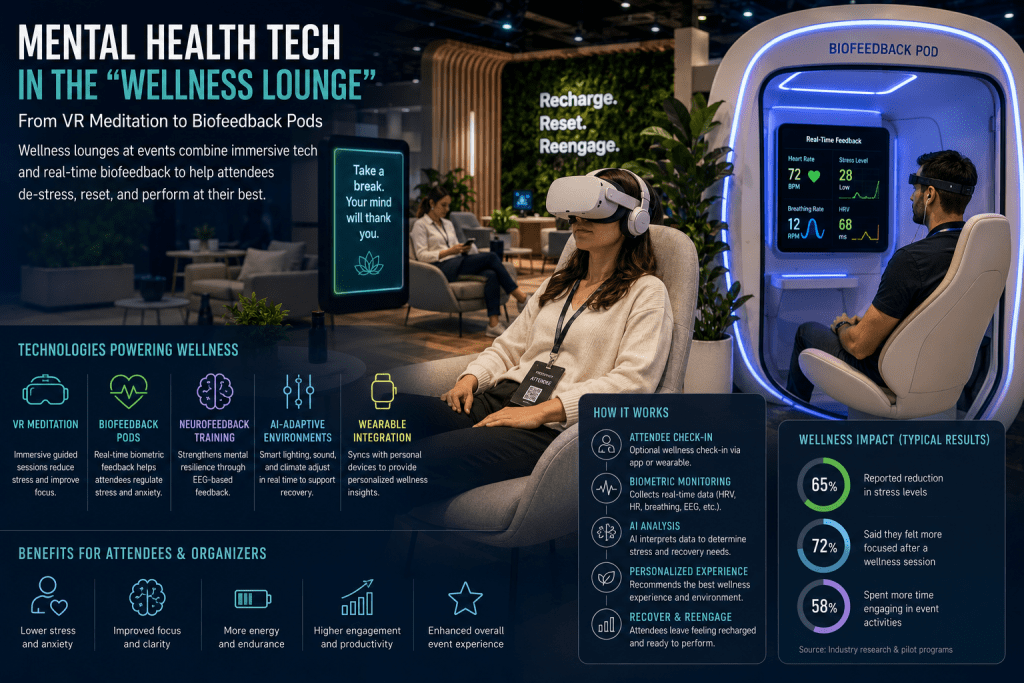
The modern event industry is increasingly recognizing mental wellness as a critical component of attendee experience design. Large conferences, exhibitions, trade shows, festivals, and corporate summits are environments characterized by sensory overload, dense schedules, social pressure, decision fatigue, and continuous digital engagement. While event technology has historically focused on attendee engagement, personalization, and operational efficiency, a growing segment of the industry is now investing in wellness-focused infrastructure powered by advanced technologies.
One of the most significant developments in this area is the rise of the “wellness lounge” — a dedicated technology-enabled space designed to help attendees regulate stress, recover cognitive focus, and manage mental fatigue during live events.
Unlike traditional relaxation areas that merely provide seating and refreshments, modern wellness lounges integrate immersive technologies such as virtual reality meditation, AI-driven mood adaptation, biometric monitoring, neurofeedback systems, sensory regulation environments, and biofeedback pods. These spaces are evolving into intelligent wellness ecosystems that combine experiential design with real-time physiological analytics.
As attendee expectations shift toward healthier and more sustainable event experiences, wellness technology is becoming a measurable operational and engagement strategy rather than a lifestyle-oriented add-on.
Why Mental Wellness Is Becoming a Core Event Technology Priority
Table of Contents
ToggleLarge-scale events create conditions that can significantly increase cognitive and emotional stress. Long walking distances, crowded venues, continuous networking demands, overstimulation from lighting and sound systems, and information-heavy programming contribute to mental fatigue accumulation throughout the event lifecycle.
Hybrid and technology-heavy events have further intensified this challenge. Attendees are now expected to simultaneously engage with mobile apps, live polling systems, networking platforms, AR experiences, digital agendas, and real-time communication tools. While these technologies improve engagement, they also increase digital cognitive load.
For organizers, attendee fatigue creates several operational risks:
- Reduced session participation
- Lower engagement duration
- Declining sponsor interaction quality
- Shortened exhibit hall retention
- Increased attendee frustration
- Reduced networking effectiveness
- Negative post-event sentiment
Wellness lounges supported by mental health technologies aim to reduce these effects by creating controlled recovery environments embedded directly within the venue ecosystem.
The Technology Architecture Behind Wellness Lounges
Modern wellness lounges are increasingly built as integrated technology environments rather than isolated relaxation spaces.
A typical architecture combines:
- Biometric sensing systems
- Immersive audiovisual infrastructure
- AI-driven environmental controls
- Wearable integrations
- Neurofeedback platforms
- Data analytics dashboards
- Smart lighting systems
- Personalized wellness applications
These components work together to create adaptive experiences tailored to attendee stress and recovery needs.
VR Meditation Systems
Virtual reality meditation has emerged as one of the most widely deployed wellness technologies in premium event environments.
VR wellness stations use immersive headsets to transport attendees into digitally simulated calming environments such as forests, beaches, mountain landscapes, or guided mindfulness spaces. Unlike standard meditation rooms, VR systems isolate users from external event distractions, making recovery sessions more effective in noisy venues.
Advanced VR meditation platforms incorporate:
- Spatial audio environments
- Guided breathing synchronization
- Eye-tracking engagement analysis
- Stress-responsive scene adaptation
- Real-time biometric feedback
Some systems integrate wearable data such as heart rate variability and breathing patterns to dynamically adjust meditation pacing and environmental intensity.
For example, if elevated stress markers are detected, the system may reduce audio stimulation, slow guided breathing intervals, or transition visual environments toward lower sensory complexity.
This level of personalization transforms meditation from a passive wellness activity into an adaptive technology-driven intervention.
Biofeedback Pods and Physiological Monitoring
Biofeedback pods represent a more advanced category of wellness lounge infrastructure. These enclosed or semi-private environments use physiological monitoring to help attendees regulate stress responses in real time.
Typical biofeedback pods include:
- Heart rate sensors
- Respiration monitors
- EEG headbands
- Skin conductance sensors
- Temperature regulation systems
- Adaptive lighting
- Noise isolation materials
The core principle behind biofeedback technology is making invisible physiological stress signals visible to users. Attendees receive live feedback about breathing patterns, stress levels, and nervous system activation through visual dashboards or guided prompts.
For example, a pod may display:
- Elevated stress indicators
- Breathing irregularities
- Recovery progress
- Relaxation scoring
- Cognitive stabilization trends
Users are then guided through interventions such as paced breathing exercises, calming soundscapes, or neurofeedback training until physiological markers improve.
In high-pressure event environments, these systems can provide measurable recovery benefits within short time windows, often between 10 and 20 minutes.
AI-Driven Environmental Adaptation
One of the most important advancements in wellness lounge design is the use of AI to dynamically adapt environmental conditions.
Traditional relaxation spaces rely on static settings. In contrast, intelligent wellness lounges continuously optimize the environment using real-time data.
AI systems may analyze:
- Occupancy density
- Ambient noise levels
- Air quality
- Temperature
- Lighting conditions
- User stress indicators
- Session engagement patterns
Based on this data, the system can automatically modify environmental variables to improve recovery outcomes.
Examples include:
- Lowering lighting intensity during high occupancy
- Adjusting sound frequencies to reduce overstimulation
- Increasing airflow in crowded periods
- Recommending shorter recovery sessions during peak demand
- Personalizing sensory experiences for individual users
Some event technology providers are experimenting with emotion-recognition systems that use voice patterns or facial analysis to estimate emotional states. However, these technologies remain controversial due to privacy concerns.
Integration with Event Apps and Wearables
Wellness lounges are increasingly integrated into broader event technology ecosystems.
Mobile event apps may now include features such as:
- Wellness lounge reservations
- Stress recovery recommendations
- Personalized break reminders
- Guided mindfulness sessions
- Cognitive fatigue notifications
Wearable integrations allow wellness platforms to collect real-time biometric signals from attendee devices, including smartwatches and fitness trackers.
This creates opportunities for predictive wellness support. For example:
- An attendee showing elevated heart rate and prolonged activity may receive a recommendation to visit a nearby recovery zone.
- Networking-heavy schedules may trigger recovery reminders between sessions.
- AI systems may suggest low-stimulation environments during periods of attendee fatigue accumulation.
These integrations position wellness technology as part of the overall attendee journey rather than a separate service area.
Operational and Business Impact
The adoption of mental health technologies in wellness lounges is increasingly tied to measurable business outcomes.
Increased Attendee Retention
Fatigued attendees are more likely to leave venues early, skip sessions, or disengage from networking opportunities. Recovery-focused environments help sustain energy levels across multi-day events.
Improved Engagement Metrics
Attendees who take structured recovery breaks often demonstrate:
- Higher session attendance
- Longer exhibit floor engagement
- Increased networking participation
- Better sponsor interaction quality
This directly affects event ROI and sponsor value.
Support for Neurodiverse Attendees
Sensory-regulated wellness spaces are also improving accessibility for neurodivergent attendees who may struggle with overstimulating event environments.
Features such as:
- Low-noise recovery zones
- Adjustable lighting
- Sensory-controlled environments
- Quiet biofeedback spaces
can significantly improve inclusivity within large-scale events.
Enhanced Brand Perception
Wellness infrastructure increasingly contributes to attendee perception of event quality and organizational responsibility. As mental wellness becomes a larger societal concern, wellness-focused event design is emerging as a competitive differentiator.
Challenges and Ethical Considerations
Despite growing adoption, wellness technologies introduce several operational and ethical complexities.
Privacy and Biometric Data Protection
Many wellness systems rely on sensitive physiological data. Organizers must establish clear policies regarding:
- Data collection consent
- Data storage duration
- Third-party platform access
- Biometric anonymization
- Regulatory compliance
Poor governance can undermine attendee trust.
Technology Overdependence
There is also a risk of over-engineering wellness experiences. Excessive reliance on technology may reduce the simplicity and authenticity that some attendees seek in recovery environments.
Successful wellness lounges balance advanced technology with human-centered environmental design.
Scalability Limitations
High-end wellness technologies such as neurofeedback systems and biometric pods remain expensive to deploy at scale. This creates accessibility gaps between premium enterprise events and smaller conferences with limited budgets.
The Future of Wellness Lounge Technology
Over the next several years, wellness lounges are expected to become more predictive, personalized, and integrated with venue intelligence systems.
Emerging developments include:
- AI-generated adaptive meditation experiences
- Real-time stress heatmaps across venues
- Digital twin modeling for crowd stress analysis
- Personalized sensory regulation environments
- Smart furniture with embedded biometric sensing
- Wellness analytics integrated into event dashboards
As event environments become increasingly data-driven, wellness technology may evolve into a standard operational layer alongside security, networking, and attendee engagement systems.
Conclusion
Mental health technology is rapidly transforming the role of wellness lounges within modern event environments. What once functioned as passive relaxation areas are becoming intelligent recovery ecosystems powered by AI, biometrics, immersive media, and adaptive environmental controls.
Technologies such as VR meditation systems, biofeedback pods, wearable integrations, and AI-driven sensory optimization are enabling organizers to address attendee stress and cognitive fatigue in more measurable and proactive ways.
For the event industry, the significance extends beyond wellness branding. Mental recovery infrastructure now affects attendee engagement, accessibility, retention, operational performance, and overall event experience quality.
As live events continue to grow in scale, complexity, and technological intensity, wellness lounges supported by advanced mental health technologies are likely to become a permanent component of future-focused event design.