


Background and context
Australian animated series Bluey has become a global favourite with families and children, placing unusual attention on the quality of its storytelling, visuals and sound. Behind the series’ audio is sound designer and voice actor Dan Brumm, who is responsible for shaping everything from dialogue clarity to subtle environmental details.
As the show has expanded internationally across broadcast and streaming platforms, maintaining consistent audio quality has become a central technical challenge. Brumm’s work highlights how careful sound design and disciplined recording practices can support character-driven storytelling in children’s television.
Key announcement
In a recent profile, Brumm outlined how he records and designs the sound for Bluey, describing a workflow that relies heavily on Sennheiser and Neumann microphones and monitoring tools in his Brisbane-based studio. He combines his role as the voice of Uncle Stripe with responsibility for recording, editing and shaping much of the show’s soundscape.
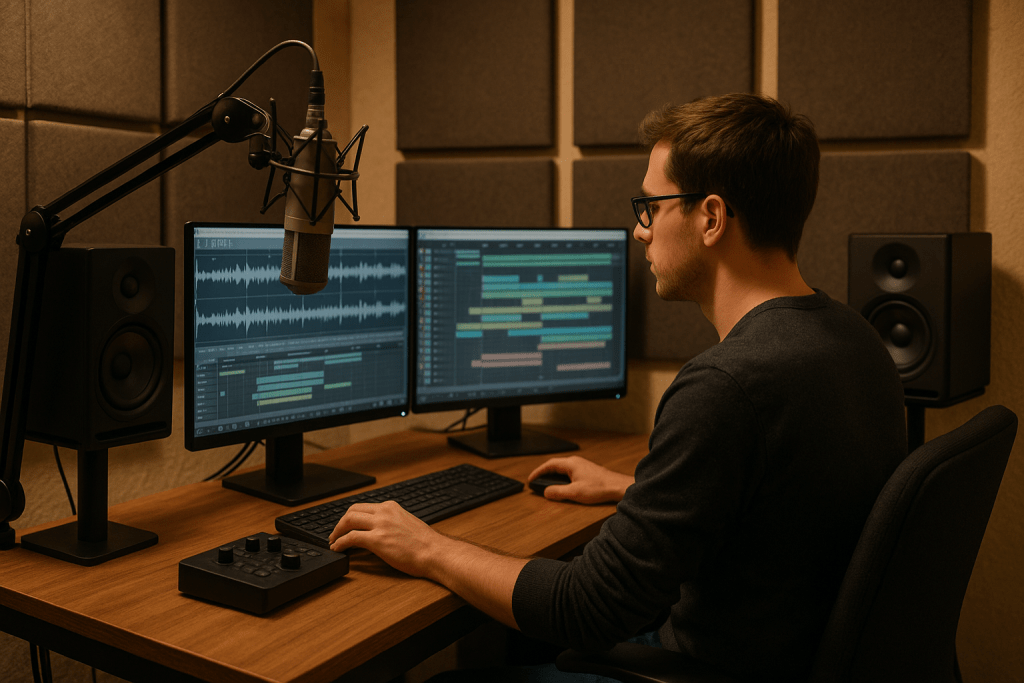
Brumm explained that dialogue is typically captured in a compact but acoustically treated room, using large-diaphragm condenser microphones from Neumann for principal voices, paired with Sennheiser models for specific characters and situations. This approach helps him preserve a consistent tonal character while adjusting for each performer’s range and style.
He also detailed how location ambience and effects are either recorded on-site or built from extensive libraries, then integrated into the final mix to match the show’s visual pacing. Monitoring is carried out on nearfield studio speakers and headphones from the same manufacturers, allowing him to check mixes in conditions that approximate both living room TVs and mobile devices.
According to Brumm, working with a stable set of microphones and reference monitors across seasons makes it easier to maintain continuity as the series evolves and as new episodes push into different environments and musical moments. More on these tools and setup details can be found via Sennheiser’s official website.
Industry impact
While Bluey is aimed at preschool audiences, its production values, including sound, are closer to high-end primetime animation. Brumm’s description of his workflow illustrates how broadcast-focused audio techniques are now expected even in short-format kids’ content.
For sound professionals in television and streaming, the case study reinforces several trends:
- The shift toward small, well-treated personal studios capable of broadcast-ready output.
- Increased reliance on a narrow, familiar set of microphones and monitors to ensure repeatable results.
- Greater emphasis on subtle environmental sound design to support character and story rather than spectacle.
Brumm’s work also reflects how voice talent and sound design responsibilities can converge in lean production teams, particularly in animation, where flexible workflows help meet demanding delivery schedules.
Why this matters
For event and AV professionals, the techniques behind Bluey carry practical lessons that extend beyond broadcast. The focus on intelligible dialogue, consistent tonal balance and careful monitoring translates directly to conference content, hybrid events and livestreams, where audiences increasingly expect TV-level polish.
Brumm’s example underscores the value of:
- Investing in room treatment and monitoring accuracy before adding more equipment.
- Building reliable signal chains with known microphones and reference speakers.
- Developing repeatable workflows that can scale as production volume grows.
As more events are recorded, repurposed and streamed on global platforms, the line between traditional broadcast audio and event production continues to blur. The sound design approach on Bluey illustrates how consistent, well-managed audio can support storytelling and audience engagement across formats, from children’s television to corporate stages.