


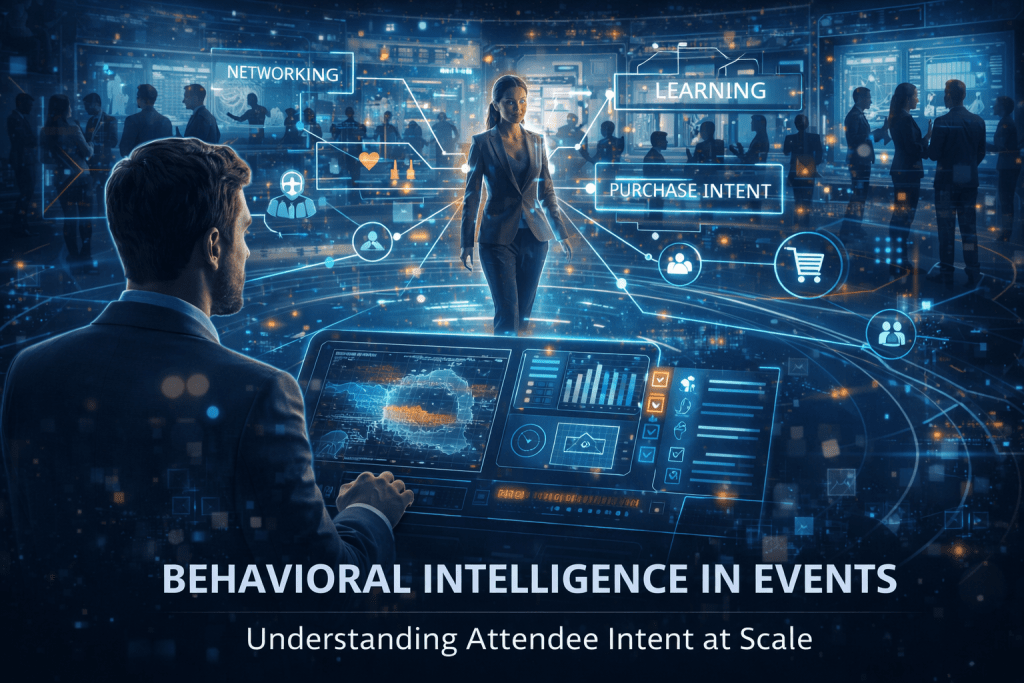
Introduction: From Descriptive Analytics to Intent-Aware Systems
Event technology has historically focused on descriptive and, more recently, predictive analytics—tracking attendance, session popularity, and engagement metrics. While these insights are valuable, they often fail to answer a more critical question: why attendees behave the way they do. As events become more complex and data-rich, the ability to infer attendee intent in real time is emerging as a key differentiator.
Behavioral intelligence in events refers to the systematic collection, processing, and interpretation of attendee actions to infer intent, preferences, and decision-making patterns at scale. Unlike traditional analytics, which aggregates past behavior, behavioral intelligence operates continuously, enabling event systems to adapt dynamically to individual and collective attendee needs.
This shift transforms event platforms from passive reporting tools into active, context-aware systems that can influence engagement, optimize experiences, and improve outcomes for organizers, sponsors, and attendees.
Defining Behavioral Intelligence in the Event Context
Behavioral intelligence combines multiple disciplines:
-
Behavioral data analytics
-
Machine learning and pattern recognition
-
Contextual inference and intent modeling
-
Real-time decision systems
In an event environment, it involves analyzing signals such as:
-
Session attendance and dwell time
-
Navigation patterns within event apps or venues
-
Interaction with content, sponsors, and other attendees
-
Communication patterns (chat, Q&A, networking)
The goal is to move beyond surface-level metrics and infer deeper constructs such as:
-
Purchase intent
-
Learning objectives
-
Networking goals
-
Drop-off risk or disengagement
Data Sources and Signal Collection
Digital Interaction Data
Event platforms generate extensive digital footprints:
-
Clickstreams within mobile apps and web platforms
-
Session joins, exits, and duration
-
Content consumption patterns
These signals provide high-resolution behavioral data, particularly in virtual and hybrid events.
Physical World Signals
For in-person events, behavioral intelligence depends on sensor-driven data:
-
RFID badge scans
-
BLE beacon proximity tracking
-
Wi-Fi triangulation for movement patterns
These inputs enable reconstruction of attendee journeys across physical spaces.
Conversational and Engagement Data
Interactions such as:
-
Chat messages
-
Q&A participation
-
Poll responses
provide contextual insights into attendee interests and sentiment.
External and Historical Data
Behavioral models can be enriched with:
-
CRM data (past event participation, customer lifecycle stage)
-
Marketing engagement history
-
Demographic and firmographic data
This allows for more accurate intent inference.
Technical Architecture for Behavioral Intelligence
Data Ingestion and Streaming Layer
Behavioral intelligence requires real-time data processing:
-
Event streaming platforms (e.g., Kafka-like architectures)
-
Low-latency ingestion pipelines
-
Event-driven triggers for downstream systems
Batch processing alone is insufficient for real-time adaptation.
Feature Engineering and Contextualization
Raw data must be transformed into meaningful features:
-
Session dwell time normalized by session length
-
Movement velocity and clustering within venues
-
Interaction frequency and recency
Contextualization is critical. For example, leaving a session early may indicate disengagement—or a scheduling conflict.
Machine Learning Models
Several model types are used:
Classification Models
-
Predict likelihood of specific outcomes (e.g., conversion, churn)
Clustering Models
-
Segment attendees based on behavior patterns
Sequential Models
-
Analyze behavior over time (e.g., LSTM, transformer-based models)
Graph-Based Models
-
Understand relationships between attendees, sessions, and content
Intent Inference Layer
This is where behavioral signals are translated into actionable insights:
-
Mapping behaviors to intent categories
-
Assigning confidence scores
-
Updating intent dynamically as new data arrives
For example:
-
Repeated visits to sponsor pages + long dwell time → high purchase intent
-
Frequent session switching → exploratory behavior
Activation and Orchestration Layer
Insights are only valuable if acted upon. This layer enables:
-
Real-time personalization (content, recommendations)
-
Triggered notifications and nudges
-
Dynamic matchmaking and networking suggestions
Real-World Applications
Personalized Agenda Optimization
Instead of static recommendations, behavioral intelligence enables:
-
Continuous adjustment of session suggestions
-
Real-time alerts based on inferred interests
-
Adaptive agendas that evolve throughout the event
Intelligent Networking and Matchmaking
By analyzing:
-
Interaction patterns
-
Profile similarities
-
Engagement signals
systems can recommend high-value connections with greater precision.
Sponsor Lead Scoring
Sponsors can move beyond basic lead capture to:
-
Identify high-intent prospects
-
Prioritize follow-ups
-
Tailor engagement strategies
This significantly improves conversion efficiency.
Engagement Risk Detection
Behavioral models can identify attendees at risk of disengagement:
-
Reduced interaction frequency
-
Early session exits
-
Declining app usage
Interventions can then be triggered to re-engage them.
Content Performance Optimization
Organizers can:
-
Identify which content drives sustained engagement
-
Understand drop-off نقاط
-
Optimize future programming
Operational and Business Impact
Enhanced Attendee Experience
Behavioral intelligence enables:
-
More relevant content
-
Reduced information overload
-
Seamless navigation across event experiences
Increased Sponsor ROI
With better intent detection:
-
Leads are more qualified
-
Engagement is more targeted
-
Conversion rates improve
Data-Driven Decision Making
Organizers gain:
-
Deeper insights into attendee behavior
-
Evidence-based planning for future events
-
Continuous optimization capabilities
Scalability
Behavioral intelligence systems can operate across:
-
Thousands of attendees
-
Multiple concurrent events
-
Global event portfolios
Challenges and Considerations
Data Privacy and Compliance
Behavioral intelligence relies on extensive data collection:
-
Location tracking
-
Interaction monitoring
-
Profile enrichment
Compliance with privacy regulations and transparent consent mechanisms is essential.
Signal Noise and Ambiguity
Not all behavior accurately reflects intent:
-
Passive attendance vs. active interest
-
Accidental clicks
-
External constraints affecting behavior
Robust models must account for noise and uncertainty.
Integration Complexity
Behavioral intelligence requires integration across:
-
Event platforms
-
CRM systems
-
Marketing tools
Data silos can limit effectiveness.
Real-Time Processing Constraints
Low-latency processing is technically demanding:
-
High infrastructure costs
-
Complexity in scaling real-time systems
Ethical Considerations
Inferring intent raises ethical questions:
-
How much personalization is appropriate?
-
When does assistance become manipulation?
Clear boundaries and governance frameworks are necessary.
Future Trends
Multimodal Behavioral Analysis
Future systems will combine:
-
Visual data (computer vision)
-
Audio analysis
-
Biometric signals
to enhance intent detection accuracy.
AI-Driven Autonomous Engagement
Behavioral intelligence will increasingly power:
-
Autonomous networking agents
-
Dynamic content curation
-
Real-time experience orchestration
Standardization of Behavioral Metrics
Industry-wide standards may emerge for:
-
Engagement scoring
-
Intent classification
-
ROI measurement
Integration with Digital Twins
Behavioral data will feed into digital twins of events:
-
Simulating attendee flows
-
Predicting outcomes
-
Optimizing event design قبل execution
Conclusion: From Observing Behavior to Understanding Intent
Behavioral intelligence represents a critical evolution in event technology—from tracking what attendees do to understanding why they do it. This shift enables more intelligent, adaptive, and impactful event experiences.
However, the value of behavioral intelligence depends on responsible implementation. Accurate models, robust infrastructure, and ethical governance are essential to ensure that insights are both actionable and trustworthy.
As event ecosystems continue to digitize, the ability to interpret attendee intent at scale will become a foundational capability. Organizations that invest in behavioral intelligence today will be better positioned to deliver personalized, high-impact experiences in an increasingly competitive landscape.