


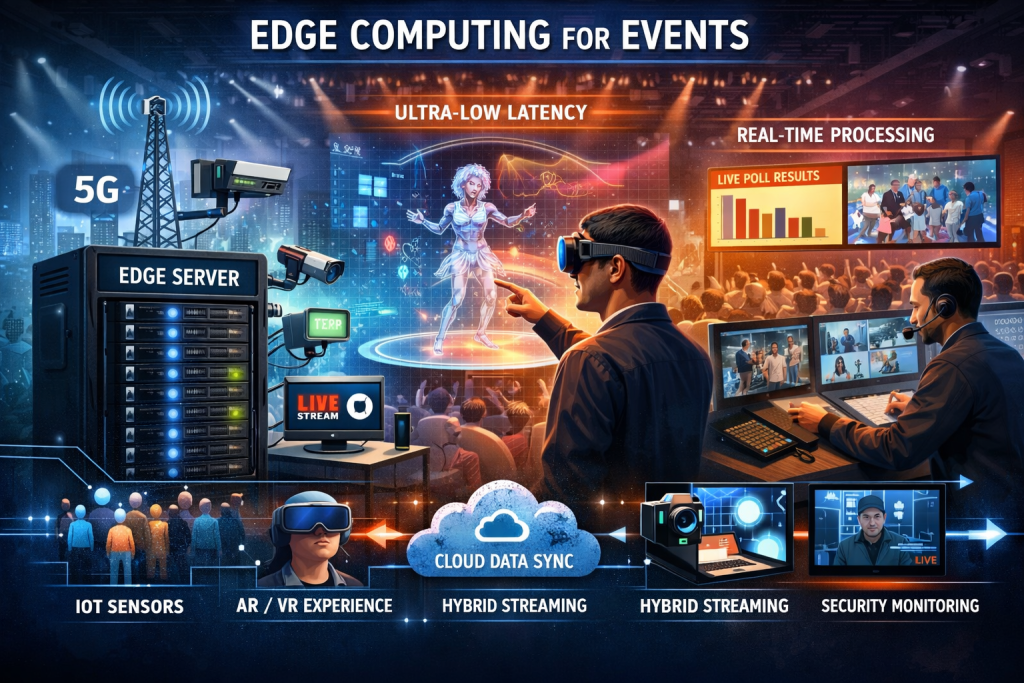
As event environments become increasingly data-intensive, the ability to process information in real time has become a critical requirement. From live audience interactions and immersive AR experiences to security monitoring and hybrid streaming, modern events depend on instantaneous data processing across multiple systems.
Traditional cloud computing models, while powerful, often introduce latency because data must travel to centralized data centers for processing before returning to event applications. In high-density, time-sensitive environments such as large conferences or live productions, even minor delays can disrupt user experiences and operational efficiency.
In 2026, edge computing is emerging as a foundational technology that brings processing power closer to the event environment. By enabling local data processing at or near the venue, edge computing significantly reduces latency, improves reliability, and supports real-time decision-making.
This article explores how edge computing works within event ecosystems, its integration with existing technologies, and the advantages it delivers across event operations.
Understanding Edge Computing in Event Contexts
Edge computing refers to the practice of processing data closer to where it is generated rather than relying solely on centralized cloud infrastructure.
In event environments, edge computing nodes are typically deployed within or near the venue. These nodes process data generated by:
-
IoT sensors monitoring crowd and environmental conditions
-
wearable devices tracking attendee interactions
-
mobile applications delivering personalized content
-
audiovisual systems supporting live production
-
security platforms analyzing surveillance data
By processing data locally, edge systems reduce the time required for data transmission and response.
The Limitations of Centralized Cloud Processing
Cloud computing remains essential for large-scale data storage and analytics. However, it introduces several challenges in event environments.
These include:
-
latency caused by data transmission to remote servers
-
dependency on stable internet connectivity
-
potential bandwidth congestion during peak usage
-
delays in processing time-sensitive interactions
For applications such as live polling, real-time navigation, or crowd control, these delays can negatively impact the attendee experience.
Edge computing addresses these limitations by handling critical processing tasks locally.
Real-Time Audience Interaction
Audience engagement platforms rely on immediate feedback to maintain participation.
For example, live polling systems must process responses instantly to display results during presentations. Similarly, interactive Q&A platforms require rapid synchronization between participants and moderators.
Edge computing enables these systems to:
-
process responses locally within the venue
-
update results in real time
-
reduce delays caused by network congestion
This ensures that audience interactions remain seamless and engaging.
Enhancing Immersive Technologies
Immersive experiences such as augmented reality and spatial computing require ultra-low latency to function effectively.
If there is a delay between user actions and system responses, the experience can feel disconnected or unresponsive.
Edge computing supports immersive technologies by:
-
processing spatial data locally
-
reducing latency in rendering digital overlays
-
enabling real-time interaction with virtual objects
This allows AR and mixed reality experiences to operate smoothly even in crowded environments.
Supporting Hybrid Event Streaming
Hybrid events depend on high-quality video streaming for remote participants.
Edge computing improves streaming performance by:
-
processing video feeds locally before transmission
-
optimizing data compression and encoding
-
reducing delays in live broadcasts
This results in more stable and responsive streaming experiences for both in-person and remote audiences.
IoT and Smart Venue Integration
Event venues increasingly rely on IoT devices to monitor conditions such as crowd density, temperature, and energy usage.
These devices generate continuous streams of data that must be processed quickly to support operational decisions.
Edge computing allows event systems to:
-
analyze sensor data in real time
-
trigger automated responses to changing conditions
-
reduce reliance on centralized processing
For example, if crowd density increases in a specific area, edge systems can immediately alert operations teams or adjust digital signage directions.
Improving Security and Surveillance Systems
Security systems benefit significantly from edge computing capabilities.
AI-powered surveillance platforms require rapid analysis of video feeds to detect unusual behavior or potential threats.
Processing this data at the edge enables:
-
faster detection of anomalies
-
reduced bandwidth usage for video transmission
-
immediate alerts to security personnel
This improves response times and enhances overall event safety.
Integration with 5G and Private Networks
Edge computing works closely with 5G and private network infrastructure.
5G networks provide high-speed connectivity, while edge computing ensures that data processing occurs locally.
This combination supports:
-
ultra-low latency applications
-
high device density environments
-
reliable performance for mission-critical systems
Together, these technologies form the backbone of modern event connectivity.
Infrastructure Requirements for Edge Deployment
Implementing edge computing in event environments requires specialized infrastructure.
Key components include:
-
edge servers or computing nodes located within the venue
-
high-speed network connections linking edge devices
-
integration with cloud platforms for data synchronization
-
monitoring systems for managing edge performance
Event organizers often collaborate with technology providers to deploy and manage edge infrastructure.
Data Synchronization with Cloud Systems
While edge computing handles real-time processing, cloud platforms remain essential for long-term data storage and analysis.
Event systems typically use a hybrid approach where:
-
edge nodes process immediate interactions
-
cloud systems store aggregated data for reporting and insights
This architecture balances performance with scalability.
Privacy and Data Security Considerations
Processing data locally can also enhance security by reducing the need to transmit sensitive information across networks.
However, edge systems must still implement:
-
encryption protocols
-
access controls
-
secure data storage practices
Ensuring consistent security across both edge and cloud environments is essential.
Measuring the Impact of Edge Computing
Event organizers can evaluate the effectiveness of edge computing through metrics such as:
-
reduced latency in audience interactions
-
improved streaming quality
-
faster response times for operational alerts
-
increased reliability of event applications
These indicators demonstrate the value of real-time processing capabilities.
Future Developments in Edge Event Technology
As edge computing continues evolving, future advancements may include:
-
AI-driven edge analytics that operate autonomously
-
integration with digital twin platforms for real-time simulation
-
enhanced support for wearable and spatial computing devices
These innovations will further strengthen the ability to deliver responsive and data-driven event experiences.
Conclusion
Edge computing is becoming a critical component of modern event technology infrastructure. By enabling real-time data processing at the venue level, it reduces latency, improves reliability, and supports advanced applications such as immersive experiences, live analytics, and intelligent security systems.
When combined with cloud platforms and high-speed connectivity, edge computing creates a balanced architecture that meets the demands of increasingly complex event environments.