


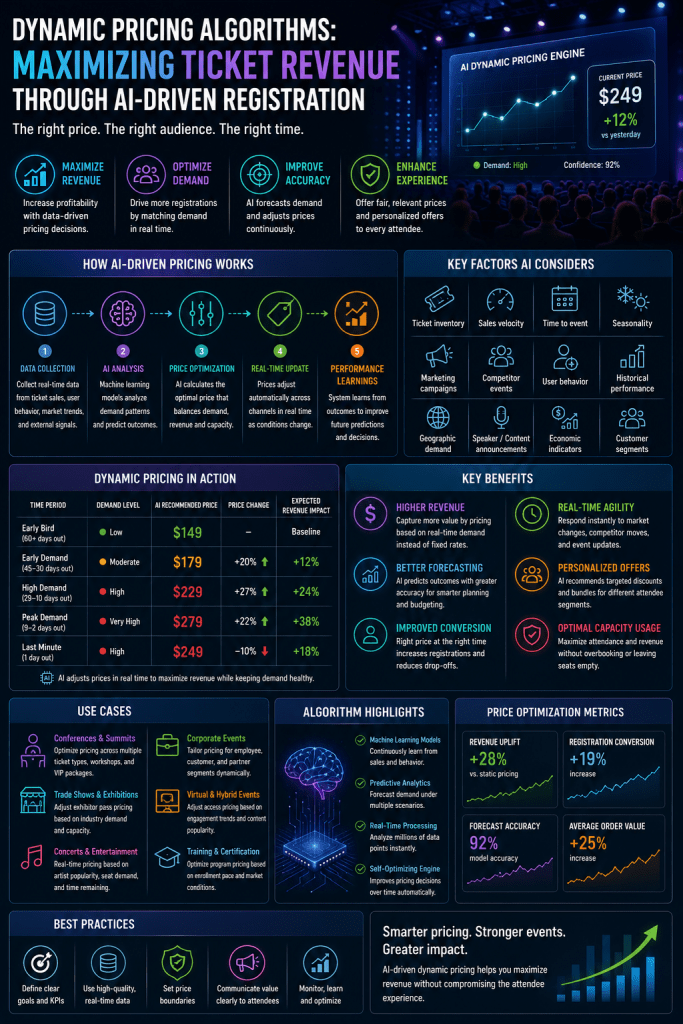
Ticket pricing has always been one of the most challenging aspects of event planning. Price tickets too high, and registrations may slow, reducing attendance and limiting sponsor exposure. Price them too low, and organizers leave significant revenue on the table while potentially undervaluing the event experience. Traditionally, event ticket pricing relied on fixed pricing tiers, early-bird discounts, promotional codes, and periodic manual adjustments based on registration trends.
Today’s event landscape is considerably more complex. Attendee demand fluctuates rapidly, marketing campaigns generate unpredictable registration spikes, competitor events influence buying behavior, and economic conditions continuously shift purchasing decisions. Static pricing models struggle to respond to these dynamic market conditions.
Artificial intelligence is transforming event registration through dynamic pricing algorithms that continuously evaluate market demand and automatically adjust ticket prices in real time. Similar to pricing strategies used by airlines, hotels, and ride-sharing platforms, AI-powered event pricing enables organizers to maximize revenue while maintaining healthy attendance levels and improving forecasting accuracy.
In 2026, dynamic pricing has become a strategic revenue optimization tool rather than simply a sales tactic. Supported by machine learning, predictive analytics, cloud-based registration platforms, and behavioral data, AI-driven pricing helps organizers make smarter, faster, and more profitable pricing decisions throughout the registration lifecycle.
Why Traditional Event Pricing Falls Short
Conventional ticket pricing generally follows predetermined milestones.
Typical pricing structures include:
- Early-bird registration
- Standard pricing
- Late registration
- On-site pricing
Although straightforward, these models rarely reflect actual market demand.
Common challenges include:
- Selling premium inventory too cheaply
- Slow registration periods
- Unpredictable attendance
- Missed revenue opportunities
- Last-minute pricing adjustments
Manual pricing decisions often rely on intuition rather than measurable market intelligence.
What Is Dynamic Pricing?
Dynamic pricing automatically adjusts ticket prices based on changing market conditions.
Rather than maintaining fixed rates for extended periods, AI continuously evaluates multiple variables before recommending or implementing pricing changes.
The objective is to balance:
- Revenue growth
- Registration volume
- Attendance targets
- Customer satisfaction
Pricing becomes responsive instead of static.
How AI Pricing Algorithms Work
Artificial intelligence processes large volumes of registration and behavioral data to identify pricing opportunities.
Demand Forecasting
Machine learning models analyze historical event performance alongside live registration activity.
Factors may include:
- Current sales velocity
- Historical attendance
- Seasonal trends
- Marketing campaign performance
- Competitor activity
The system predicts future demand with increasing accuracy.
Behavioral Analysis
AI evaluates attendee purchasing behavior including:
- Time spent on registration pages
- Abandoned registrations
- Repeat website visits
- Device usage
- Geographic location
These signals help estimate purchase intent.
Continuous Optimization
Rather than updating prices weekly, AI can evaluate market conditions continuously, allowing organizers to respond quickly to changing demand.
Pricing Factors Considered by AI
Modern pricing platforms evaluate numerous variables simultaneously.
Common inputs include:
- Ticket availability
- Registration pace
- Event capacity
- Speaker announcements
- Marketing campaigns
- Sponsorship activity
- Regional demand
- Historical pricing performance
- Day of purchase
- Customer segments
The combination of these variables produces pricing recommendations that are significantly more sophisticated than traditional manual methods.
Personalizing Registration Experiences
AI-driven pricing increasingly supports personalized attendee journeys.
Targeted Discounts
Rather than distributing generic discount codes, organizers can offer personalized incentives based on attendee behavior.
Examples include:
- Returning attendees
- Students
- Group registrations
- Corporate buyers
- High-value prospects
This improves conversion while protecting overall pricing integrity.
Intelligent Upselling
During registration, AI recommends relevant upgrades such as:
- VIP access
- Workshops
- Networking receptions
- Certification programs
- Hospitality packages
These personalized offers increase average transaction value.
Bundle Optimization
Machine learning identifies package combinations most likely to appeal to different audience segments.
Revenue Optimization
Dynamic pricing focuses on maximizing total event value rather than simply increasing ticket prices.
Managing High Demand
When registrations accelerate rapidly following:
- Major speaker announcements
- Product launches
- Marketing campaigns
AI can gradually increase pricing while demand remains strong.
Stimulating Slow Periods
If registration activity declines unexpectedly, pricing algorithms may recommend temporary promotional pricing to restore momentum.
Capacity Management
Pricing adjustments help distribute registrations more evenly throughout the sales cycle, reducing operational uncertainty.
Benefits for Event Organizers
AI-driven pricing delivers measurable operational advantages.
Improved Revenue Forecasting
Predictive analytics provide greater confidence in expected ticket sales and cash flow.
This supports budgeting and resource planning.
Faster Decision-Making
Automated recommendations reduce reliance on manual pricing reviews.
Organizers respond more quickly to changing market conditions.
Better Inventory Management
Premium experiences such as VIP seating or executive networking sessions can be priced independently based on demand.
This maximizes revenue from limited inventory.
Enhancing the Attendee Experience
Although dynamic pricing benefits organizers, attendees also gain advantages.
Earlier Purchase Incentives
Participants who register sooner often receive better pricing, encouraging earlier commitment.
Relevant Offers
Personalized recommendations reduce unnecessary promotions while highlighting experiences aligned with attendee interests.
Greater Registration Flexibility
Adaptive pricing can accommodate different budgets through a wider range of purchasing opportunities.
Ethical Considerations
Pricing transparency remains essential.
Clear Communication
Attendees should understand that pricing may change based on availability or demand.
Transparent policies reduce confusion and maintain trust.
Avoiding Unfair Discrimination
Dynamic pricing should never rely on sensitive personal characteristics.
Pricing decisions should focus on legitimate market conditions rather than protected attributes.
Maintaining Brand Reputation
Excessive or unpredictable price fluctuations may damage attendee confidence.
Organizations should establish reasonable pricing boundaries.
Challenges of AI-Driven Pricing
Despite its advantages, dynamic pricing requires thoughtful implementation.
Data Quality
AI models depend on accurate historical and real-time data.
Incomplete information reduces forecasting accuracy.
System Integration
Pricing engines should integrate seamlessly with:
- Registration platforms
- CRM systems
- Payment gateways
- Marketing automation
- Analytics dashboards
Integrated ecosystems improve decision-making.
Human Oversight
AI recommendations should support—not replace—strategic pricing decisions.
Organizers remain responsible for balancing financial objectives with attendee satisfaction.
The Future of Intelligent Event Registration
Several emerging technologies are expected to further enhance pricing optimization.
Future innovations include:
- Real-time competitor pricing analysis
- AI-generated marketing campaigns
- Blockchain-secured ticket marketplaces
- Predictive attendance modeling
- Digital twin demand simulations
- Personalized loyalty pricing
- Autonomous revenue management platforms
These capabilities will enable increasingly responsive registration ecosystems.
Conclusion
Dynamic pricing algorithms are transforming event registration by replacing static ticket structures with intelligent, AI-driven pricing strategies that continuously adapt to changing market conditions. Through machine learning, predictive analytics, behavioral analysis, and automated optimization, organizers can maximize ticket revenue while improving attendance forecasting and operational efficiency.
The benefits extend beyond financial performance. Attendees receive more relevant offers, organizers gain stronger forecasting capabilities, and premium event experiences are allocated more effectively based on actual demand.
As artificial intelligence becomes increasingly integrated into event management platforms, ticket pricing will continue evolving from a periodic administrative task into a continuous revenue optimization process. Organizations that embrace AI-driven registration strategies will be better positioned to balance profitability, attendee satisfaction, and long-term event growth in an increasingly competitive marketplace.