


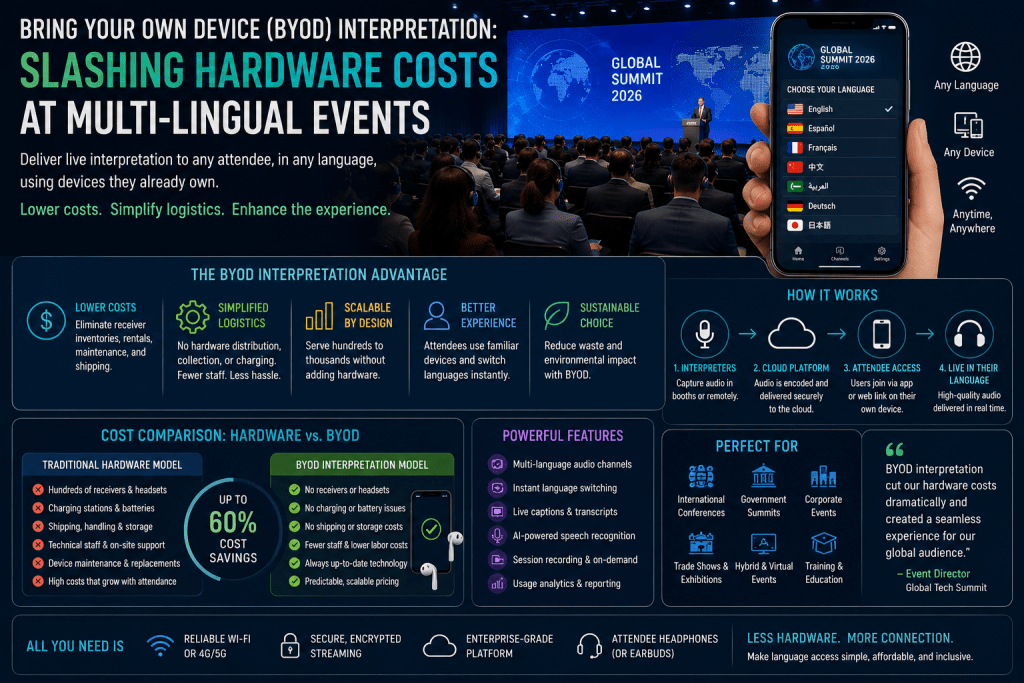
For decades, multilingual events have relied on a familiar interpretation model: soundproof interpreter booths, dedicated transmitters, radio frequency distribution systems, and hundreds or even thousands of handheld receivers distributed to attendees. While this approach has enabled effective communication across languages, it has also introduced significant operational complexity and cost.
Managing interpretation hardware at large conferences, international summits, trade shows, and corporate events requires substantial logistical effort. Organizers must procure equipment, distribute receivers, collect devices, charge batteries, maintain inventory, troubleshoot failures, and ensure compliance with venue and regulatory requirements.
In 2026, a growing number of event organizers are replacing this hardware-heavy model with Bring Your Own Device (BYOD) interpretation systems. Instead of relying on dedicated receivers, attendees access live interpretation streams directly through their own smartphones, tablets, or laptops.
Powered by cloud-based audio platforms, mobile applications, web streaming technologies, and increasingly sophisticated AI-assisted language tools, BYOD interpretation is rapidly becoming one of the most important trends in multilingual event delivery.
For event organizers, the appeal extends beyond cost reduction. BYOD interpretation offers scalability, flexibility, improved analytics, reduced logistical burdens, and a more sustainable approach to language access.
Why Traditional Interpretation Hardware Is Expensive
Conventional interpretation systems require a significant amount of physical infrastructure.
A typical deployment often includes:
- Interpreter booths
- RF transmitters
- Infrared systems
- Distribution equipment
- Charging stations
- Receiver inventories
- Headsets
- Collection and sanitation processes
These systems can represent a substantial portion of multilingual event budgets.
Logistics Challenges
Hardware management involves numerous operational tasks.
Event teams must:
- Distribute devices
- Track inventory
- Prevent losses
- Replace damaged equipment
- Charge batteries
- Manage returns
For large conferences, this often requires dedicated staff and support resources.
Scaling Limitations
As attendee numbers increase, hardware requirements expand proportionally.
Supporting additional participants often means:
- More receivers
- More storage
- More staffing
- More maintenance
This can significantly increase costs for global events.
What Is BYOD Interpretation?
BYOD interpretation allows attendees to access live translated audio through their personal devices rather than dedicated interpretation receivers.
Users connect using:
- Smartphones
- Tablets
- Laptops
- Wireless earbuds
- Headphones
Interpretation streams are typically delivered through:
- Mobile applications
- Web browsers
- Event platforms
- Dedicated interpretation portals
Attendees simply select their preferred language and begin listening.
The experience often mirrors consumer streaming applications, making adoption relatively intuitive.
How BYOD Interpretation Works
Modern BYOD systems rely on cloud-based audio delivery infrastructure.
Interpreter Audio Capture
Interpreters work from:
- On-site booths
- Remote interpretation hubs
- Home-based studios
- Distributed language centers
Audio is captured and transmitted to centralized platforms.
Cloud Distribution
Interpretation channels are processed and distributed through cloud-based streaming systems.
Attendees connect using internet-enabled devices and select their preferred language stream.
Device Playback
Audio is delivered directly to personal headphones or earbuds.
Many platforms support:
- Multiple languages
- Instant language switching
- Low-latency delivery
- Accessibility features
without requiring specialized hardware.
The Economics of BYOD Interpretation
Cost reduction remains one of the strongest drivers of adoption.
Eliminating Receiver Inventories
Traditional interpretation systems often require hundreds or thousands of receivers.
BYOD models remove this requirement entirely.
This reduces:
- Equipment rental costs
- Purchase costs
- Storage requirements
- Maintenance expenses
Lower Staffing Requirements
Without physical receiver distribution, organizers can reduce labor associated with:
- Device management
- Collection processes
- Technical support
This improves operational efficiency.
Simplified Logistics
BYOD systems significantly reduce transportation and storage demands.
For international events, these savings can be substantial.
More Predictable Scaling
Adding additional attendees generally requires minimal additional infrastructure compared to hardware-based systems.
This improves budget predictability.
Enhancing the Attendee Experience
Cost savings alone do not explain the growth of BYOD interpretation.
The attendee experience is also improving.
Familiar Devices
Most participants already understand how to use their smartphones.
This reduces onboarding requirements.
Language Flexibility
Attendees can switch languages instantly without exchanging receivers or changing channels manually.
This is particularly valuable for multilingual audiences.
Accessibility Benefits
Many platforms support:
- Live captions
- Adjustable audio settings
- Screen-reader compatibility
- Text-based translation
These features improve inclusivity.
Reduced Equipment Burden
Attendees no longer need to carry additional hardware throughout an event.
This creates a more streamlined experience.
Supporting Hybrid and Virtual Participation
Traditional interpretation systems were designed primarily for physical events.
BYOD platforms naturally support hybrid participation.
Unified Language Access
Both in-person and remote attendees can access the same interpretation streams.
This creates a more consistent experience.
Global Reach
Remote participants from around the world can receive multilingual support without requiring specialized equipment.
This expands audience accessibility.
On-Demand Content
Many platforms automatically archive translated sessions.
Attendees can revisit content after the event in their preferred language.
BYOD and AI-Powered Translation
Artificial intelligence is increasingly integrated into interpretation ecosystems.
Live Captioning
Many BYOD platforms support AI-generated captions alongside human interpretation.
This improves accessibility and comprehension.
Machine Translation Integration
AI translation can supplement human interpreters by providing:
- Additional language coverage
- Backup services
- Automated transcripts
This expands multilingual capabilities.
Hybrid Language Models
Leading platforms increasingly combine:
- Human interpreters
- AI translation
- Real-time captioning
to create scalable language support ecosystems.
Network Infrastructure Requirements
While BYOD reduces hardware costs, it increases dependence on connectivity.
Reliable Wi-Fi Is Essential
Attendees require stable internet access to receive interpretation streams.
Organizers must ensure:
- Adequate bandwidth
- Network redundancy
- Coverage consistency
- Capacity planning
across the venue.
Private 5G Opportunities
Some venues are using private 5G networks to support high-density BYOD deployments.
These systems offer improved reliability and performance.
Latency Management
Interpretation experiences depend on low-latency delivery.
Poor network performance can negatively affect synchronization and user satisfaction.
Security and Privacy Considerations
BYOD systems introduce new governance requirements.
Secure Streaming
Interpretation streams should be protected against unauthorized access.
Many platforms employ:
- Authentication controls
- Encryption
- User management systems
to protect content.
Data Protection
Organizers must understand how attendee data is collected, processed, and stored.
Compliance with privacy regulations remains important.
Challenges and Limitations
Despite its advantages, BYOD interpretation is not suitable for every environment.
Device Compatibility
Attendees use a wide range of devices and operating systems.
Platforms must support diverse user environments.
Battery Dependency
Participants depend on their own device battery life.
Event organizers should provide charging infrastructure where possible.
Connectivity Risks
Unlike traditional RF receivers, BYOD systems rely heavily on network performance.
Robust connectivity planning is essential.
User Education
While smartphone adoption is widespread, some attendees may still require onboarding assistance.
Clear instructions improve adoption rates.
The Future of Multilingual Event Delivery
Several emerging trends are expected to accelerate BYOD adoption.
These include:
- AI-powered interpretation assistance
- Real-time voice cloning
- Personalized translation streams
- Smart earbuds with integrated interpretation
- Spatial audio language channels
- Mixed-reality translation overlays
- Edge-computing language delivery
As these technologies mature, language access will become increasingly seamless and personalized.
Conclusion
BYOD interpretation is transforming how multilingual events deliver language access. By leveraging attendees’ existing devices instead of dedicated receiver hardware, organizers can significantly reduce costs, simplify logistics, improve scalability, and create more flexible attendee experiences.
The technology aligns particularly well with modern event realities, including hybrid participation, cloud-based infrastructure, AI-powered translation tools, and growing expectations for digital convenience.
While success depends on strong network infrastructure, thoughtful implementation, and user-friendly design, the benefits are compelling. Lower hardware expenses, reduced operational complexity, enhanced accessibility, and improved scalability make BYOD interpretation one of the most significant innovations in multilingual event technology.
As global events continue expanding their international reach, BYOD platforms are likely to become the new standard for delivering language access—replacing physical receivers with connected, flexible, and highly scalable digital experiences.