


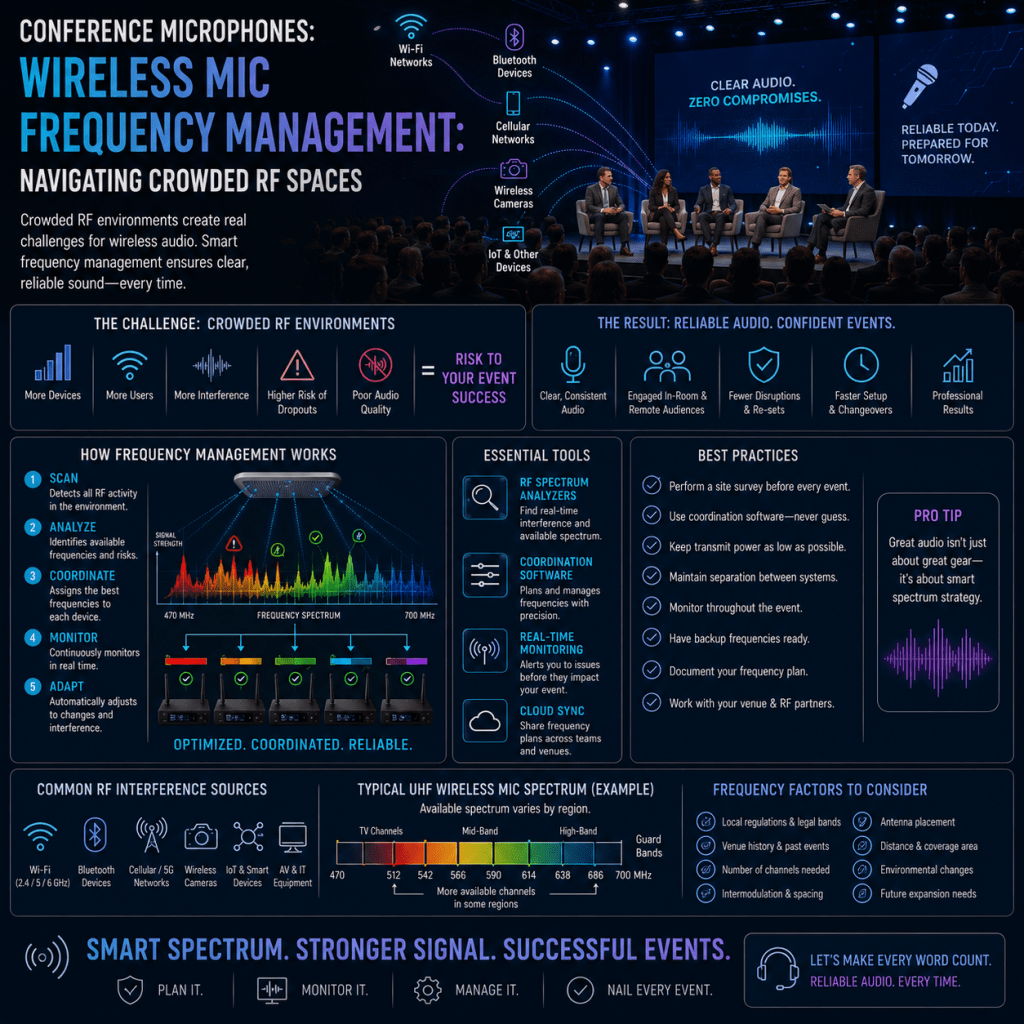
Wireless microphones have become indispensable in modern events. From keynote presentations and panel discussions to live entertainment, product launches, and hybrid conferences, wireless audio systems provide the mobility, flexibility, and professional production quality that today’s event environments demand.
However, as event technology ecosystems become increasingly connected, wireless microphones are operating within some of the most congested radio frequency (RF) environments in history. Convention centers, stadiums, exhibition halls, and large conference venues now host thousands of devices simultaneously, including Wi-Fi networks, Bluetooth equipment, smartphones, streaming systems, IoT sensors, wireless cameras, and private 5G infrastructure.
In this crowded wireless landscape, RF spectrum has become one of the most valuable and challenging resources for event production teams to manage. Poor frequency coordination can result in signal dropouts, audio interference, reduced microphone performance, and even complete communication failures during critical presentations.
As a result, RF management has evolved from a specialized technical task into a core operational requirement for modern event success. In 2026, effective wireless microphone deployment depends as much on intelligent spectrum management as it does on microphone quality itself.
Why RF Management Matters More Than Ever
Wireless microphones rely on radio frequencies to transmit audio from performers and presenters to receivers.
Historically, event venues had relatively limited wireless competition.
Today’s environments are dramatically different.
Large convention centers may simultaneously support:
- Thousands of smartphones
- Multiple Wi-Fi networks
- Bluetooth accessories
- Wireless presentation systems
- Streaming infrastructure
- Security systems
- IoT devices
- Private cellular networks
Each device contributes to overall RF congestion.
Without proper coordination, interference risks increase substantially.
The Cost of Audio Failure
Audio problems remain among the most visible technical failures during live events.
Wireless interference can produce:
- Audio dropouts
- Signal distortion
- Unexpected noise
- Complete microphone loss
- Session disruptions
For keynote presentations, executive addresses, and broadcast productions, these failures can significantly impact attendee experience and event credibility.
Understanding the RF Spectrum
Effective frequency management begins with understanding the wireless environment.
What Is RF Spectrum?
Radio frequency spectrum refers to the range of electromagnetic frequencies used for wireless communication.
Wireless microphones operate within specific portions of this spectrum.
Different regions regulate spectrum differently, and available frequencies continue to evolve as governments reallocate portions of the spectrum for telecommunications and data services.
Spectrum Compression
Over the past decade, many countries have auctioned portions of wireless spectrum to mobile network operators.
As a result, microphone systems now operate within increasingly constrained frequency ranges.
This creates greater pressure on event organizers to maximize spectrum efficiency.
Common Sources of Wireless Interference
Modern event environments contain numerous interference sources.
Wi-Fi Networks
Large venues often deploy extensive Wi-Fi infrastructure.
High-density access points can create RF challenges, particularly when poorly coordinated with other wireless systems.
Bluetooth Devices
Attendees frequently carry multiple Bluetooth-enabled devices including:
- Earbuds
- Smartwatches
- Laptops
- Presentation remotes
Collectively, these devices contribute to RF noise.
Cellular Infrastructure
Private 5G deployments and enhanced mobile connectivity solutions are becoming increasingly common in event venues.
These systems must be carefully coordinated with wireless microphone operations.
Other Wireless Audio Systems
Large events often deploy dozens or even hundreds of wireless microphones simultaneously.
Without proper planning, microphone systems can interfere with one another.
Frequency Coordination: The Foundation of Reliable Audio
Professional RF management begins with frequency coordination.
Spectrum Analysis
Before an event begins, RF engineers conduct spectrum scans to identify:
- Existing transmissions
- Interference sources
- Available frequencies
- Signal strength patterns
This analysis forms the basis for system planning.
Frequency Allocation
Each wireless device is assigned carefully selected frequencies that minimize conflict.
Engineers must account for:
- Intermodulation products
- Adjacent channel interference
- Venue-specific RF conditions
This process becomes increasingly complex as device counts increase.
Ongoing Monitoring
RF conditions change continuously during events.
Professional teams monitor spectrum usage throughout production to identify emerging issues before they impact performance.
The Rise of Intelligent RF Management Systems
Artificial intelligence is beginning to transform spectrum management.
Automated Frequency Planning
Modern RF software platforms can analyze venue conditions and automatically recommend optimal frequency assignments.
These systems reduce planning time while improving accuracy.
Real-Time Interference Detection
AI-powered monitoring tools continuously evaluate:
- Signal quality
- Noise levels
- Spectrum occupancy
- Device performance
Potential problems can be identified and resolved before users notice disruptions.
Predictive Spectrum Management
Emerging systems increasingly predict interference risks based on historical venue data and real-time conditions.
This allows proactive adjustments rather than reactive troubleshooting.
High-Density Wireless Deployments
Large conferences frequently require extensive wireless infrastructure.
Managing Hundreds of Channels
Major conventions may deploy:
- Presenter microphones
- Panel microphones
- Audience Q&A systems
- Interpretation services
- Broadcast communications
- Production intercoms
Managing these systems requires sophisticated coordination strategies.
Zone-Based Frequency Planning
Many venues divide RF operations into zones.
Different areas receive dedicated frequency allocations, reducing interference and improving scalability.
Shared Spectrum Resources
Modern RF management increasingly resembles network resource management.
Spectrum must be allocated efficiently across multiple stakeholders and event functions.
Integration with Smart Venue Infrastructure
Wireless microphone systems are becoming part of broader venue technology ecosystems.
Centralized RF Management
Convention centers increasingly deploy centralized monitoring platforms capable of managing:
- Wireless microphones
- Wi-Fi infrastructure
- IoT devices
- Cellular systems
through unified dashboards.
Digital Twin Applications
Some venues now use digital twin technology to model RF behavior before events begin.
These simulations help identify potential problem areas and optimize deployments.
Network-Based Device Management
Advanced wireless systems increasingly support remote configuration, monitoring, and diagnostics through networked control platforms.
This improves operational efficiency.
Hybrid Events and RF Complexity
Hybrid events create additional spectrum demands.
Wireless Production Requirements
Hybrid productions often require:
- Additional microphones
- Wireless cameras
- Streaming infrastructure
- Remote communication systems
These elements increase RF density significantly.
Broadcast-Grade Reliability
Remote attendees often have lower tolerance for audio failures than in-person audiences.
Reliable RF management is therefore essential to maintaining hybrid event quality.
Operational Best Practices
Successful RF management depends on preparation and discipline.
Conduct Site Surveys
Every venue presents unique RF conditions.
Comprehensive surveys should occur before equipment deployment.
Maintain Frequency Documentation
Accurate records help technical teams:
- Resolve issues quickly
- Coordinate multiple vendors
- Support troubleshooting efforts
Establish Backup Frequencies
Critical microphones should always have contingency plans.
Backup frequencies enable rapid recovery if interference occurs.
Coordinate Across Stakeholders
Large events often involve multiple production partners.
RF planning should include:
- Venue operators
- AV providers
- Broadcast teams
- Network administrators
to avoid conflicts.
Emerging Technologies Shaping RF Management
Several innovations are expected to influence wireless microphone operations in the coming years.
Wideband Wireless Systems
New microphone platforms support broader tuning ranges, allowing greater flexibility within crowded environments.
Dynamic Frequency Allocation
Future systems may automatically shift frequencies in response to changing RF conditions.
Cloud-Based Monitoring
Remote spectrum monitoring platforms are enabling centralized management across multiple venues and events.
AI-Driven Optimization
Machine learning algorithms will increasingly automate frequency planning and interference mitigation.
The Future of Wireless Audio
As wireless device density continues growing, RF management will become increasingly strategic.
Event organizers will need to treat spectrum as a managed operational resource rather than an invisible technical layer.
Future wireless ecosystems will likely feature:
- Automated coordination
- Predictive analytics
- Dynamic spectrum allocation
- AI-assisted optimization
- Integrated venue-wide RF governance
These capabilities will be essential for supporting the next generation of connected event experiences.
Conclusion
Wireless microphones remain a cornerstone of modern event production, but their reliability increasingly depends on sophisticated RF management practices. As convention centers and event venues become more connected, crowded spectrum environments present new challenges that cannot be solved through hardware alone.
Successful deployments require careful frequency coordination, real-time monitoring, intelligent planning, and collaboration across multiple technology stakeholders. Emerging AI-driven management platforms, digital twin simulations, and adaptive wireless systems are helping event professionals navigate these complexities while improving reliability and operational efficiency.
In 2026, managing wireless microphone frequencies is no longer simply a technical task—it is a critical component of delivering seamless attendee experiences, supporting hybrid event success, and ensuring that every speaker can be heard clearly when it matters most.