


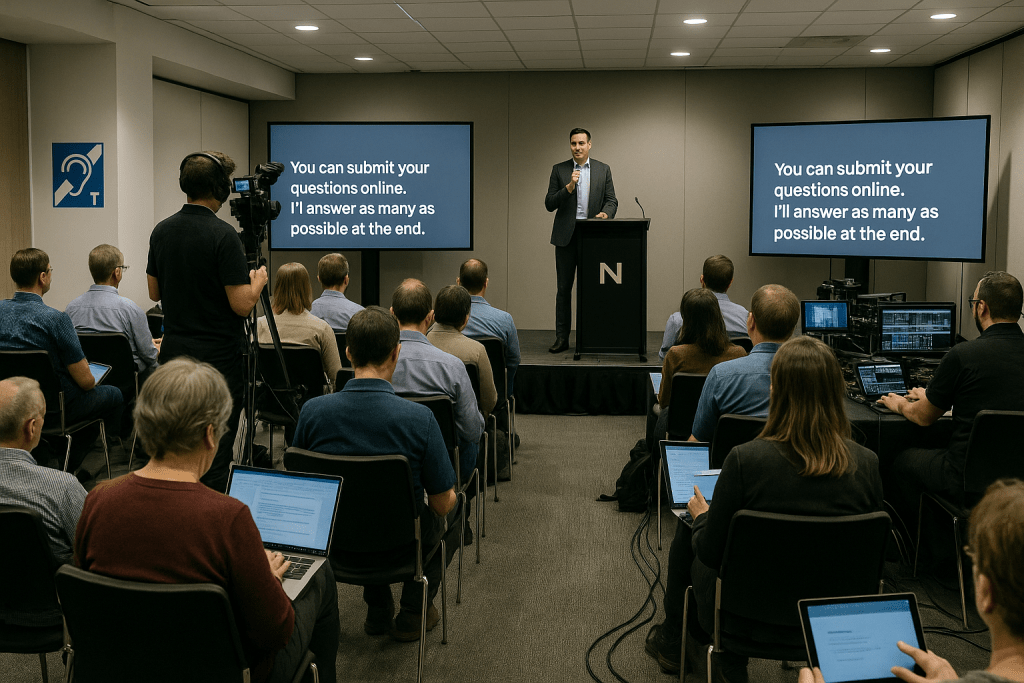
Accessibility has moved from a niche consideration to a core requirement in professional event planning, as organisers recognise that visual impact and smooth scheduling are not enough to define success. Increasingly, the measure of an effective conference, exhibition or hybrid event is whether all participants can see, hear, understand and contribute in ways that meet their individual needs.
In this context, Present Communications, a long-standing AV and event technology supplier, is placing a stronger emphasis on accessible and inclusive solutions across its portfolio. The company is focusing on tools and services that support delegates with differing abilities and circumstances, whether they are on site or joining remotely.
Background: accessibility as a design requirement
Across the business events sector, accessibility has historically been treated as a compliance exercise or a late-stage adjustment. Physical access ramps, reserved seating and basic audio support were often added after the main design was finalised. However, evolving expectations from attendees, advances in digital tools and a growing body of accessibility guidance are pushing organisers to embed inclusion at the outset of event planning.
For many attendees, barriers are not only physical. Challenges can include being able to follow presentations at speed, processing dense information, engaging in Q&A without speaking in public, or participating from different time zones or with limited bandwidth. Hybrid and virtual formats have further exposed these issues, highlighting the need for solutions that are both technically robust and user-friendly.
Specialist providers are responding by integrating accessibility features into core event technology stacks, rather than treating them as bolt-ons. This includes captioning, assistive listening, content adaptation and flexible participation options designed to work in live, virtual and on-demand contexts.
Key developments in Present Communications’ offering
Present Communications is aligning its services with this shift by emphasising accessibility as part of its standard event delivery. While the company has long supplied audio-visual infrastructure and connectivity for conferences and meetings, it is now foregrounding capabilities that support inclusive participation.
Key elements of its approach include:
- Support for seeing and hearing content clearly: Ensuring that screens, projection, lighting and sound systems are configured so that presentations are visible and audible to as many attendees as possible, regardless of seating position or room layout.
- Tools for understanding information: Facilitating technologies such as caption feeds, multiple language outputs and flexible display options that make it easier for participants to follow fast-paced sessions, complex data and panel discussions.
- Options for active participation: Enabling audience engagement through digital Q&A, polling and messaging platforms that allow participants to contribute without relying solely on open microphones or in-person interaction.
- Hybrid and remote access: Extending the reach of events so that delegates who cannot attend physically—whether due to disability, travel constraints or other barriers—can still view sessions, interact with speakers and engage with fellow participants online.
The company positions these features not as optional extras, but as integral parts of event design, to be discussed alongside stage sets, audio distribution and streaming requirements during the planning phase.
Industry impact and evolving expectations
The wider events industry is under pressure to demonstrate that inclusion extends beyond written policies. Corporate clients, public sector organisations and membership bodies are increasingly asking how venues and technology providers will accommodate a broad range of accessibility needs, from hearing and visual support to neurodiversity and remote participation.
As expectations rise, event organisers are reassessing long-standing assumptions about what constitutes a successful event. A technically flawless keynote that is inaccessible to a portion of the audience is now widely viewed as a missed opportunity and, in some cases, a reputational risk. This shift is pushing suppliers to present clear, practical options that align with accessibility standards and can be implemented without creating excessive complexity for production teams.
Providers like Present Communications, which combine AV infrastructure with digital interaction tools, are well-placed to influence how accessibility is embedded into mainstream event workflows. Their role increasingly involves advising on best practice as much as supplying equipment, from room layout considerations to the placement of screens and speakers that maximise visibility and audibility.
Why this matters for event professionals and technology providers
For organisers, the trend towards accessible event technology has several practical implications:
- Planning from the outset: Accessibility requirements now need to be considered at the RFP and scoping stages, not added in the final weeks. This includes building time into schedules for testing captioning, remote participation tools and assistive listening systems.
- Vendor selection: Event professionals will increasingly look for partners with demonstrable experience in inclusive delivery, rather than basic AV provision alone. Providers that can speak confidently about accessible setups and integration with hybrid platforms are likely to stand out.
- Budget allocation: As accessibility moves from “nice to have” to an essential element, budget lines will need to reflect this. Clear descriptions of what is possible—such as scalable captioning options or different levels of audience interaction—can help clients make informed decisions.
- Data and feedback: Evaluating attendee feedback on accessibility features will play a greater role in post-event analysis. Understanding how participants used captioning, remote Q&A or alternative viewing options can inform future design choices.
For technology providers, there is an opportunity to differentiate through thoughtful integration of accessibility tools into existing service offerings. Rather than marketing standalone solutions, the focus is shifting to how accessible experiences can be delivered consistently across multi-room conferences, exhibition theatres, webinar series and fully hybrid events.
Conclusion
As the definition of a successful event evolves, accessibility and inclusion are emerging as central metrics alongside content quality and production values. Present Communications’ emphasis on accessible event technology reflects this broader industry trend, in which seeing, hearing, understanding and participating are treated as fundamental design requirements.
For event professionals, the message is clear: accessibility can no longer sit at the margins of planning. As more suppliers bring inclusive solutions to the forefront of their propositions, organisers have an expanding toolkit to build events that work better for all attendees—whether they are in the room, on another floor or joining from another country.