


Background and context
Modern rock tours place heavy demands on wireless audio systems, with dense RF environments, quick changeovers, and high expectations for sound quality. Bands working at arena and festival scale increasingly rely on digital wireless platforms that can handle crowded spectrum conditions and complex routing.
Canadian rock band Three Days Grace is currently on a global tour that covers arenas, festivals, and mixed-bill events. The production needs a wireless setup that can cope with shifting venues and a variety of local RF regulations, while remaining as streamlined as possible for a touring crew.
To meet these requirements, the band’s audio team has standardised on a fully digital wireless system from Sennheiser, moving away from older analogue solutions and consolidating microphones and in-ear monitoring into a single ecosystem.
Key announcement
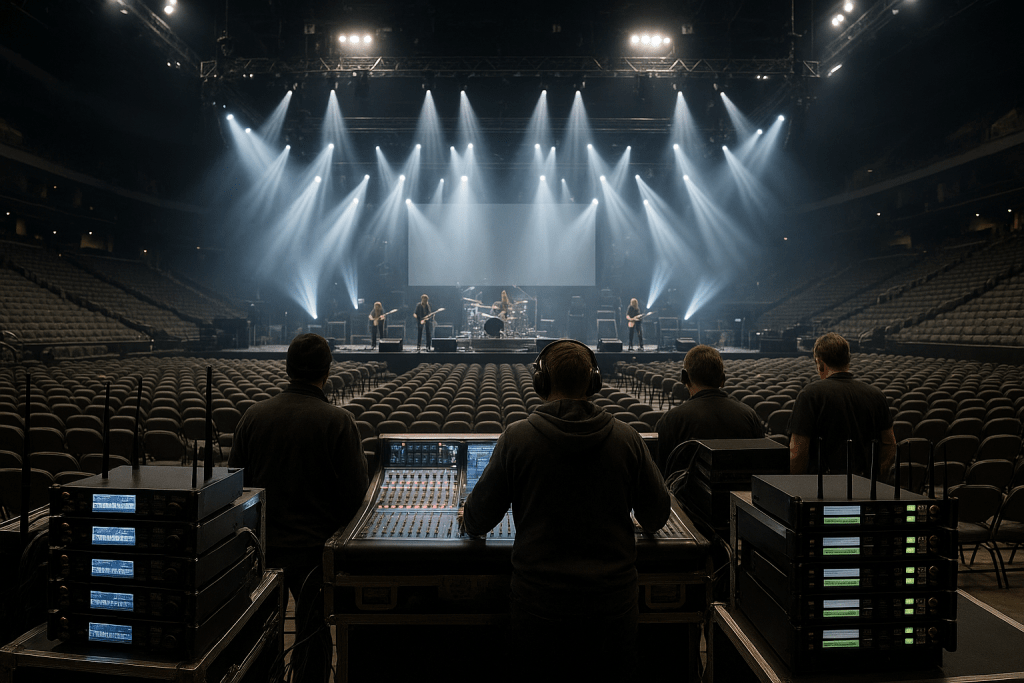
Three Days Grace has deployed Sennheiser’s EW-DX digital wireless system as the backbone of its RF setup for the current touring cycle. The rig includes handheld vocal microphones, instrument packs, and a multi-channel base station configuration designed to simplify frequency coordination and day-to-day operation.
According to the touring crew, a primary goal was to reduce complexity while improving reliability. The new system is used across lead and backing vocals, guitars, and utility channels, with digital transmission intended to minimise noise and maintain consistent audio quality from venue to venue.
The tour’s RF engineer and front-of-house team report that EW-DX’s networked control and monitoring tools support faster setup during festival-style shows where line-check windows are short. Centralised management software is used to scan local RF conditions, assign frequencies, and monitor battery status and RF performance in real time.
The band’s long relationship with Sennheiser products, dating back to earlier touring cycles, informed the decision. The current tour represents a shift to the manufacturer’s newer digital platform, aiming to future-proof the rig as spectrum usage becomes more congested. Further details on the system are available via Sennheiser’s official product pages at sennheiser.com.
Industry impact
While major acts have been gradually moving to digital wireless over the last decade, the adoption by rock bands that perform in both arena and festival environments underlines how expectations are changing in live touring. High-gain, loud stage setups have traditionally been challenging for wireless systems, particularly in terms of stability and noise performance.
Three Days Grace’s implementation illustrates a few broader trends:
- Growing reliance on integrated, networked wireless systems that can be coordinated from a single interface.
- Increased use of digital transmission to handle crowded RF environments at urban arenas and multi-stage festivals.
- Closer collaboration between manufacturers, touring engineers, and artists to tailor systems to specific production needs.
For rental companies and production providers, this type of touring deployment may encourage further investment in scalable digital platforms that can move easily between headline tours and festival packages.
Why this matters
For event technology professionals, the band’s shift highlights the practical advantages and trade-offs of digital wireless in high-pressure touring scenarios. Consistent RF performance, quick deployment, and the ability to monitor many channels from a central point are increasingly seen as essential, not optional, for large-scale productions.
Engineers working in concert, festival, and corporate environments can draw lessons from this case: choosing systems with robust coordination tools, planning for tight turnarounds, and standardising on a single platform where possible to reduce failure points.
As spectrum availability continues to tighten in many regions, examples like the Three Days Grace tour suggest that digital wireless solutions capable of dense channel counts and flexible networking will play a central role in future live sound workflows.