


Background and context
The Eurovision Song Contest has become a benchmark for large-scale live production, where staging, broadcast technology and creative design converge on a global platform. Each year, the event pushes advances in lighting, video and show control systems, with LED technology now central to how performances are presented on screen and in the arena.
Within this context, LED floors and integrated LED elements in set architecture have shifted from visual add-ons to core tools for creative direction. Designers increasingly rely on these surfaces not only to extend the video canvas but also to support camera choreography, augmented reality and dynamic scene changes during fast-paced live broadcasts.
Key announcement
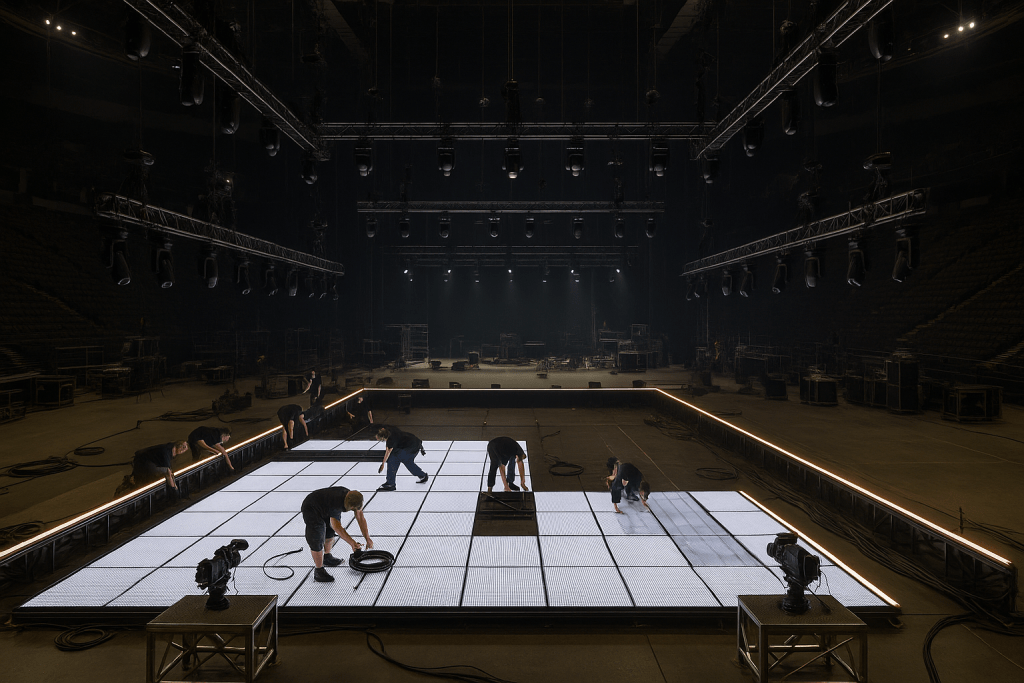
Spectera, a company specialising in LED installations for live events and broadcast productions, has been confirmed as an LED technology supplier for the Eurovision Song Contest 2026. The company will provide LED floor systems and LED strip elements that will be incorporated into the main stage design and surrounding structures.
According to the manufacturer, its contribution will focus on a large, load-bearing LED floor capable of supporting performers and staging elements, as well as linear LED components integrated into risers, set pieces and architectural details. These elements are designed to work in sync with the event’s wider lighting and video system, supporting both the in-venue audience experience and the televised broadcast.
While detailed technical specifications have not been fully disclosed, Spectera notes that the system is designed for high brightness, wide viewing angles and colour consistency across camera positions. The LED floor is expected to be used as an active storytelling surface, tightly coordinated with content on overhead and backdrop screens.
The company frames its participation in Eurovision 2026 as a continuation of previous involvement in large broadcast shows across Europe. More information about its LED solutions for live productions is available on Spectera’s official website.
Industry impact
Eurovision is often viewed as a proving ground for new event and broadcast technologies due to its scale, complexity and international visibility. Suppliers that feature on this stage frequently influence technical standards and creative expectations for other large shows, including national music contests, TV formats and touring productions.
- LED floors have moved from niche use to near-standard components on high-end televised music events.
- Linear LED elements are increasingly used to define set geometry, create depth for cameras and bridge lighting and video disciplines.
- Tight integration between video content, lighting cues and performance blocking is becoming an operational requirement rather than an added extra.
By committing significant LED resources to Eurovision 2026, Spectera adds to a broader trend in which specialist providers collaborate closely with production designers, broadcast engineers and content teams from the earliest design phases. This approach helps ensure that creative ideas remain feasible within the constraints of rigging, power, processing and rehearsal schedules.
Why this matters
For event technology professionals, the Eurovision 2026 LED deployment highlights several developments that are rapidly filtering down to other market segments. As audiences become accustomed to immersive, screen-rich environments on flagship broadcasts, expectations rise for corporate shows, festivals and hybrid events.
The increased reliance on LED floors and integrated strips underscores the need for closer coordination between stage design, content production and technical implementation. Robust hardware is only one part of the equation; reliability, maintainability and efficient show control are equally important in a live, high-pressure setting.
Spectera’s role at Eurovision 2026 illustrates how specialised LED providers are positioning themselves within this ecosystem. For venues, rental companies and production houses, the project offers another reference point for how large-format LED infrastructures can be specified, integrated and operated at scale.
As more events look to deliver television-grade visuals, the solutions tested on stages like Eurovision are likely to shape purchasing decisions, design methodologies and skill requirements across the wider live events and broadcast industries.