


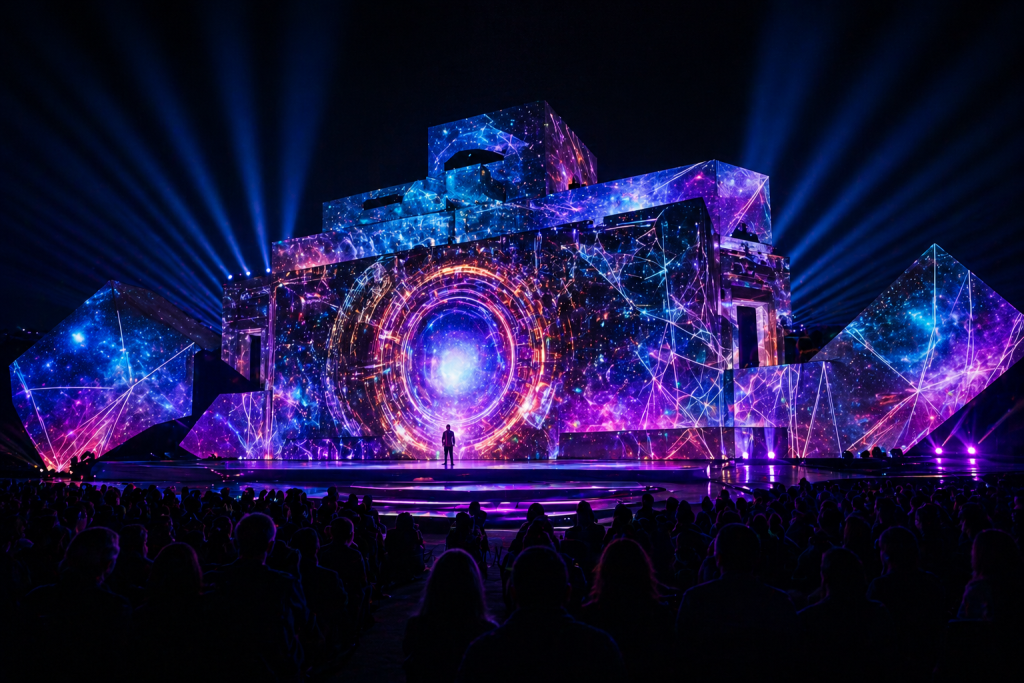
Introduction: From Screens to Surfaces
Table of Contents
ToggleConventional event visuals have been dominated by LED walls and flat displays. While effective, these systems confine content to predefined geometries and limit how deeply visuals can integrate with the environment. Projection mapping redefines this model by treating physical space itself as the display surface.
Rather than placing content on screens, projection mapping aligns visuals with real-world geometry—turning stages, facades, and objects into dynamic visual systems. This shift enables events to move from display-based storytelling to spatially embedded experiences.
Defining Projection Mapping in Event Contexts
Projection mapping is the process of projecting calibrated visuals onto irregular surfaces so that content conforms to physical structures. The technique relies on geometric alignment, perspective correction, and precise synchronization.
In event environments, projection mapping is used for:
- Architectural transformations on buildings and large venues
- Stage scenography that replaces or augments physical sets
- Immersive environments across walls, floors, and ceilings
- Object-based mapping for product visualization
The defining characteristic is spatial fidelity—visuals appear integrated with the structure, not layered onto it.
Core System Architecture
Projection mapping systems combine spatial modeling, high-performance hardware, and real-time control systems.
Geometry Capture and Spatial Modeling
Accurate mapping begins with a digital representation of the physical surface.
This can be achieved through:
- LiDAR scanning or photogrammetry
- CAD models for designed structures
- Manual calibration for smaller setups
The model defines the coordinate system used to align visuals with physical geometry.
Content Design and Mapping Software
Specialized software platforms are used to design and align content. These tools support:
- Mesh-based mapping to match surface geometry
- Warping and keystone correction
- Multi-surface and multi-projector configurations
Content must be created with spatial constraints in mind—designers often build visuals around architectural features to enhance realism.
Projection Hardware and Optics
Projectors are the primary output devices. Key technical considerations include:
- Brightness (lumens) relative to ambient light conditions
- Resolution and color accuracy
- Lens selection based on throw distance and surface geometry
Large-scale installations often require multiple projectors with edge blending to create seamless visuals.
Media Servers and Show Control
Media servers manage playback, synchronization, and system control.
They ensure:
- Frame-accurate synchronization across multiple outputs
- Integration with lighting, audio, and stage automation systems
- Real-time adjustments during live execution
Show control systems coordinate all elements, enabling precise timing and transitions.
Advanced Techniques and Capabilities
Projection mapping has evolved beyond static visuals into dynamic, responsive systems.
Edge Blending and Multi-Projector Systems
Multiple projectors can be combined to create large, continuous images. Edge blending ensures seamless transitions between projection zones.
Real-Time Rendering and Generative Content
Modern systems use real-time rendering engines to generate visuals dynamically. This allows content to adapt to live inputs such as audio signals or user interaction.
Interactive Mapping
Sensors and tracking systems enable interaction. Visuals can respond to:
- Performer movement
- Audience participation
- Environmental data
This transforms projection mapping from passive display to interactive medium.
3D Illusion Techniques
Careful use of perspective, shading, and animation creates illusions of depth and transformation. Surfaces can appear to:
- Break apart or reconstruct
- Reveal internal structures
- Shift in scale or dimension
These effects depend on precise alignment and timing.
Integration with Event Technology Systems
Projection mapping operates as part of a larger event ecosystem.
Lighting systems must be coordinated to avoid washing out projections. Audio systems are synchronized to align visuals with sound cues.
Event operating systems and orchestration layers can trigger projection sequences based on schedules or real-time conditions. Integration with sensors and data platforms enables adaptive content.
In advanced environments, projection mapping integrates with XR systems and digital twins, creating hybrid physical-digital experiences.
Operational and Business Impact
Projection mapping offers significant advantages in both production and experience design.
For attendees, it delivers immersive, high-impact visuals that transform environments. This enhances engagement and memorability.
For organizers, it provides flexibility. Physical sets can be minimized or replaced, reducing logistics and enabling rapid changes between scenes.
For sponsors, it enables creative brand integration within the environment itself, rather than relying on separate display areas.
Strategically, projection mapping differentiates events by enabling unique, site-specific experiences that cannot be replicated with standard displays.
Technical Challenges and Constraints
Despite its capabilities, projection mapping presents several challenges.
Ambient light is a major constraint. High brightness is required for outdoor or well-lit environments.
Calibration must be precise. Misalignment can break the illusion and reduce impact.
Hardware requirements can be significant, particularly for large-scale installations involving multiple projectors and servers.
Content creation is resource-intensive, requiring expertise in 3D design, animation, and spatial alignment.
Future Outlook: Convergence with Spatial Computing
Projection mapping is converging with broader spatial computing technologies.
Real-time engines and AI-driven systems will enable more adaptive and intelligent visuals. Projection systems may respond dynamically to audience behavior or environmental conditions.
Advances in projector technology—such as higher brightness, laser sources, and compact form factors—will improve scalability and efficiency.
Integration with XR and digital twin systems will enable unified spatial experiences across physical and digital layers.
Conclusion: Engineering Visual Space
Projection mapping transforms event environments into programmable visual spaces. By aligning digital content with physical geometry, it enables a level of integration and immersion that traditional display systems cannot achieve.
For event technology leaders, projection mapping is not simply a visual tool—it is a method of engineering space itself.
As the technology continues to evolve, its role will expand from spectacle to infrastructure, shaping how environments are designed, experienced, and understood in modern events.