


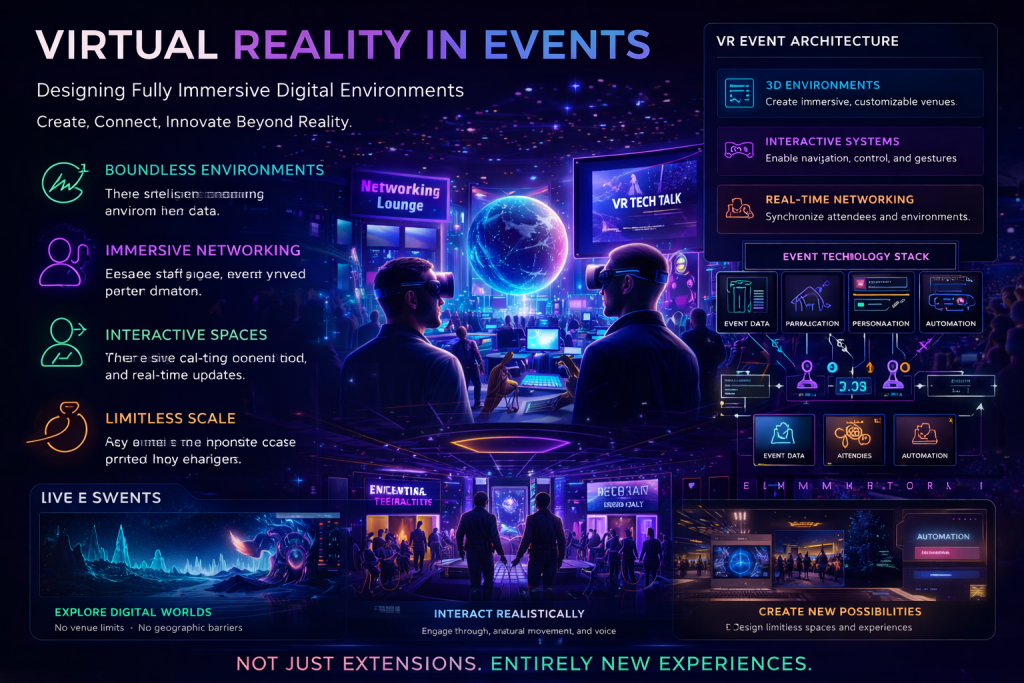
Introduction: From Digital Extensions to Alternative Event Spaces
Event technology has progressively extended physical experiences through digital layers—mobile apps, live streams, hybrid platforms, and interactive tools. Yet, these extensions largely preserve the structure of traditional events: sessions, stages, and networking translated into screens.
Virtual Reality (VR) represents a different paradigm. Instead of extending physical events, it creates entirely new environments where spatial, social, and experiential boundaries can be redefined. In VR, events are not constrained by venue capacity, geography, or physical infrastructure. They are constructed as immersive digital spaces where presence is simulated rather than assumed.
For event technology, this shift is not merely visual. It introduces new architectural, operational, and experiential models that require rethinking how events are designed, delivered, and managed.
Defining VR in Event Contexts
Virtual Reality in events refers to fully immersive, computer-generated environments accessed through head-mounted displays (HMDs) or compatible devices. Unlike augmented or mixed reality, VR replaces the user’s physical surroundings entirely.
Within event contexts, VR environments can include:
- Virtual venues with customizable layouts
- Interactive booths and sponsor spaces
- Social environments for networking
- Live or pre-recorded sessions within immersive settings
The defining characteristic is spatial immersion. Attendees experience the event as if they are داخل a three-dimensional environment, interacting with objects and other participants in real time.
System Architecture: Rendering, Interaction, and Networking
Delivering VR events requires a multi-layered architecture that supports real-time rendering, interaction, and synchronization.
Rendering Engine and Environment Design
At the core is the rendering engine, responsible for generating the virtual environment. This includes:
- 3D models of venues, objects, and avatars
- Lighting, textures, and environmental effects
- Physics simulations for realistic interactions
Performance is critical. Rendering must occur at high frame rates to maintain immersion and prevent motion discomfort. This often requires optimization techniques such as level-of-detail rendering and efficient asset management.
Interaction Layer
Interaction systems enable users to navigate and engage with the environment. These include:
- Motion tracking for head and hand movements
- Controllers or gesture recognition for input
- Spatial audio for realistic communication
Interaction design must balance realism with usability. Overly complex interactions can reduce accessibility, while overly simplified systems may limit engagement.
Networking and Synchronization
VR events are inherently social experiences. Networking systems synchronize user actions and environmental changes across participants.
Low-latency communication is essential to maintain consistency and presence. This involves:
- Real-time state synchronization
- Avatar movement and interaction updates
- Voice and spatial audio transmission
Scalability is a key challenge, particularly in large events with thousands of concurrent users.
Backend Infrastructure
Supporting systems handle identity, session management, content delivery, and analytics. These components integrate VR environments with broader event technology ecosystems.
Cloud infrastructure is typically used for scalability, while edge computing can reduce latency for critical interactions.
Experience Design: Beyond Physical Constraints
Designing VR events requires a shift from replicating physical spaces to leveraging digital possibilities.
Traditional event structures—such as stages and booths—can be reimagined. Sessions may take place in environments that reflect the content, such as simulated environments or abstract spaces that enhance engagement.
Navigation is no longer limited to physical movement. Attendees can teleport between locations, reducing friction and enabling efficient exploration.
Networking experiences can be more dynamic. Spatial proximity, avatar interactions, and contextual environments create new forms of social engagement.
However, design must consider cognitive load. Immersive environments can be overwhelming if not structured carefully. Clear navigation, intuitive interfaces, and guided experiences are essential.
Integration with Event Technology Systems
VR platforms do not operate in isolation. They integrate with existing event systems to provide a cohesive experience.
Event data platforms capture interactions within VR environments, contributing to behavioral intelligence and analytics. Personalization engines can adapt environments and recommendations based on user behavior.
Networking systems extend into VR, enabling connections based on proximity and shared interests. Workflow automation systems coordinate actions such as session transitions and notifications.
This integration ensures that VR experiences are aligned with broader event objectives and operations.
Operational and Business Impact
Virtual Reality expands the possibilities of event delivery.
From an operational perspective, it reduces dependence on physical infrastructure. Events can scale without the constraints of venue capacity or geographic limitations.
For attendees, it offers immersive experiences that go beyond traditional formats. Engagement is enhanced through interaction, exploration, and presence.
Sponsors benefit from new forms of engagement. Interactive environments allow for deeper product exploration and more meaningful interactions.
Strategically, VR enables new event models, including fully virtual events or hybrid formats that integrate physical and digital experiences.
Challenges and Constraints
Despite its potential, VR in events faces several challenges.
Accessibility is a primary concern. Not all attendees have access to VR hardware, and user familiarity varies. Ensuring inclusive experiences requires alternative access methods, such as desktop or mobile interfaces.
Performance requirements are significant. High-quality VR experiences demand powerful hardware and optimized systems.
User comfort must be considered. Motion sickness and fatigue can affect engagement, particularly in longer sessions.
Content creation is resource-intensive. Designing immersive environments requires specialized skills and tools.
Future Outlook: Toward Persistent Virtual Event Worlds
The evolution of VR in events is moving toward persistent environments—virtual spaces that exist beyond individual events.
These environments can host multiple events, evolve over time, and maintain continuity for attendees. Identity systems may persist across events, enabling ongoing engagement and interaction.
Advances in hardware, rendering technologies, and network infrastructure will improve accessibility and performance. Integration with other technologies, such as AI and digital twins, will enhance capabilities.
As these systems mature, VR may become a standard component of event ecosystems rather than a specialized offering.
Conclusion: Reimagining Events as Digital Spaces
Virtual Reality redefines what an event can be. By creating fully immersive environments, it shifts the focus from extending physical experiences to designing entirely new ones.
This transformation introduces new opportunities for engagement, scalability, and innovation. It also requires a rethinking of architecture, design, and operations.
For event technology leaders, VR represents both a challenge and an opportunity. It demands new capabilities but offers the potential to create experiences that are not bound by physical limitations.
As the technology evolves, VR will play an increasingly important role in shaping the future of events—where presence is not determined by location, but by experience.