


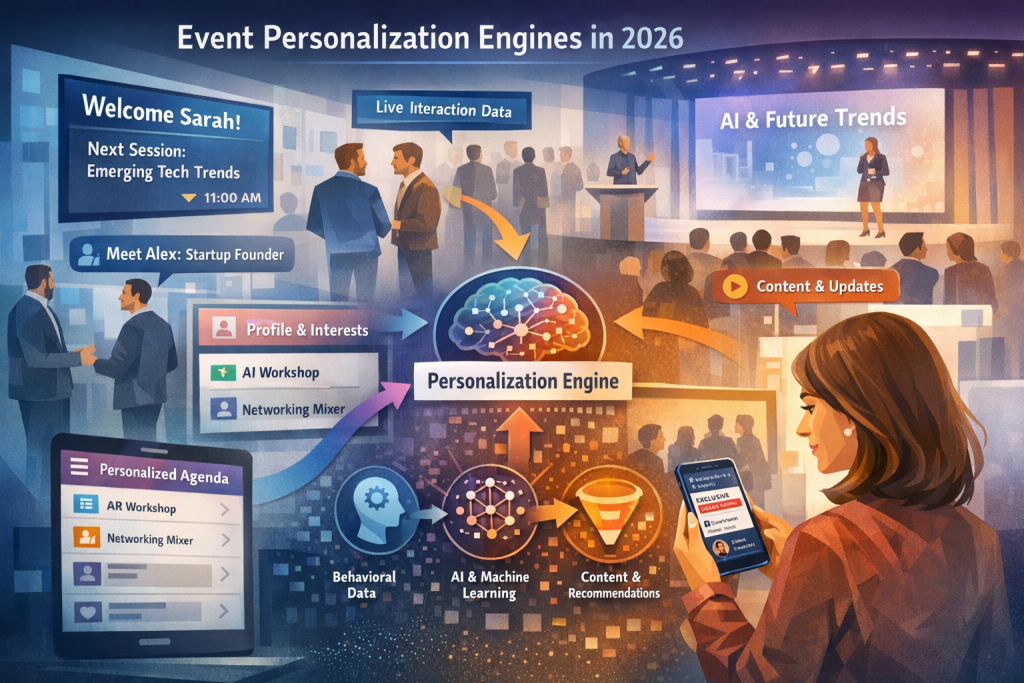
Personalization has moved from a marketing enhancement to a core operational requirement in modern event technology. In 2026, attendees no longer expect generic agendas, static notifications, or one-size-fits-all experiences. Instead, they expect events to adapt dynamically to their interests, behavior, and goals.
To meet these expectations, event organizers are deploying personalization engines—integrated systems powered by artificial intelligence, real-time data pipelines, and behavioral analytics. These engines orchestrate attendee experiences across mobile applications, digital signage, networking platforms, and content delivery systems.
Unlike basic recommendation tools, modern personalization engines operate continuously throughout the event lifecycle, adjusting experiences in real time based on evolving attendee behavior.
This article explores the architecture, data models, integration strategies, and operational impact of personalization engines in advanced event environments.
Defining Event Personalization Engines
A personalization engine is a system that analyzes attendee data and delivers tailored content, recommendations, and interactions.
In event environments, personalization engines influence:
-
session recommendations
-
networking matches
-
sponsor content delivery
-
push notifications
-
navigation guidance
-
content consumption pathways
These systems rely on machine learning models that process both static profile data and dynamic behavioral signals.
The goal is to create individualized experiences for each participant while maintaining scalability across thousands of attendees.
Data Foundations of Personalization
Unified Attendee Profiles
Personalization begins with unified attendee profiles that consolidate multiple data sources into a single identity layer.
These profiles typically include:
-
registration data such as role, industry, and interests
-
zero-party data voluntarily shared by attendees
-
historical participation in previous events
-
engagement data from current sessions
-
networking activity and connections
Identity resolution ensures that all interactions are associated with the correct participant.
Without accurate identity mapping, personalization accuracy declines significantly.
Behavioral Data Streams
In addition to profile data, personalization engines rely heavily on real-time behavioral signals.
These signals include:
-
session attendance patterns
-
mobile app interactions
-
booth visits and engagement duration
-
content downloads
-
audience response participation
Streaming data pipelines capture these interactions as they occur, enabling real-time analysis.
Machine Learning Models and Recommendation Systems
Content-Based Filtering
Content-based models recommend sessions or exhibitors based on similarities between attendee preferences and available content.
For example, if an attendee shows interest in artificial intelligence topics, the system prioritizes sessions and sponsors related to that domain.
Collaborative Filtering
Collaborative filtering identifies patterns among similar attendees.
If participants with similar profiles attend certain sessions or engage with specific sponsors, the system recommends those experiences to others with comparable characteristics.
Hybrid Recommendation Models
Most advanced systems combine multiple techniques, including:
-
graph-based relationship modeling
-
clustering algorithms
-
reinforcement learning
Hybrid models improve recommendation accuracy by considering both individual preferences and collective behavior patterns.
Real-Time Experience Orchestration
Dynamic Agenda Adjustments
Personalization engines continuously update attendee agendas based on real-time conditions.
For example:
-
if a session reaches capacity, the system recommends alternative sessions
-
if an attendee skips a scheduled session, the system suggests nearby options
-
if engagement levels drop, new content recommendations are triggered
These adjustments ensure that attendees always have relevant options available.
Context-Aware Notifications
Push notifications are no longer static reminders. Personalization engines deliver context-aware messages based on:
-
attendee location within the venue
-
upcoming schedule
-
behavioral signals
-
time of day
For example, an attendee passing near a relevant sponsor booth may receive a notification highlighting a product demonstration.
Integration Across Event Systems
Personalization engines must integrate seamlessly with multiple components of the event technology stack.
Mobile Applications
The event mobile app serves as the primary interface for personalized experiences.
Integration enables:
-
personalized schedules
-
real-time recommendations
-
networking suggestions
-
location-based alerts
Digital Signage and On-Site Displays
Advanced events extend personalization beyond mobile devices.
Digital signage systems can display:
-
personalized greetings
-
session recommendations
-
targeted sponsor messages
These interactions are often triggered through wearable credentials or proximity detection systems.
Networking Platforms
AI-powered networking tools integrate with personalization engines to recommend connections based on:
-
shared interests
-
complementary business goals
-
prior engagement patterns
This increases the likelihood of meaningful networking outcomes.
Sponsor and Revenue Optimization
Personalization engines also play a critical role in sponsor engagement.
By analyzing attendee preferences and behavior, systems can:
-
recommend relevant sponsor booths
-
deliver targeted promotional content
-
prioritize high-value prospects for exhibitors
This targeted approach improves lead quality and increases sponsor satisfaction.
Sponsors benefit from more efficient interactions, while attendees receive more relevant content.
Hybrid and Virtual Personalization
Personalization engines extend to virtual and hybrid participants.
Remote attendees receive:
-
tailored session recommendations
-
personalized content playlists
-
AI-curated networking opportunities
Because virtual environments generate detailed interaction data, personalization models can operate with high accuracy.
Infrastructure Requirements
Deploying personalization engines requires robust technical infrastructure.
Key components include:
-
centralized data lakes for unified data storage
-
real-time streaming pipelines for behavioral data
-
machine learning platforms for model training
-
API integrations across event systems
Scalability is essential to handle large volumes of data during peak event activity.
Privacy and Ethical Considerations
Personalization relies on extensive data collection, which introduces privacy considerations.
Event organizers must implement:
-
transparent data collection policies
-
opt-in consent mechanisms
-
anonymization where appropriate
-
secure data storage practices
Attendees should understand how their data is used to enhance their experience.
Ethical personalization avoids intrusive or excessive data usage.
Measuring Personalization Effectiveness
The impact of personalization engines can be evaluated through metrics such as:
-
increased session attendance alignment with interests
-
higher engagement with recommended content
-
improved networking success rates
-
increased sponsor interaction conversion
These indicators demonstrate whether personalization enhances the overall event experience.
Strategic Implications for Event Design
Personalization engines change how events are designed.
Instead of creating fixed agendas for all participants, organizers design flexible content frameworks that adapt dynamically to attendee behavior.
This approach shifts event planning from static scheduling to continuous experience orchestration.
Future Developments in Personalization Technology
As AI technologies evolve, personalization engines will become even more sophisticated.
Future capabilities may include:
-
predictive personalization based on anticipated behavior
-
conversational AI assistants guiding attendee journeys
-
integration with wearable devices for seamless interaction
These advancements will further enhance the ability to deliver individualized experiences at scale.
Conclusion
Event personalization engines represent a major advancement in how attendee experiences are designed and delivered. By combining unified data architecture, machine learning models, and real-time analytics, these systems enable events to adapt dynamically to each participant.
For event organizers, personalization engines improve engagement, optimize sponsor value, and create more meaningful experiences without increasing operational complexity.
As expectations for personalized experiences continue to grow, these systems will become a standard component of advanced event technology ecosystems.