


Train Anniversary Tour Highlights Vocal Technology Breakthrough
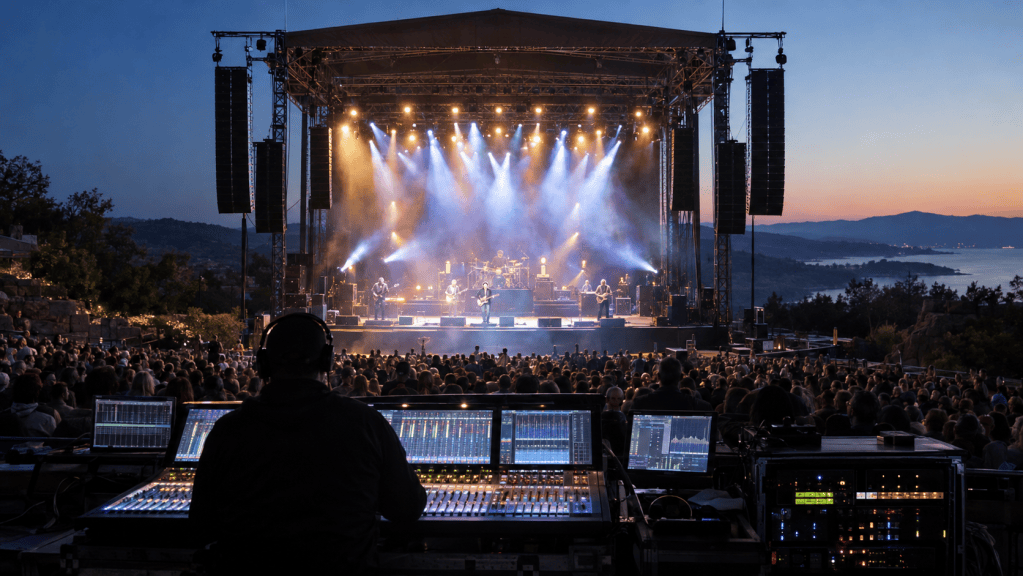
Train’s summer 2026 tour, Drops of Jupiter: 25 Years in the Atmosphere, doubled as a large-scale field test for one of the most discussed new tools in live sound: L-Acoustics Source Intelligence. Across a 36-date North American amphitheatre run, LMG Touring supplied a complete production package built around an L-Acoustics K Series system, while front of house engineer Jason “J-Mo” Moore relied on Source Intelligence to reshape how Pat Monahan’s lead vocal sat in the mix.
The tour marked the 25th anniversary of Train’s Diamond-certified single “Drops of Jupiter” and ran from July 8 at iTHINK Financial Amphitheatre in West Palm Beach, Florida, through August 30 at White River Amphitheatre in Auburn, Washington.
Vocal Enhancement Engine Tackles Stage Bleed And Feedback
Source Intelligence is L-Acoustics’ real-time vocal enhancement engine designed to strip away stage bleed and room ambience from a vocal microphone without degrading the core vocal signal. Crucially for live use, it operates at low enough latency to sit directly in a front of house signal chain.
Moore, who has mixed front of house for Train for more than 13 years and previously toured with artists including Sister Hazel, Seven Mary Three, Collective Soul, Kenny Wayne Shepherd, and Selena Gomez, was motivated to deploy Source Intelligence to address two classic live sound challenges: excessive bleed into vocal microphones and the risk of feedback when a vocalist moves in front of the main arrays.
According to Moore, his first experience with the system came during rehearsals via virtual soundcheck. He reports that listening back to familiar multitrack recordings through Source Intelligence, with the bleed removed from the vocal channels, was a striking change from what he was used to hearing.
Front Of House Workflow And Mix Benefits
Integrating Source Intelligence into the touring front of house setup required no unusual routing, with the engine inserted much like conventional outboard processing through the console. Moore notes that one immediate operational benefit was the ability to keep the lead vocal channel open during line checks, which simplified communication with stage technicians without bringing the usual wash of stage noise into the system.
Once in daily use, the cleaner vocal input affected the rest of the mix chain. With less unwanted content in the microphone signal, Moore was able to make more targeted equalization and compression decisions, and he reports that time-based effects such as reverb and delay returned to the mix with greater clarity.
The most dramatic impact, however, came in situations that normally make engineers cautious: loud stages, open microphones, and vocalists stepping toward or even in front of the main hangs. Moore cites moments when Monahan moved in front of the right main array, when his typical instinct was to reach for the channel fader and pan controls to avoid feedback. With Source Intelligence active, he discovered that those reflexive moves were no longer necessary, describing a substantial increase in gain before feedback and greater headroom on the main vocal.
Control Options For Complex Stage Scenarios
Beyond raw isolation, Moore points to the way Source Intelligence allowed him to tailor its action to different performance moments. For instances when Monahan used a tambourine or harmonica on the same microphone as his vocal, Moore created a console macro to bypass the processing on cue, retaining full control over when the enhancement engine was engaged.
On drum vocals, Moore leveraged the software’s high and low mix controls to reintroduce a controlled amount of natural bleed, using the feature to strike a balance between isolation and the ambient energy that suits a live drum sound. He also notes that he had the flexibility to reserve Source Intelligence for full-band segments while leaving more intimate acoustic sections unprocessed when desired, reinforcing that the tool adapted to his mix choices rather than dictating them.
Moore characterizes the audible result as a shift from a congested, noisy environment toward a studio-like vocal presentation, underscoring the contrast between traditional live vocal microphones and those treated by Source Intelligence.
LMG Touring K Series Loudspeaker Deployment
To support the tour’s broad mix of amphitheatre venues, LMG Touring designed and deployed a comprehensive L-Acoustics K Series system. The main left and right hangs each comprised 12 K1 cabinets over six K2 as the primary arrays, with additional out-fill arrays of 12 K2 per side to extend horizontal coverage for wider seating areas.
Low-frequency reinforcement was delivered by 20 KS28 subwoofers flown in two hangs of 10 cabinets behind the main arrays in a cardioid configuration, supplemented by eight more KS28 end-stacked on the stage deck in two groups of four to provide further impact down low.
For front-fill coverage at the stage lip, six Kara II cabinets were distributed across the downstage edge, with two ARCS cabinets placed at the far sides of the stage to broaden the nearfield listening area. Onstage side-fill for the band consisted of three Kara II over one SB18 subwoofer on each side of the performance area, while X15 HiQ wedges supplied additional monitoring on the main stage.
System power and processing came from 51 LA12X amplified controllers housed in 17 LA-RAK II AVB racks, providing consistent amplification and networking infrastructure across the tour. An L-ISA Core processor was used to host the Source Intelligence engine, integrating the vocal enhancement technology into the wider L-Acoustics ecosystem.
North American Amphitheatre Tour Itinerary
The Drops of Jupiter: 25 Years in the Atmosphere tour spanned 36 dates across North America during the summer season. It opened on July 8 at iTHINK Financial Amphitheatre in West Palm Beach, Florida, and concluded on August 30 at White River Amphitheatre in Auburn, Washington.
Across the run, LMG Touring’s L-Acoustics system and Source Intelligence deployment enabled Moore to maintain a consistent, highly controlled vocal presentation in a variety of outdoor environments, demonstrating the technology’s impact under real-world touring conditions.

