


Background and context
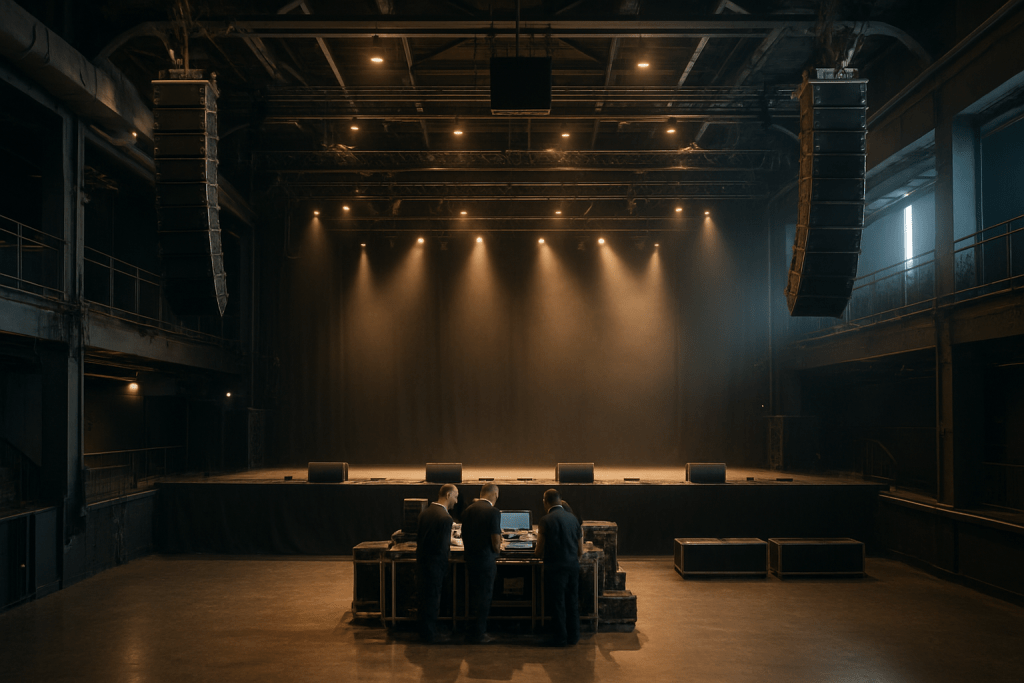
OM, a 1,700-capacity concert venue in Seraing, near Liège, has emerged as a major addition to Belgium’s live music infrastructure. Housed in a former 1948 banquet hall built for workers at the Cockerill steel complex, the site has been transformed from an industrial relic into what is currently the largest dedicated live music room in Wallonia.
The project is backed by the team behind Les Ardentes, a major summer festival in Liège that regularly attracts large audiences and international touring acts. Their ambition for OM was to bring a similar standard of production to a mid-size indoor venue, with a programme that ranges from rock, metal and hip-hop to jazz and electronic music.
This mix of styles, combined with the building’s industrial architecture, placed particular demands on the audio system. The venue needed high sound pressure levels and full-range coverage comparable to an outdoor festival, but within a confined, visually sensitive space where large ground-stacked subwoofer arrays and visually dominant loudspeakers were not desirable.
Key announcement
To meet these requirements, OM appointed Belgian integrator XLR, an L-Acoustics Certified Provider, to design and install a new sound system. XLR specified the L-Acoustics K3 line array as the core of the solution, supported by a range of additional loudspeakers and amplifiers from the same manufacturer.
The main system consists of two hangs of eight K3 elements per side, using the install version of the enclosure. Low-frequency reinforcement is delivered by four KS28 subwoofers per side, flown next to the main arrays rather than placed on the floor. According to XLR, this approach evens out bass coverage across the audience and keeps the stage area clear for different stage designs and show formats.
Further coverage is provided by two X12 loudspeakers for near-field in-fill and four A10 Wide cabinets used as front-fills for the audience closest to the stage. The system is powered by six LA12X amplified controllers. More details on the K3 system are available on the L-Acoustics official product pages at l-acoustics.com.
XLR used L-Acoustics’ Soundvision modelling software during the design phase to predict coverage and optimise loudspeaker placement in the 1950s-era hall. The company reports that with eight K3 per side, they were able to achieve full coverage of the audience area without installing any delay speakers, maintaining a relatively even sound pressure level from front to back.
Industry impact
The choice of L-Acoustics K3 reflects broader trends in venue design, where operators seek compact line array systems that still meet the expectations of touring productions accustomed to large-format rigs. By flying both the main arrays and subwoofers, OM is able to maintain a clean stage and audience floor while still delivering substantial low-end energy for bass-heavy genres.
For visiting engineers and artists, the presence of a globally recognised brand and familiar system architecture is likely to reduce setup time and technical negotiation around riders. According to the venue team, early feedback from touring crews has been positive, with many acts arriving already comfortable working on L-Acoustics platforms.
The installation also illustrates how regional venues are leveraging high-end modelling tools such as Soundvision to address acoustical challenges in repurposed industrial buildings. The ability to simulate coverage and response in advance has become a standard expectation for new or renovated performance spaces of this scale.
Why this matters
OM’s deployment of K3 is significant for the Belgian and wider European live music market. It shows how mid-size venues are investing in sound systems that can support a full spectrum of programming while remaining compatible with international touring standards.
For event producers and promoters, the venue offers a new option in Wallonia with production values closer to those of large outdoor festivals but in an indoor, 1,700-capacity format. This may influence routing decisions for artists seeking consistent audio quality across club, theatre and arena dates.
From a technology perspective, the project underlines the role of compact, full-bandwidth line array systems in modern venue design. OM’s solution demonstrates how a relatively small number of flown enclosures, combined with careful modelling and targeted fills, can eliminate the need for delay towers and reduce visual impact without compromising coverage.
As more post-industrial buildings are converted into cultural spaces, the approach taken at OM — using a high-spec, rider-friendly system adapted to a challenging acoustic environment — is likely to serve as a reference point for similar projects across the region.