


Background and context
Shenzhen University in southern China has equipped its new Arts Complex with a coordinated suite of sound systems from L-Acoustics, aiming to deliver a consistent listening experience across four very different performance spaces.
The 128,000-square-metre facility, completed for the university’s 40th anniversary in 2023, includes a 1,000-seat grand theatre, a 500-seat theatre, a 266-seat experimental theatre and a 245-seat concert hall, alongside studios, practice rooms and recording suites.
Local integrator Racpro, L-Acoustics’ distributor and Certified Provider for Greater China, handled system design, installation, training and ongoing support.
Key announcement
The university’s brief was to bring all four venues up to the same professional standard while respecting each room’s distinct architecture and use case. That required separate system designs but a common sonic character and operational approach.
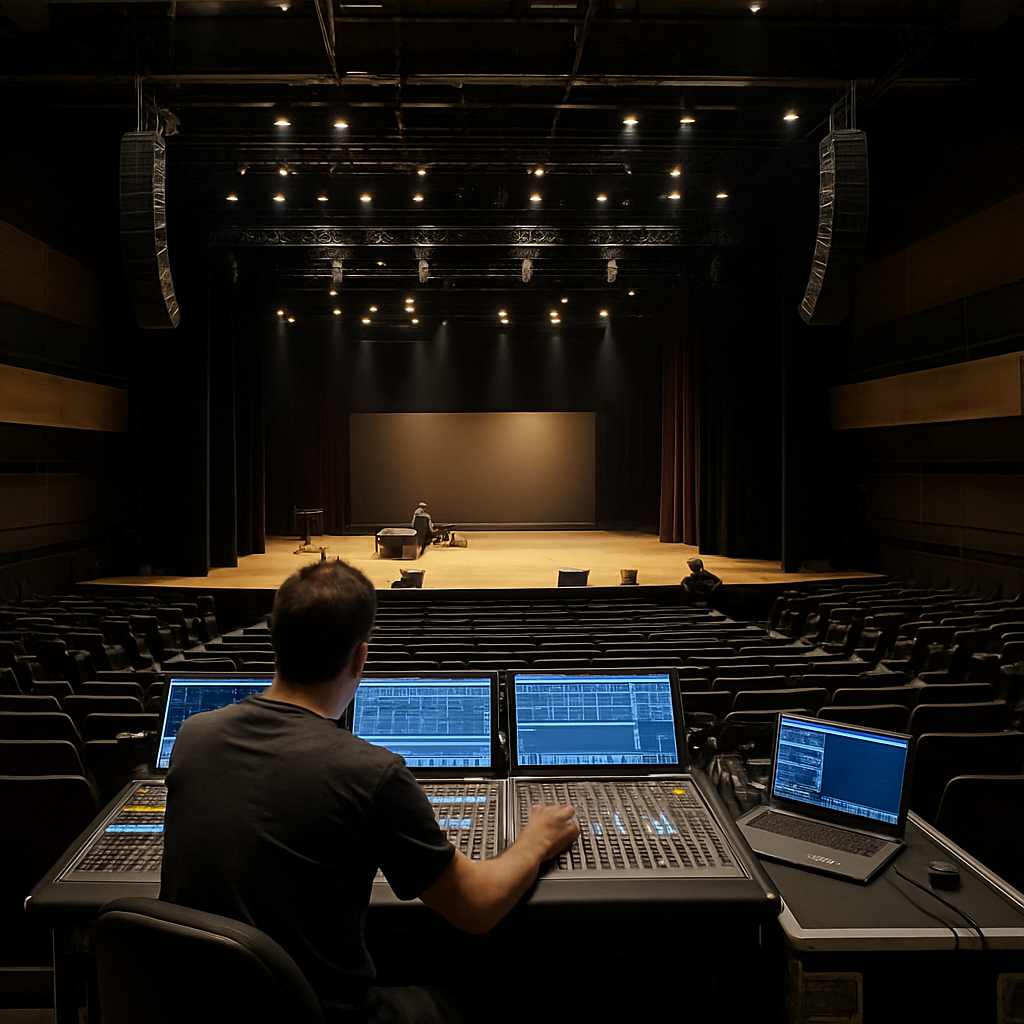
In the two larger theatres, most loudspeakers are hidden behind acoustic treatment to preserve architectural lines. In contrast, the experimental theatre’s system is fully visible, doubling as a teaching tool for students learning sound design and production.
Racpro relied heavily on L-Acoustics’ Soundvision modelling software, running multiple simulations for each venue to determine rigging angles, delay settings and coverage before construction was finalised. This was particularly important where equipment would be concealed behind fixed cladding, limiting opportunities for later adjustments.
In the grand theatre, the main system uses left-right hangs of three A15i Wide per side with a centre cluster of two A15i Wide, all installed within the acoustic treatment. X12 loudspeakers provide in-fill, 5XT units cover the stage lip, and X8/X8i loudspeakers handle under-balcony and surround seating. Low frequencies are reinforced by KS28 and KS21i subwoofers.
The 500-seat theatre follows a similar design, with left-right hangs of three A15i Wide and a centre hang of two A15i Wide, plus X12 for in-fill, 5XT for front-fill, X8 surrounds and KS28 subwoofers. The goal here is even coverage and intelligible speech for both performances and day-to-day teaching.
The experimental theatre uses left-right hangs of five Kiva II per side, each above an SB15 enclosure to extend low frequency response without separate flown subs. A single X12 serves as a centre channel, while a pair of ground-stacked SB18 IIi subwoofers provides additional low end.
In the concert hall, Racpro specified a simpler configuration: four flown X12 loudspeakers as the main system, focusing on clarity and straightforward operation for faculty and student users.
Industry impact
The project highlights how higher education venues are increasingly adopting professional touring-grade systems while demanding discreet integration and flexible use. The Shenzhen installation shows a move away from one-size-fits-all campus solutions toward venue-specific designs with shared voicing and control concepts.
For manufacturers and integrators, it underlines the importance of prediction tools such as Soundvision in complex architectural projects where equipment must align with stringent aesthetic and acoustic requirements.
The deployment also illustrates a growing expectation that performance systems in universities support both live production and curriculum delivery, including audio education, theatre training and hybrid lecture formats.
Why this matters
For event technology professionals, Shenzhen University’s Arts Complex offers a case study in standardising audio quality across multiple spaces without imposing a single physical design. The combination of A Series, K Series and X Series loudspeakers, together with dedicated subs, is tailored to each room’s role while maintaining a shared sound signature.
The project also emphasises lifecycle considerations beyond installation. Racpro delivered on-site training and created scene presets so non-specialist staff can recall setups for events such as recitals, lectures or theatre productions without reprogramming the system each time.
As universities continue to invest in multi-purpose cultural hubs, similar projects are likely to inform how integrators balance design, pedagogy and production needs. Further technical details on the loudspeaker ranges used in Shenzhen can be found on the L-Acoustics website at http://www.l-acoustics.com.

