


Background and context
Veteran Korean vocalist Yim Jae-Beom marked 40 years in music with a farewell concert at Seoul’s KSPO Dome earlier this year, drawing an audience of up to 15,000. The show covered the full span of his career, from heavy rock and metal to ballads, R&B, soul and orchestral arrangements.
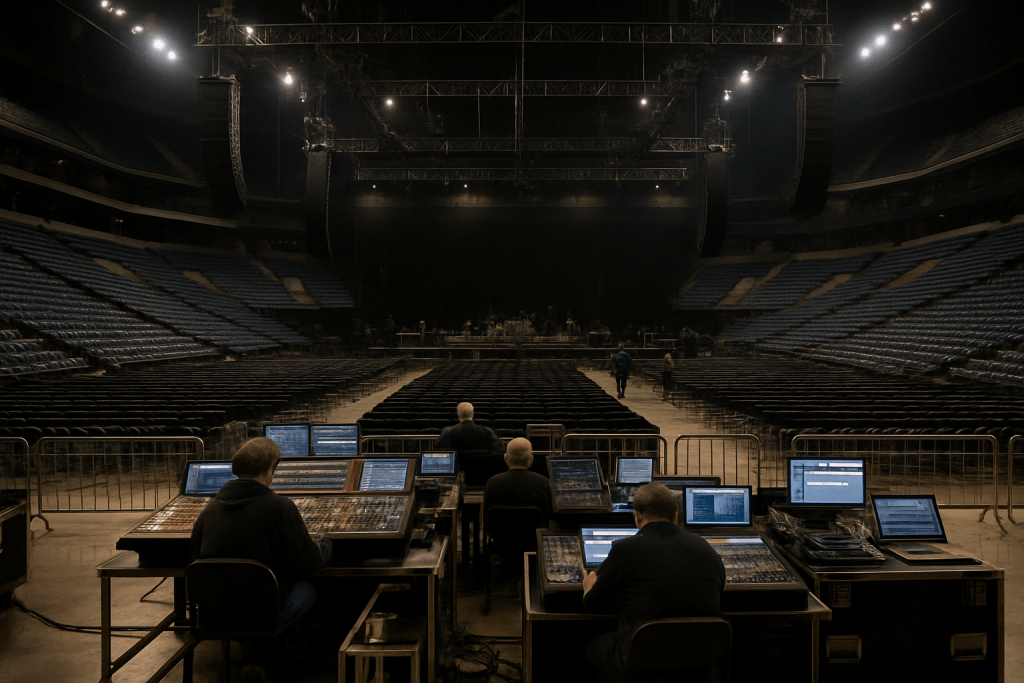
KSPO Dome, originally built as the gymnastics arena for the 1988 Seoul Olympics, is now one of South Korea’s busiest large-scale concert venues. Its wide floor and steep, three-tier seating bowl present well-known challenges for achieving consistent sound and a sense of intimacy at scale.
For this production, composer and music producer Gi-Deok Park sought to deliver a close, detailed listening experience in an arena-sized space, prioritising natural vocal reproduction over high-impact, high-SPL sound design.
Key announcement
To meet that brief, L-Acoustics Certified Provider Klausys and Korean rental company Hyundae Sound deployed an L-ISA immersive system built around the manufacturer’s K Series loudspeakers. It was the first major concert in Korea to use L-ISA at KSPO Dome since the Los Angeles Philharmonic’s appearance there in 2019.
The team opted for an L-ISA Focus configuration with five frontal K2 arrays forming the main Scene system. This approach was chosen to maintain tonal consistency across the horizontal sound field and to support precise spatial placement of sources such as lead vocal, band sections and orchestral elements.
The main system used 60 K2 cabinets spread across the five Scene clusters. A further 48 Kara II loudspeakers provided extension and out-fill coverage, while seven A15 Focus cabinets served as spatial fills along the front of the stage to reinforce imaging for the closest seats.
Low frequencies were handled by two flown clusters of eight KS28 subwoofers each, supported by four ground-stacked KS28 units. The sub system was configured in a cardioid arrangement to control rear energy, reduce comb filtering and improve low-frequency consistency throughout the venue.
System drive relied on 18 LA-RAK II AVB touring racks, with an L-ISA Processor I at the centre of the audio network. A P1 processor and an LC16D audio converter bridged MADI outputs from the L-ISA Processor into a redundant Milan-AVB network, allowing legacy and networked devices to operate together and maintaining clock synchronisation between the mixing console and the AVB media clock.
Industry impact
For design and prediction, Klausys used L-Acoustics’ Soundvision software. Beyond coverage and SPL mapping, the team highlighted the value of modelling L-ISA zones in advance, giving clearer expectations of the spatial image across the floor and three tiers of seating. The software was also used to verify rigging parameters and to communicate system layouts to the wider production crew.
The concert’s visual design was built with the immersive system in mind. Show producer James Koo aligned video content with the L-ISA object-based mix, linking movement on the screens to corresponding shifts in the sound field controlled through the L-ISA Controller.
According to the production team, the use of L-ISA at this scale in Korea showed how immersive approaches can support narrative and emotional goals in a mainstream concert environment, rather than being limited to experimental or classical work.
Why this matters
The Yim Jae-Beom farewell concert illustrates how immersive audio technologies are moving further into large-format, popular music shows in Asia. In this case, the system was deployed not for spectacle but to deliver clarity and proximity in a difficult acoustic environment.
For event and touring professionals, the project underlines several trends: increasing reliance on detailed modelling before load-in, closer integration between audio and visual design, and the use of networked infrastructures that combine legacy formats with newer protocols such as Milan-AVB.
More information on the L-ISA platform and related loudspeaker systems is available on the L-Acoustics website at https://www.l-acoustics.com.