


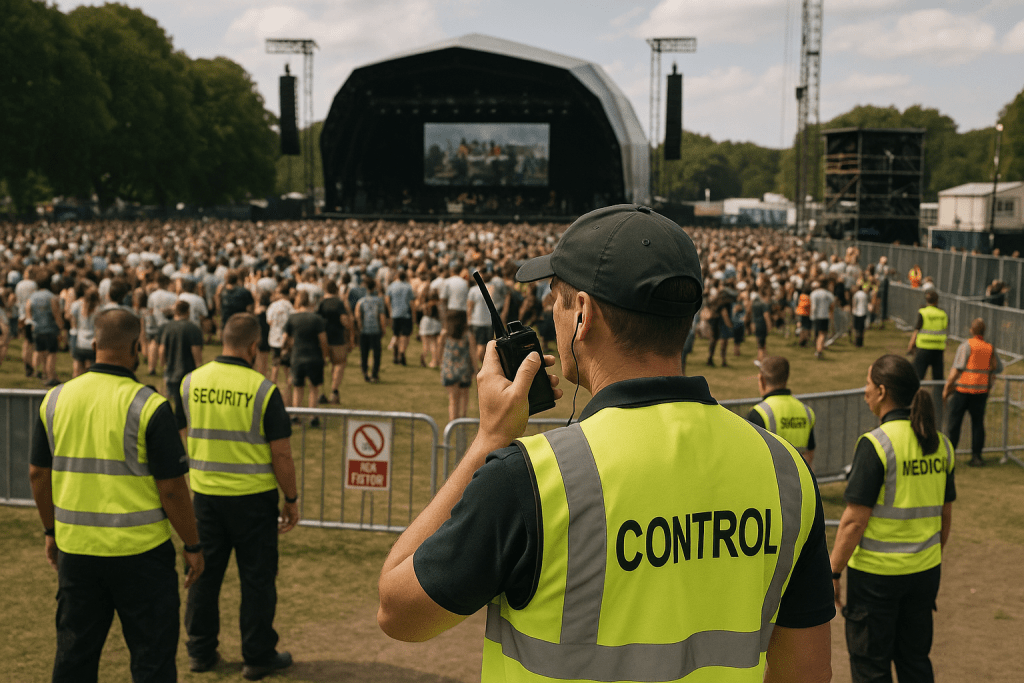
The UK’s festival and live events sector hosts millions of attendees every year, from internationally recognised music festivals to regional food fairs, city marathons and stadium concerts. While audiences focus on performances and experiences, a complex infrastructure of operations, safety and logistics runs quietly in the background.
At the centre of that infrastructure, two-way radios continue to play a pivotal role. Despite the growth of smartphones, apps and cloud collaboration tools, radio systems remain a primary communication backbone for many organisers, security teams and production crews managing large-scale events.
Background and industry context
Over the past decade, live events have become more complex and data-driven. Multiple stakeholders – including production, security, medical teams, traffic control, vendors and local authorities – must coordinate in real time. At the same time, attendee expectations for safety, accessibility and smooth operations have risen, and regulatory frameworks have become stricter around crowd management and incident response.
Connectivity on site is frequently a challenge. Live events often take place in rural locations, temporary greenfield sites or dense urban environments where mobile networks can become overloaded. High volumes of attendees using phones for social media, payments and streaming can push consumer networks to capacity, making them unreliable for time-critical staff communications.
In this context, dedicated radio systems provide an independent, resilient layer of communication. They are engineered specifically for mission-critical voice, using licensed or carefully managed spectrum, with equipment designed to withstand harsh weather, noise and continuous use throughout long event days.
Key operational roles for two-way radios
For festivals, concerts and mass participation events, two-way radios underpin a wide range of core operations:
- Safety and security: Security personnel, stewards and safety officers rely on radios to report crowd surges, suspicious behaviour, access control issues and lost persons. Instant push-to-talk functionality enables quick escalation to control rooms and emergency teams.
- Medical and emergency response: Medical teams use radios to receive incident alerts, coordinate first response, request ambulance support and relay information to command centres. The ability to broadcast to designated groups or channels helps medical coordinators deploy resources efficiently.
- Crowd and traffic management: Entrances, exits, transport hubs and car parks require constant monitoring. Radios support coordination between gate staff, traffic marshals, public transport liaison officers and local authorities during peak arrival and departure times.
- Technical production: Stage managers, lighting and sound engineers, rigging teams and site technicians use radios to synchronise builds, sound checks, show cues and de-rigs, often across multiple stages or zones.
- Vendor and site operations: Catering, concessions, cleaning, waste management and infrastructure teams need rapid communication to resolve issues such as stock shortages, spillages, power outages or sanitation problems before they impact attendees.
In many cases, event organisers design channel plans to group users by function (for example, security, medical, production, traffic), while maintaining an overarching control or command channel monitored by senior operations staff.
Why radios remain essential alongside newer tools
Event organisers have increasingly adopted mobile apps, messaging platforms and incident management software. However, radios continue to be regarded as essential rather than optional, for several reasons:
- Instant, group-based communication: Radios enable one-to-many and many-to-many voice communication with minimal latency. Staff can communicate with an entire team or zone at the press of a button, without needing to unlock devices or navigate apps.
- Resilience when networks fail: Because professional radio systems can operate on dedicated frequencies and infrastructure, they are less susceptible to the congestion that impacts public mobile networks during peak event times.
- Designed for demanding environments: Many radios are ruggedised, with long-lasting batteries, high audio clarity in noisy settings, and accessories such as earpieces and shoulder microphones suitable for use in crowds or adverse weather.
- Support for structured command and control: Radios reinforce established incident management protocols. Clear call procedures, pre-defined channels and control room monitoring support disciplined communication during normal operations and emergencies.
In practice, two-way radios increasingly operate alongside digital incident logging systems, mapping tools and workforce management platforms. Voice remains critical for immediate coordination, while digital tools provide audit trails, analytics and reporting after the event.
Industry impact for live event operations
As events grow in scale and complexity, the communication layer has become a key factor in safety planning and licensing. Local authorities and safety advisory groups often expect organisers to demonstrate robust communication systems for both day-to-day operations and major incident scenarios.
Radio fleets and supporting infrastructure now form a significant element of event technology planning. Large festivals and venue-based shows may use temporary or semi-permanent radio networks, often designed and managed by specialist providers. These systems can include:
- Multiple channels and talk groups aligned to the event’s organisational structure
- Repeater infrastructure to extend coverage across large or complex sites
- Encryption features for sensitive communications, particularly around security or high-profile talent
- Location-aware or GPS-enabled units in some deployments, where real-time staff positioning aids response coordination
For contractors and suppliers, the ability to integrate into an event’s radio plan is increasingly part of operational readiness. Training on radio protocols and discipline is commonly included in staff briefings to reduce miscommunication, minimise channel congestion and ensure critical messages are heard.
Why this matters for event professionals and technology providers
For event organisers, production companies and venues, understanding the capabilities and limitations of two-way radios is central to designing effective communication strategies. Decisions about fleet size, channel configuration, coverage planning and user training can materially affect operational efficiency and response times.
Technology providers and rental specialists have an opportunity to support the sector by aligning radio solutions with broader event technology stacks. This may include integrating radio traffic with control room dashboards, linking incident management platforms to radio talk groups, or providing analytics on call volumes and usage patterns to inform future planning.
As hybrid and digitally enabled events continue to develop, on-site safety and operations must still function reliably even if consumer-facing digital services encounter issues. Radios provide a stable communications foundation that does not depend on attendee connectivity or public networks, helping organisers maintain continuity under pressure.
For teams working across festivals, concerts, sporting fixtures and city-wide cultural programmes, the consistent presence of two-way radios supports a common operational language and approach. Staff can move between events and organisations with transferable skills in radio use and communication protocols, strengthening the sector’s overall resilience.
Conclusion
Despite rapid innovation in event technology, two-way radios retain a central role in managing large-scale live events. Their reliability, immediacy and suitability for challenging environments make them a core component of safety and operations planning.
As live events continue to evolve, radios are unlikely to be replaced by consumer devices. Instead, they are being incorporated into wider, more integrated communication and control systems. For event professionals, investing time in effective radio strategy – from channel plans to user training – remains one of the most impactful ways to safeguard audiences, support staff and deliver smooth, large-scale experiences.