


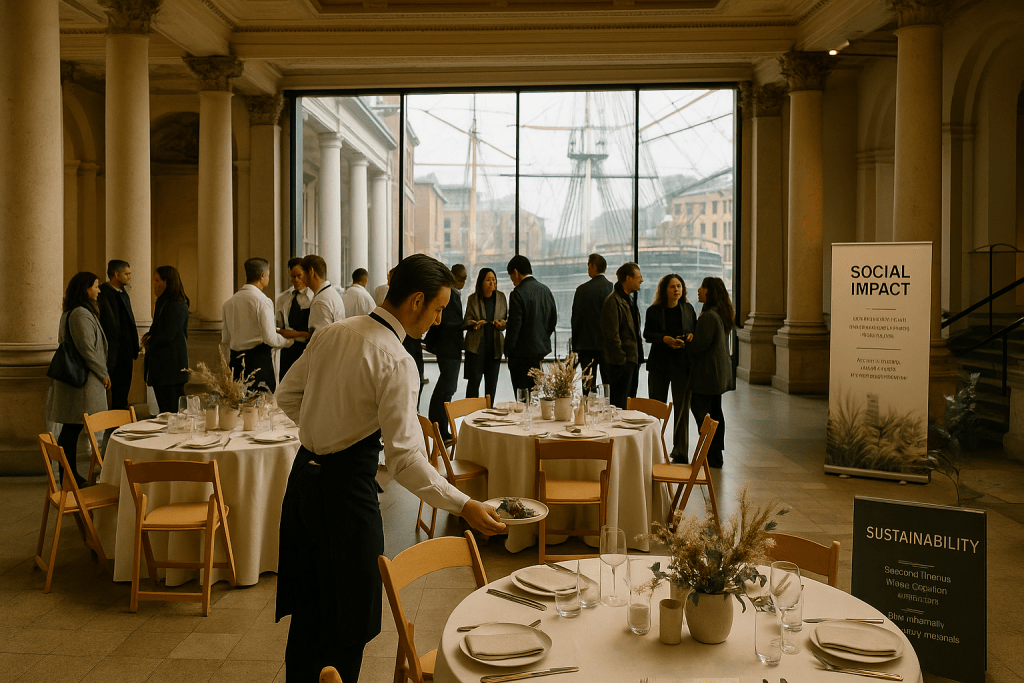
A collaborative wedding showcase between The Clink Events and Royal Museums Greenwich has placed social impact and sustainability at the centre of the guest experience, reflecting a broader shift in how couples and planners are defining value in the weddings and private events sector.
Rather than focusing solely on décor, photography and traditional hospitality, the showcase framed a wedding as an opportunity to make ethical and community-focused choices. From socially responsible catering to the use of heritage spaces and carefully selected suppliers, the event was positioned as a live case study in how purpose and celebration can co-exist.
Background and evolving expectations
Across the wider events industry, sustainability and responsible procurement have moved from optional extras to core decision criteria. This is particularly visible in the wedding market, where couples are seeking ways to align major life milestones with their personal values, including environmental responsibility, inclusion and social justice.
At the same time, venues and caterers are adapting to new expectations around supply chains, waste reduction and demonstrable social impact. This shift is prompting a re-think of everything from menu design and staffing models to the way event spaces are marketed and configured for hybrid and in-person experiences.
Within this context, the partnership between The Clink Events – known for its work in rehabilitation and training within the justice system – and Royal Museums Greenwich – a collection of historic venues in London – is notable. The collaboration brings together a mission-led catering partner with a high-profile cultural setting, creating a platform to showcase how values-driven experiences can be delivered at scale.
Key elements of the showcase
The Clink Events x Royal Museums Greenwich Wedding Showcase was conceived as an immersive journey through a purpose-led wedding day, rather than a traditional static fair or open house. The format combined live demonstrations, curated supplier participation and guided venue tours.
Core elements included:
- Socially responsible catering: The Clink Events highlighted its training-led approach, where catering activity contributes to skills development and rehabilitation. Sample menus were used to demonstrate how seasonal, responsibly sourced ingredients can be integrated into premium wedding catering.
- Historic and cultural venues: Royal Museums Greenwich spaces were presented as multi-purpose locations suitable for ceremonies, receptions and photography. The showcase emphasised the flexibility of the estate while acknowledging the stewardship responsibilities associated with heritage sites.
- Curated supplier ecosystem: Participating suppliers were selected to reflect complementary values, such as sustainable floristry, low-impact décor, conscious fashion choices and experience-led entertainment. The curated mix encouraged couples and planners to consider the collective impact of their supplier list.
- Story-led planning: Rather than centring on isolated products or services, the event mapped out a full wedding narrative – from arrival and ceremony to dining and evening reception – demonstrating how ethical decisions can be integrated at each stage.
While the showcase was primarily an in-person experience, the approach aligns with broader trends toward content capture and hybrid usage. Many elements, such as supplier presentations and venue walkthroughs, lend themselves to digital repurposing for future couples and remote stakeholders.
Industry impact and takeaways
The showcase underlines several ongoing developments across the wedding and private event landscape:
- Values as a selection filter: Couples are increasingly asking not only what an experience looks like, but what it stands for. This is influencing venue choice, catering partners and the selection of entertainment and production suppliers.
- Social impact as a differentiator: Catering and service providers with clear, measurable social outcomes are carving out a distinctive position in a crowded market. Demonstrating how bookings contribute to wider community benefits is becoming a key part of stakeholder communication.
- Heritage venues as storytelling backdrops: Cultural and historic sites are leveraging their narratives to enhance the emotional resonance of weddings and private events, while also exploring how to embed sustainability standards within protected environments.
- Integrated supplier collaboration: The event illustrated the value of pre-vetted networks of suppliers who share common priorities around environmental and social responsibility, simplifying due diligence for planners and couples.
For event technology providers, the rise of purpose-led briefs is also reshaping requirements around data capture and reporting, particularly when clients want to evidence sustainability metrics, supply chain transparency or community contributions associated with an event.
Why this matters for event professionals and technology providers
For planners, venues and agencies, showcases like this are a signal that purpose-led design is moving from niche to mainstream. Professionals involved in weddings and private events may need to adapt in several areas:
- Proposal and pitch content: RFP responses increasingly benefit from including information on supplier vetting, social impact initiatives, carbon management and waste strategies, even for comparatively small-scale celebrations.
- Supplier management and data: Building a roster of partners who can provide verifiable data on sourcing, labour practices and environmental policies is becoming essential. Technology platforms that consolidate this information and facilitate reporting can add tangible value.
- Guest experience design: Attendees are more receptive to understanding the positive impact of their participation, whether through discrete storytelling, digital signage, QR codes linking to impact reports or follow-up communications.
- Hybrid and digital extensions: While weddings remain predominantly in-person, digital tools enable remote guests to participate and can support more efficient planning. Virtual walkthroughs, digital seating and menu selection, and online gifting tied to charitable outcomes are all areas of growth.
Technology suppliers that support traceability, content capture and experience personalisation are well placed to align with these emerging priorities. Tools that convert operational decisions into clear impact narratives can help planners communicate value to increasingly discerning clients.
Conclusion
The Clink Events x Royal Museums Greenwich Wedding Showcase illustrates how social purpose, heritage settings and contemporary event design can be combined to meet changing client expectations. By using a live event format to demonstrate practical, values-led choices at every touchpoint, the partners provided a template that other venues, planners and suppliers can adapt to their own markets.
For the broader event ecosystem, the showcase reinforces that the conversation around weddings is no longer limited to aesthetics and logistics. As couples look for ways to ensure their celebrations reflect their principles, there is growing space for providers who can align operational excellence with measurable social and environmental impact – supported by the right mix of partners, processes and technology.