


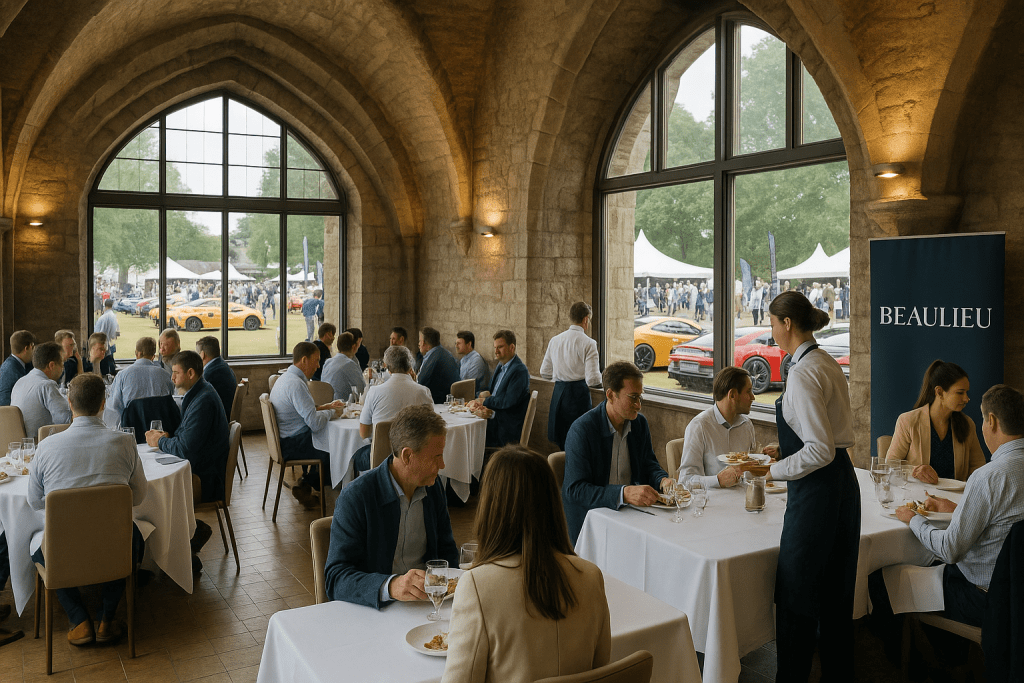
Beaulieu Supercar Weekend, one of the UK’s well-known live automotive showcases, is set to introduce a new hospitality concept for its 2026 edition. The event, scheduled for 1–2 August 2026, will feature a premium experience operated by Restaurant Associates, offering attendees an enhanced setting alongside the existing show content.
The hospitality offering will be housed in The Domus at Beaulieu, a historic venue within the estate, and is being positioned as a dedicated base for guests seeking a more curated and comfortable way to experience the weekend’s supercar activity.
Background and industry context
Large-scale outdoor and motorsport events are increasingly incorporating structured hospitality products to diversify revenue, deepen engagement and cater to changing visitor expectations. While Beaulieu Supercar Weekend has traditionally focused on track activity, static displays and automotive showcases, the introduction of a defined premium hospitality environment follows a broader trend in live events: blending entertainment with higher-value, managed guest experiences.
For organisers and venue partners, hospitality environments offer an opportunity to segment audiences, provide tiered access and introduce new commercial models. In the wider event sector, this can encompass everything from corporate hosting and sponsor suites to lifestyle-led lounges and ticketed dining packages, often supported by digital booking tools and on-site service platforms.
Key developments at Beaulieu Supercar Weekend
From 2026, visitors opting into the new hospitality option will gain access to a reserved space within The Domus throughout the two-day event. While full package details have not been publicly itemised, the experience has been described as combining a comfortable all-day base with curated dining.
Restaurant Associates, a hospitality specialist with a presence across cultural, corporate and visitor attractions, will operate the premium space. The concept is being framed as a self-contained environment within the wider site, intended to enable guests to move between the supercar programme and the hospitality area while retaining a single, consistent base of operations.
The focus on “quality dining” suggests an emphasis on upgraded food and beverage versus typical general admission options. Although technology specifics have not been disclosed, such experiences increasingly rely on digital reservation systems, capacity management, and integrated POS and ordering tools to manage volume, timings and service flow over multi-day events.
The use of The Domus also highlights how heritage venues are being repurposed for contemporary event formats. For organisers, this combines the estate’s architectural character with a controlled, ticketed environment suitable for corporate hosting, group bookings and hospitality-led audience segments.
Industry impact for live and hybrid event models
The move to introduce a formal hospitality layer at Beaulieu Supercar Weekend underlines several shifts in live event design that are relevant across sectors:
- Tiered experiences: By adding a premium layer, the event creates multiple audience journeys, from standard access to hospitality-based attendance. This model is increasingly common in sports, exhibitions and festivals, where organisers seek to attract both general visitors and higher-yield guests.
- Extended dwell time: Providing a base in The Domus, with dining and seating, encourages attendees to spend longer on site and transition between track action, displays and hospitality more comfortably. Longer dwell times typically correlate with increased spend and engagement.
- Corporate and sponsor opportunities: A structured hospitality product can support B2B hosting, sponsor activations and relationship-building meetings. For automotive brands, suppliers and partners, this type of environment can serve as a controlled setting for conversation away from the main concourse.
- Operational data and planning: Premium packages that require pre-booking often provide organisers with clearer insights into attendance profiles, capacity needs and resource allocation, supporting data-driven planning across F&B, staffing and logistics.
Although the announcement centres on the 2026 edition, similar hospitality concepts are increasingly being built into recurring event portfolios, creating a template that can be refined year on year using feedback and utilisation data.
Why this matters for event professionals and technology providers
For event organisers, the Beaulieu Supercar Weekend hospitality initiative reflects a broader opportunity to rethink how audiences experience onsite content. While the core attraction remains the supercars themselves, the premium space demonstrates how venue assets and F&B partners can be leveraged to produce new products without fundamentally altering the event’s identity.
Event professionals considering similar models can draw several practical takeaways:
- Product definition: Clear positioning of what hospitality includes—access rules, food and beverage provision, time windows, and proximity to main attractions—is essential. Even when public information remains high level, internal clarity supports pricing, staffing and capacity planning.
- Integration with ticketing: Hospitality access typically benefits from integration with existing ticketing systems, allowing upsell at point of purchase, segmented communications, and more accurate forecasting of attendance by package type.
- On-site guest flow design: Locating hospitality in a distinct space such as The Domus introduces the need for well-managed guest routes, signposting and access control. Technology such as digital wayfinding, access scanning and timed entry can support a smoother experience.
- Data capture and feedback: Premium guests can be a key source of qualitative feedback. Post-event surveys, digital check-in data and purchase histories can help refine the offer, identify peak usage times and adjust menu, seating or programming.
- Hybrid and digital touchpoints: Even though this is a firmly in-person experience, supporting digital touchpoints—such as online pre-selection of menus, in-app communication, or digital concierge services—can differentiate the product and streamline onsite operations.
For technology vendors, developments like this signal ongoing demand for integrated hospitality management capabilities within broader event tech stacks. Systems that can handle tiered ticketing, F&B pre-orders, real-time capacity monitoring and personalised communications are increasingly relevant for large-scale consumer events as well as trade and corporate shows.
Conclusion
The decision to introduce a new premium hospitality experience at Beaulieu Supercar Weekend 2026 illustrates how even established live events are evolving their onsite propositions. By collaborating with Restaurant Associates and utilising The Domus as a dedicated base, organisers are layering a structured, higher-comfort option onto an already popular motorsport-focused weekend.
For the wider event and technology community, the development is a reminder that hospitality is no longer a peripheral add-on but a central component of audience design, commercial strategy and operational planning. As visitor expectations continue to rise, particularly for multi-day outdoor and experiential events, similar hospitality-led enhancements are likely to become more prevalent, backed by a growing ecosystem of digital tools to support delivery and measurement.