


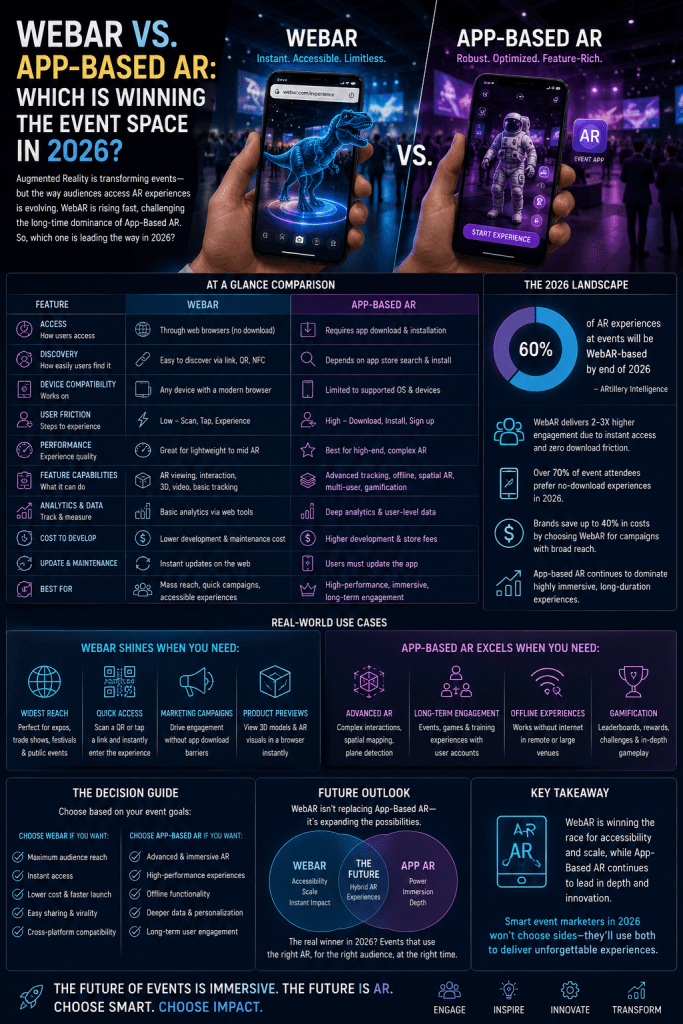
Augmented reality has become one of the most influential engagement technologies in the event industry. From trade shows and conferences to festivals, product launches, and brand activations, AR experiences are helping organizers bridge the gap between physical and digital interactions. Attendees can visualize products in three dimensions, navigate venues through digital overlays, participate in gamified experiences, and access contextual information without disrupting their event journey.
As AR adoption continues to grow, however, a strategic question is dominating event technology discussions in 2026: should organizers deploy WebAR experiences that run directly through a browser, or invest in dedicated app-based AR platforms?
Both approaches have matured significantly over the past several years. Improvements in mobile hardware, browser capabilities, 5G connectivity, cloud rendering, and AI-powered content delivery have narrowed the performance gap that once strongly favored native applications. At the same time, attendee expectations around convenience and frictionless access have increased dramatically.
For event organizers, the choice between WebAR and app-based AR is no longer purely technical. It affects attendee adoption, engagement rates, data collection, operational complexity, sponsorship opportunities, and ultimately return on investment.
Understanding the Two AR Approaches
Before evaluating market leadership, it is important to understand how each model operates.
What Is WebAR?
WebAR delivers augmented reality experiences directly through mobile web browsers.
Attendees typically access content through:
- QR codes
- NFC tags
- Event websites
- Mobile links
- Digital signage
No app download is required.
Modern WebAR experiences use browser-based technologies to access smartphone cameras, sensors, and graphics processing capabilities.
What Is App-Based AR?
App-based AR relies on a dedicated mobile application.
The application may be:
- An event app
- A brand-specific application
- A venue platform
- A specialized AR experience
Users install the software before accessing augmented reality features.
Native applications generally provide deeper integration with device hardware and operating systems.
The Biggest Battle: Friction vs. Functionality
The competition between WebAR and app-based AR can largely be summarized as a trade-off between accessibility and capability.
Why WebAR Is Growing Rapidly
The greatest advantage of WebAR is simplicity.
Attendees can access experiences immediately without:
- App store visits
- Account creation
- Installation delays
- Device storage concerns
This dramatically reduces participation barriers.
At large public events, every additional step in the user journey reduces engagement rates. WebAR minimizes these obstacles, allowing organizers to activate experiences almost instantly.
For marketing teams, this translates directly into higher participation.
Why Native Apps Still Matter
App-based AR offers greater control and functionality.
Native applications can leverage:
- Advanced device sensors
- Persistent user profiles
- Offline content storage
- Enhanced graphics rendering
- Background processing
This allows developers to create more sophisticated experiences than many browser-based systems can currently support.
For highly complex AR applications, native platforms still maintain a performance advantage.
Attendee Adoption Trends in 2026
User behavior increasingly favors frictionless experiences.
The Download Problem
One of the biggest challenges facing event applications is installation resistance.
Industry studies consistently show that many attendees hesitate to download event-specific applications because of:
- Storage limitations
- Privacy concerns
- One-time use perceptions
- Registration requirements
As events compete for engagement, organizers are prioritizing technologies that remove barriers to participation.
QR Code Familiarity
The widespread adoption of QR code interactions has significantly accelerated WebAR usage.
Attendees have become comfortable scanning codes to access:
- Menus
- Maps
- Event schedules
- Digital content
Adding AR functionality to this familiar behavior feels natural and intuitive.
As a result, WebAR adoption rates often exceed app-based participation for casual experiences.
Performance and User Experience
While accessibility favors WebAR, performance remains a key consideration.
Graphics and Rendering Quality
App-based AR generally provides stronger graphical performance.
Native applications can support:
- Larger 3D models
- Higher-resolution assets
- Complex animations
- Advanced environmental interactions
This is particularly important for product visualization and immersive brand experiences.
Improvements in WebAR
Recent browser advancements have significantly improved WebAR capabilities.
Modern platforms now support:
- Real-time object placement
- Surface tracking
- Image recognition
- Environmental understanding
- Interactive 3D experiences
For many event use cases, the performance gap is becoming less noticeable.
Latency and Responsiveness
Native applications still typically deliver lower latency and smoother interactions.
However, widespread 5G deployment and edge computing infrastructure have helped narrow the difference considerably.
For most attendee-facing activations, WebAR performance is now sufficient.
Event Use Cases Where WebAR Is Winning
Several event categories increasingly favor browser-based deployment.
Trade Show Engagement
Exhibitors use WebAR for:
- Product visualization
- Interactive brochures
- Equipment demonstrations
- Lead-generation experiences
Because visitors can access content immediately, engagement rates are often higher.
Venue Navigation
AR-powered wayfinding is particularly well suited to WebAR deployment.
Attendees can simply scan a code and receive directional overlays without installing software.
This supports faster adoption and broader usage.
Sponsor Activations
Sponsors increasingly favor WebAR because it reduces participation friction.
The easier it is to launch an experience, the more attendees are likely to engage with sponsored content.
Where App-Based AR Still Leads
Despite WebAR growth, several applications continue to benefit from native platforms.
Multi-Day Conferences
Large conferences often encourage app adoption because attendees already use event applications for:
- Agendas
- Networking
- Messaging
- Session scheduling
Adding AR features into an existing application creates minimal additional friction.
Persistent Event Communities
Year-round event ecosystems increasingly rely on native applications to maintain ongoing engagement.
AR becomes one component within a broader digital platform rather than a standalone experience.
Advanced Gamification
Complex gamification programs often require:
- User accounts
- Progress tracking
- Achievement systems
- Loyalty rewards
Native applications generally handle these functions more effectively.
Analytics and Data Collection
Measurement is a critical consideration for event technology investments.
WebAR Analytics
Modern WebAR platforms provide detailed metrics including:
- Activation rates
- Session duration
- Interaction patterns
- Geographic engagement
- Conversion performance
Because experiences launch instantly, organizers often gather data from larger participant pools.
App-Based Data Advantages
Native applications provide richer behavioral intelligence.
Organizers can track:
- Cross-session engagement
- Long-term user behavior
- Personalization preferences
- Multi-event participation
This creates more comprehensive attendee profiles.
Cost and Operational Considerations
Budget constraints play a major role in technology selection.
Development Costs
WebAR often requires lower deployment costs because organizers avoid:
- App store approvals
- Multi-platform development
- Ongoing application maintenance
Updates can be deployed instantly through the web.
App Lifecycle Costs
Native applications involve broader responsibilities including:
- Operating system compatibility
- Security updates
- Version management
- User support
These factors increase long-term operational requirements.
Content Flexibility
WebAR content can be modified rapidly without requiring users to download updates.
This agility is particularly valuable for fast-moving event environments.
The Role of AI in Future AR Experiences
Artificial intelligence is accelerating innovation across both platforms.
Emerging capabilities include:
- AI-generated AR content
- Personalized visual experiences
- Context-aware recommendations
- Real-time translation overlays
- Dynamic attendee guidance
As AI becomes more deeply integrated, platform differences may become less important than experience design itself.
So, Which Is Winning in 2026?
The answer depends on how success is measured.
If success is defined by:
- Adoption rates
- Ease of access
- Participation volume
- Rapid deployment
then WebAR is clearly gaining momentum and leading many event implementations.
If success is defined by:
- Advanced functionality
- Persistent engagement
- Rich data ecosystems
- Deep personalization
then app-based AR continues to maintain important advantages.
Increasingly, however, the market is moving toward hybrid strategies where WebAR serves as the entry point and native applications provide enhanced experiences for highly engaged users.
Conclusion
The debate between WebAR and app-based AR reflects a broader shift in event technology toward balancing accessibility with capability. In 2026, WebAR is rapidly expanding because it removes friction, improves participation rates, and simplifies deployment for organizers and sponsors. At the same time, app-based AR remains valuable for complex experiences, long-term engagement programs, and highly personalized attendee journeys.
Rather than producing a single winner, the market is evolving toward complementary use cases. WebAR is becoming the preferred solution for broad audience activation, while native applications continue supporting deeper engagement and richer functionality.
For most event organizers, the question is no longer whether to use augmented reality. The more important decision is determining which delivery model aligns best with attendee expectations, business objectives, and the overall event experience.