


Background and context
L-Acoustics has expanded its L Series with L1, a new flagship line array module, and CS1, a matching cardioid subwoofer aimed at high-capacity touring and fixed installations. The systems are designed around the company’s Progressive Ultra-Dense Line Source (PULS) approach, which focuses on packing more transducers into a smaller footprint for stadium and festival applications.
Although only formally introduced in May 2026 in Los Angeles, L1 and CS1 have already been used on major tours and events. Early deployments include Bruno Mars’ “The Romantic” tour with Clair Global, Harry Styles’ “Together, Together” tour with Solotech, Joker Xue’s world tour with MRT, and the Brit Awards in London with Britannia Row.
In the festival space, CS1 has provided sub-bass on the main stages at Coachella (with RAT Sound) and Ultra Music Festival (with Unreal-Systems/AgorA), where stage-to-stage interference and low-frequency spill are ongoing concerns for production teams.
Key announcement
L1 is positioned as the top tier of the L Series for large-format line array use. Each enclosure includes two side-mounted 18-inch low-cardioid drivers, four 15-inch low-frequency drivers, eight 8-inch mid drivers, and six coaxial high-frequency compression drivers (4-inch plus 2.5-inch). This configuration supports a claimed maximum output of 160 dB SPL per enclosure over a 35 Hz–20 kHz bandwidth.
The companion L1D element shares the same transducer layout but offers a wider, progressive 60-degree vertical coverage pattern for nearfield zones, with a stated maximum of 155 dB SPL. Horizontal coverage is managed via Panflex modules, with selectable symmetrical and asymmetrical patterns for both L1 and L1D.
The CS1 subwoofer extends the system’s low-end performance. It uses four 21-inch drivers in a cardioid arrangement to deliver up to 150 dB peak SPL down to 25 Hz. Both L1 and CS1 are designed to work with the LA7.16 amplified controller, providing one discrete amplification and DSP channel per acoustic element and integrating with the LA-RAK III touring rack.
L-Acoustics also links L1 and CS1 with its new Source Intelligence platform and an updated Autofilter algorithm in the Soundvision software. Autofilter allows designers to shape low-frequency coverage from an L1 array, targeting tighter control down to 20 Hz without adding latency.
Industry impact
A key focus of the new system is low-frequency directivity for noise-sensitive environments and multi-stage events. The cardioid low-frequency architecture in L1 is specified to provide up to 18 dB of rear rejection between 20 and 250 Hz and over 26 dB below 80 Hz, concentrating bass energy on the audience while reducing spill behind and to the sides of the arrays.
CS1 applies a similar concept in the sub-bass region, which is particularly relevant at large outdoor festivals where overlapping low-frequency content can blur mixes between stages. L-Acoustics positions this as a way to address long-standing noise management and zoning requirements in urban venues and city-center stadiums.
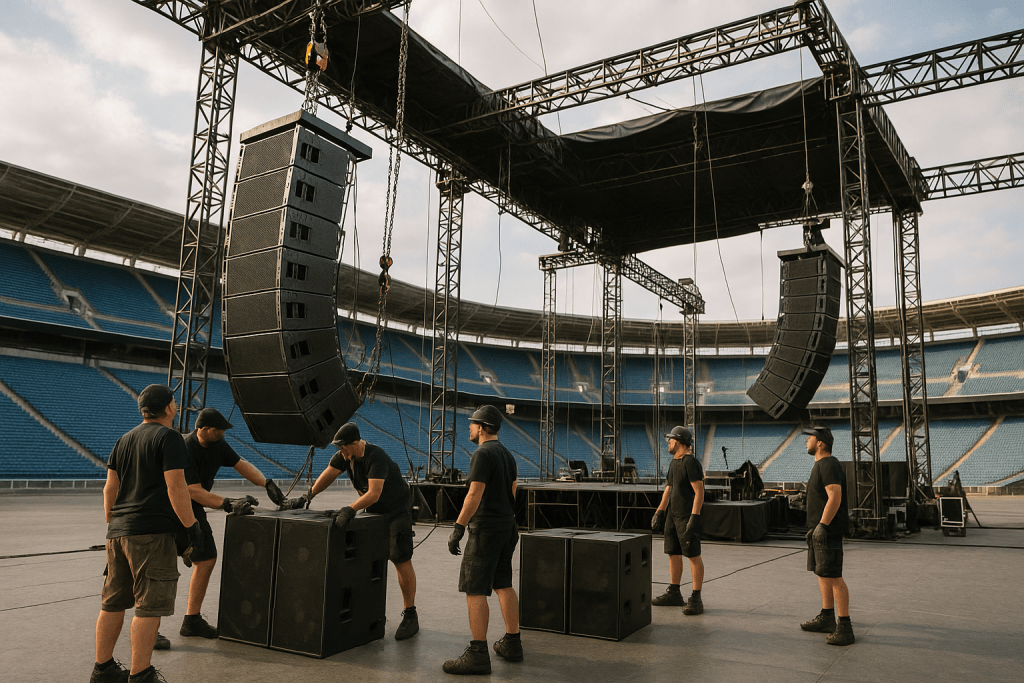
On the deployment side, the company indicates that a system made up of two CS1, four L1 and one L1D can match the output of a conventional 21-box K1 rig, while requiring roughly two-thirds fewer rigging actions and less overall weight in the air. An auto-locking rigging system with no external pins, a single multipin SC32 connection per enclosure and concentrated amplifier power in LA-RAK III are all intended to speed up load-in and load-out.
The Hollywood Bowl has become the first venue to install L1 permanently, in a white finish to blend with its bandshell architecture. This marks the third generation of L-Acoustics systems at the venue, following earlier V-DOSC and K1 installations.
Why this matters
For sound companies and production managers, L1 and CS1 represent an attempt to combine high output, pattern control and faster deployment in a single package, at a time when large-scale tours and festivals face tighter noise regulations, shorter changeover windows and increasing pressure on staffing and logistics.
More precise low-frequency management at the array level could help festivals reduce interference between stages and give stadium operators additional tools for meeting local noise limits. At the same time, the consolidation of power into fewer but more capable enclosures may allow some tours to reduce truck space, trim rigging time and lower the structural load on venues.
L1 and CS1 are currently in a pilot phase with selected L-Acoustics partners, with broader availability planned from early 2027. Further technical information and specifications are available on the L-Acoustics website product pages at https://l-acoustics.com/products/l1-system/.