


Background and context
As brands continue to compete for attention in a crowded media environment, experiential marketing has become a central strategy for direct audience engagement. Live, hybrid, and digitally extended experiences now sit alongside traditional advertising as key tools for building loyalty and community.
Within this landscape, a group of 10 experiential firms has been singled out in 2026 for their role in pushing the boundaries of brand experiences. These organizations are experimenting with new formats, technology integrations, and approaches to storytelling that are influencing how campaigns are conceived and delivered.
Key announcement
The latest “Industry Innovators” list for 2026 highlights 10 experiential trailblazers credited with reshaping how brands interact with audiences. While each agency operates with its own creative style and sector focus, they share several common themes: a strong emphasis on immersive environments, data-informed design, and cross-channel experiences that move beyond one-off events.
According to the feature, these firms are recognized for initiatives such as:
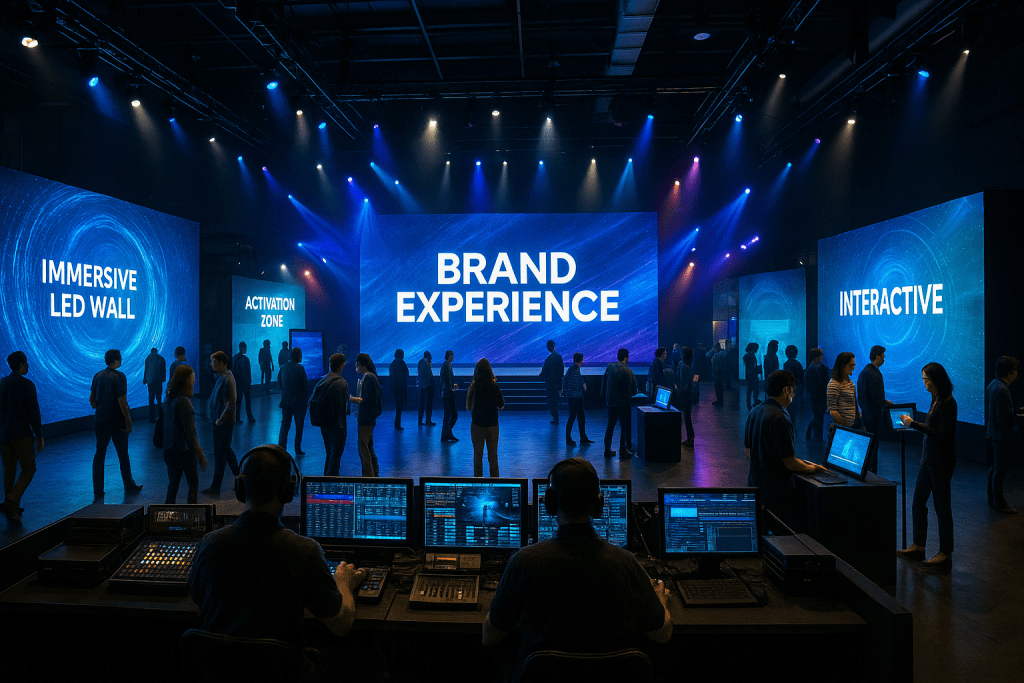
- Designing large-scale brand activations that merge physical staging, interactive media, and narrative-driven environments.
- Integrating real-time content, audience feedback, and analytics into event design and post-event measurement.
- Developing hybrid experiences that extend on-site events with virtual platforms, mobile engagement, and social media extensions.
- Piloting new uses of AR, VR, projection mapping, and responsive lighting to deepen audience immersion.
Many of the highlighted projects rely on robust technical infrastructure, from show control and content management to audience interaction tools. For event technologists and AV providers, this recognition underscores a growing expectation that technology is embedded from the initial concept phase, not added late in the process.
Industry impact
The focus on these 10 innovators reflects a broader shift across the events and marketing industries. Expectations for experiential work now extend beyond spectacle to measurable outcomes, accessibility, and sustainability. The featured firms are cited for building programs that address all of these factors.
Operationally, this is driving closer collaboration between creative agencies, production partners, and technology vendors. Complex builds involving interactive installations, multi-screen content, and synchronized lighting and audio require tightly integrated workflows and clear technical planning.
- AV teams are being engaged earlier to advise on feasibility and infrastructure needs.
- Data teams are increasingly involved in designing how attendee journeys are tracked and evaluated.
- Producers are rethinking logistics to support rapid setup, modular design, and efficient touring of experiential assets.
For event technology providers, the work of these agencies signals sustained demand for flexible media servers, networked audio, dynamic lighting control, and platforms that support interactive and multi-sensory experiences at scale.
Why this matters
The recognition of these 10 experiential trailblazers is less about individual brands and more about the direction of the sector. It points to a future in which live and hybrid experiences are expected to be:
- Technologically sophisticated, with seamless integration of content, interactivity, and infrastructure.
- Data-aware, using insights to adapt experiences in near real time and to demonstrate ROI.
- Audience-centric, designed around participation and co-creation rather than passive attendance.
For organizers, agencies, and technology partners reading EventTechnology.org, the 2026 innovators list serves as a benchmark for evolving expectations. It reinforces the need for continued investment in technical skills, interoperable systems, and collaborative processes that can support increasingly ambitious experiential concepts.
Further details on the work of these experiential firms and their projects can typically be found through their official sites and case study pages, where they outline specific activations and the technologies used to deliver them.