


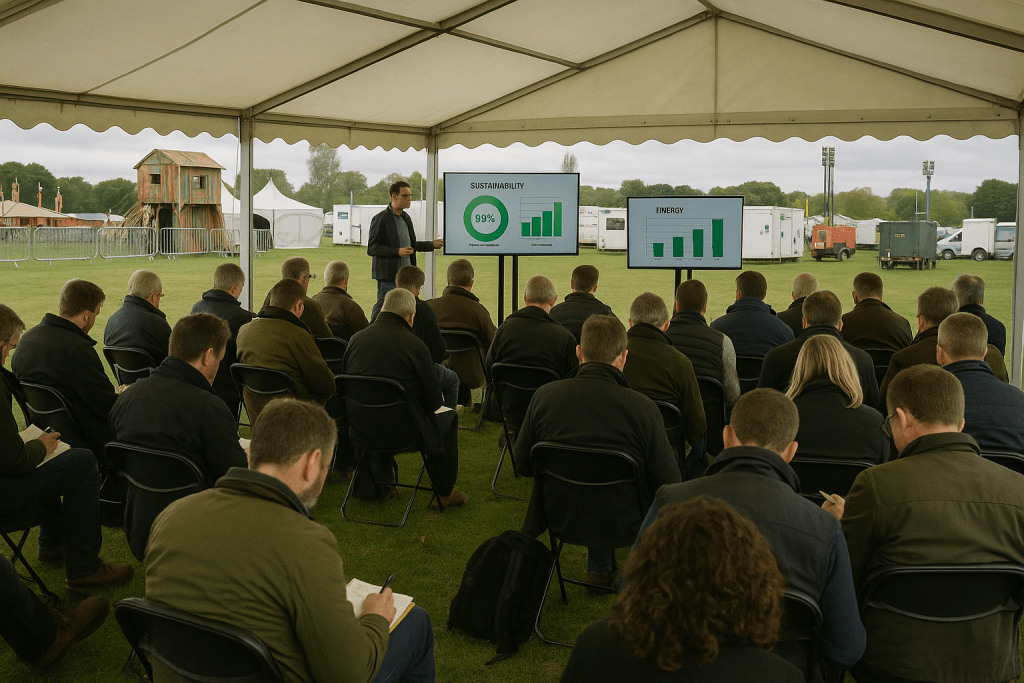
The Sustainable Event Summit (SES) is set to return to the Showman’s Show on Wednesday 21 October for its tenth edition, marking a decade of structured industry discussion around the environmental impact of outdoor and live events. This year’s programme will centre on energy use and introduce a framework of 30 climate actions targeted for completion by 2030.
The summit will coincide with the recently released third edition of The Show Must Go On report, using its findings as a reference point for data, recommended practices, and sector benchmarks. Organisers intend SES 2026 to serve as a working forum where event professionals can translate the report’s recommendations into practical plans across festivals, concerts, sporting events, and other large-scale gatherings.
Background and industry context
Over the last decade, sustainability has moved from a peripheral topic to a central operational concern for event organisers. Rising scrutiny from regulators, sponsors, attendees, and local communities has pushed festivals, outdoor shows, and touring productions to measure and reduce their environmental footprint. Energy generation and consumption remain among the heaviest contributors to event-related carbon emissions, particularly where temporary infrastructure and off-grid power are required.
The Sustainable Event Summit first emerged as a platform to consolidate learnings across different types of outdoor and live events. Since then, recurring themes have included fuel use, temporary power systems, transport emissions, materials and waste, and the broader role events can play in climate transition. Over time, the discussion has shifted from basic awareness to more data-led approaches, with increasing emphasis on measurable outcomes and industry-wide collaboration.
The latest edition of The Show Must Go On report has reinforced this shift, offering updated data and case studies on how events are addressing carbon impacts, particularly around power generation, energy efficiency, and low-carbon alternatives. SES aims to act as a bridge between the report’s insights and on-the-ground decision-making, helping teams move from one-off initiatives to long-term strategies.
Key developments and summit focus
For its tenth outing, the Sustainable Event Summit will formally launch Vision for Sustainable Events’ thematic focus on energy, anchoring discussions around how the sector can decarbonise power use over the rest of the decade. The event will also introduce a set of 30 climate actions for 2030, outlining areas where event organisers, suppliers, venues, and local authorities can align efforts.
The summit will convene outdoor event organisers, production companies, infrastructure and technology suppliers, and representatives from local authorities, alongside environmental specialists and data practitioners. Sessions are expected to explore topics such as:
- Strategies for reducing reliance on diesel generators and high-emission power sources.
- Deployment of more efficient temporary power systems and smart load management.
- Integration of grid connections and renewable sources where infrastructure permits.
- Data collection and reporting practices to track progress toward 2030 goals.
- Collaboration models between organisers, suppliers, and host locations.
While the headline focus is energy, the 30 climate actions are expected to span related operational areas—such as logistics, materials, and audience engagement—where energy decisions intersect with broader sustainability objectives. The summit format is designed not only for presentations but also for peer-to-peer exchange, enabling delegates to share experiences, challenges, and practical solutions.
Industry impact and collaboration
By tying its tenth edition to a defined set of climate actions and a specific 2030 time frame, SES is aligning with wider climate commitments being made across business and public sectors. For event organisers, these timelines intersect with venue investment cycles, equipment procurement, and multi-year contracts with suppliers. Establishing clear action areas now may influence how future tenders, technical specifications, and partnership agreements are structured.
Local authorities and destination partners are also a growing part of this conversation. Many are setting their own net zero targets and increasingly expect events hosted in their jurisdictions to conform with local climate policies. By bringing local government stakeholders into the summit environment, SES aims to support more coordinated approaches to planning, permitting, and infrastructure development.
Suppliers of power, infrastructure, and technology stand to play a pivotal role. Progress toward the 30 climate actions will likely drive demand for equipment that can reduce fuel use, enable better load balancing, and integrate renewables, alongside digital tools that measure performance in real time. The summit’s focus on collaboration and resource sharing suggests that knowledge transfer between suppliers and organisers will be central to scaling workable solutions.
Why this matters for event professionals and technology providers
For event professionals, the tenth Sustainable Event Summit represents a checkpoint in the sector’s sustainability journey. Many organisations have already implemented initial measures—such as basic carbon reporting, reduced fuel use, or pilot solar installations—but are now under pressure to move beyond incremental gains. A common set of climate actions can help teams prioritise, compare progress, and communicate expectations across all partners involved in event delivery.
Technology providers, particularly those in power systems, monitoring, and data analytics, may find the summit’s energy focus highly relevant. As events seek to cut emissions without compromising reliability or audience experience, there is growing interest in:
- Hybrid and renewable-powered generators.
- Battery storage solutions suitable for temporary deployments.
- Energy management platforms that provide live performance data.
- Tools to calculate carbon impacts and support reporting frameworks.
These capabilities are increasingly seen not just as optional enhancements but as integral components of responsible event design. Vendors able to demonstrate measurable reductions in fuel consumption or emissions are likely to be better positioned as the 2030 climate actions become embedded into contracts and procurement criteria.
The summit also reinforces the importance of shared standards and terminology. As more organisations adopt science-based targets or align with national and regional climate policies, having a consistent language around energy metrics, baselines, and reporting can streamline collaboration and reduce friction between stakeholders.
Conclusion
The return of the Sustainable Event Summit to the Showman’s Show for its tenth edition signals a more structured phase in the events industry’s approach to climate action. By spotlighting energy and framing 30 actions for 2030, the gathering aims to move sustainability discussions beyond broad goals toward coordinated, measurable steps that can be adopted across outdoor and live events.
For organisers, suppliers, and technology partners, SES offers an opportunity to align operational plans with emerging expectations around emissions, reporting, and infrastructure investment. As the sector navigates tightening environmental standards and shifting stakeholder demands, forums like this are likely to influence how event design, power planning, and data strategies evolve over the remainder of the decade.