


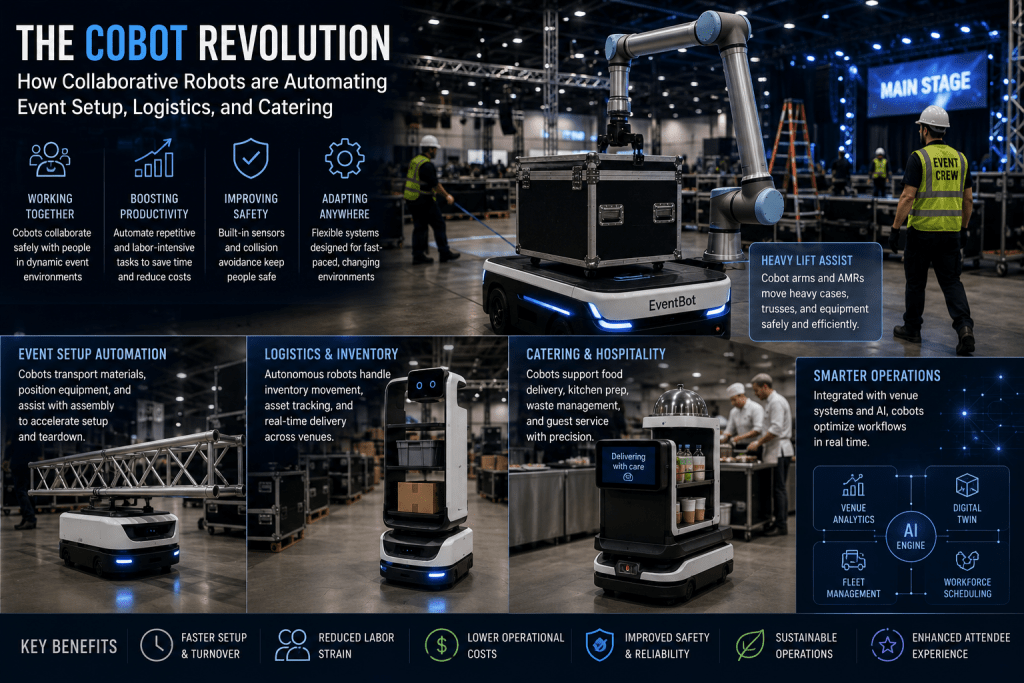
The event industry is entering a new phase of operational automation driven by collaborative robotics, commonly known as cobots. Unlike traditional industrial robots designed for isolated manufacturing environments, cobots are engineered to work safely alongside humans in dynamic, fast-moving operational settings. Their emergence is beginning to reshape how large-scale events manage setup, logistics, material handling, catering operations, and venue support services.
For years, event technology innovation focused primarily on attendee-facing systems such as registration platforms, engagement apps, hybrid streaming infrastructure, and AI-powered personalization. However, rising labor shortages, compressed setup timelines, increasing operational complexity, and growing cost pressures are now pushing organizers and venue operators to automate backstage operations with greater sophistication.
Cobots are becoming an important part of this transformation.
Modern event environments require thousands of repetitive, physically demanding, and time-sensitive tasks to be executed with precision. These include transporting staging materials, assembling modular infrastructure, managing inventory movement, distributing catering supplies, and supporting overnight venue turnovers. Collaborative robots are increasingly being deployed to augment human teams in these operational areas while improving efficiency, safety, and consistency.
Rather than replacing event staff entirely, cobots are primarily designed to reduce repetitive strain, improve operational throughput, and support hybrid human-machine workflows.
Why Cobots Are Gaining Traction in Event Operations
Table of Contents
ToggleEvent environments present unique operational challenges that differ significantly from warehouses or manufacturing facilities.
Large venues operate under conditions that include:
- Constant spatial reconfiguration
- Temporary infrastructure deployment
- High pedestrian density
- Tight setup windows
- Multi-vendor coordination
- Dynamic crowd movement
- Overnight operational cycles
- Frequent material transportation
These conditions make event logistics labor-intensive and highly vulnerable to delays.
At the same time, the event industry continues to face workforce shortages in areas such as:
- Venue operations
- Material handling
- Food service staffing
- Overnight setup crews
- Technical installation teams
- Cleaning and maintenance services
Cobots are increasingly viewed as operational support systems capable of stabilizing workflows without requiring fully autonomous environments.
Their value lies in adaptability. Unlike fixed industrial robotics, collaborative robots can operate in partially structured spaces and safely interact with human workers using advanced sensors, computer vision, and obstacle detection systems.
Core Technologies Powering Event Cobots
Modern collaborative robots combine multiple technologies that enable flexible deployment inside event venues.
Autonomous Navigation Systems
One of the most important capabilities in event-focused cobots is autonomous mobility.
These systems use:
- LiDAR mapping
- Computer vision
- Simultaneous localization and mapping (SLAM)
- Depth sensors
- Proximity detection
- Real-time path optimization
Unlike warehouse robots operating in controlled layouts, event cobots must navigate constantly changing environments with temporary walls, staging equipment, cable runs, moving attendees, and vendor traffic.
AI-driven navigation systems continuously update spatial maps in real time, allowing cobots to safely reroute around obstacles and maintain operational continuity.
Machine Vision and Object Recognition
Computer vision enables cobots to identify:
- Equipment cases
- Catering carts
- Storage zones
- Floor markings
- Human workers
- Temporary structures
Advanced object recognition systems are particularly important during venue setup phases where layouts change rapidly throughout deployment cycles.
Some systems also integrate QR code or RFID scanning to improve inventory tracking and asset verification.
Human-Robot Interaction Systems
Collaborative robots are specifically designed for safe proximity operation with human workers.
Safety features include:
- Force-limiting joints
- Emergency stop systems
- Collision avoidance sensors
- Gesture recognition
- Voice command interfaces
- Predictive motion planning
This allows cobots to work in mixed operational zones without requiring isolated robotic barriers.
For example, a logistics cobot transporting lighting equipment across a convention center can automatically slow down or stop when pedestrian traffic increases nearby.
Event Setup Automation
One of the earliest applications of cobots in events is infrastructure setup assistance.
Large-scale event production involves continuous movement of heavy and repetitive equipment such as:
- Truss systems
- LED panels
- Audio equipment
- Seating modules
- Pipe-and-drape systems
- Signage structures
- Cable reels
Cobots equipped with robotic arms and autonomous transport systems can assist with repetitive transportation and positioning tasks.
Smart Material Transport
Autonomous transport cobots are increasingly being used to move equipment between:
- Loading docks
- Storage rooms
- Exhibition halls
- Production zones
- Technical control areas
These robots reduce manual pushing and carrying workloads while maintaining continuous logistics movement during setup windows.
Some systems integrate directly with event scheduling platforms and venue management software to prioritize delivery routes based on deployment timelines.
Assisted Installation Workflows
Collaborative robotic arms are also being tested for repetitive installation support tasks such as:
- Holding lighting fixtures during mounting
- Assisting with modular booth assembly
- Supporting precision positioning for LED walls
- Managing repetitive fastening operations
These applications improve consistency while reducing worker fatigue during overnight installation periods.
Logistics and Inventory Automation
Event logistics environments are often highly fragmented, with equipment and supplies distributed across temporary storage zones throughout venues.
Cobots are helping automate several logistics functions.
Real-Time Inventory Movement
Autonomous robots can transport:
- Registration materials
- Marketing collateral
- Technical accessories
- Venue supplies
- Catering inventory
- Exhibitor shipments
When integrated with RFID systems and inventory platforms, cobots can update asset movement data automatically as materials move through operational zones.
This improves:
- Asset visibility
- Inventory accuracy
- Delivery timing
- Loss prevention
- Vendor coordination
Dynamic Route Optimization
AI-powered logistics cobots can adjust delivery paths based on real-time venue conditions.
For example, if crowd density increases near a main corridor, the system may reroute deliveries through alternative service pathways to maintain efficiency and reduce congestion.
This capability becomes particularly valuable during live event operations where venue traffic patterns continuously change.
Catering and Hospitality Automation
Catering operations are another major area of collaborative robotics adoption within events.
High-volume conferences and exhibitions require rapid food preparation, supply replenishment, and waste management under strict timing constraints.
Autonomous Food Delivery
Mobile service robots are increasingly being used to transport food and beverages between:
- Kitchen areas
- VIP lounges
- Hospitality suites
- Backstage zones
- Meeting rooms
These systems reduce repetitive staff travel while improving delivery consistency.
In premium event environments, some robots are also being used for attendee-facing hospitality services such as autonomous beverage delivery and smart snack distribution.
Kitchen Support Cobots
Within catering operations, collaborative robotic systems can assist with:
- Tray handling
- Ingredient transport
- Beverage dispensing
- Dish sorting
- Waste movement
- Inventory replenishment
Rather than replacing culinary staff, these systems primarily automate repetitive movement-intensive tasks, allowing human workers to focus on preparation quality and attendee interaction.
Smart Waste Management
Waste accumulation during events creates continuous operational pressure.
Autonomous waste-handling robots can monitor fill levels, transport waste containers, and optimize disposal routes across venues.
This improves cleanliness consistency while reducing manual maintenance demands during peak attendance periods.
Integration with Smart Venue Infrastructure
The effectiveness of cobots increases significantly when integrated into broader smart venue ecosystems.
Modern event venues increasingly operate with interconnected systems including:
- IoT sensors
- Digital twins
- Venue analytics platforms
- Occupancy monitoring
- Environmental controls
- Workforce management systems
Cobots can consume real-time venue intelligence to improve operational decisions.
For example:
- Occupancy data can optimize delivery timing
- Environmental sensors can reroute robots during hazardous conditions
- Scheduling systems can prioritize setup tasks dynamically
- Digital twins can simulate robotic movement paths before deployment
This creates a more coordinated operational automation environment rather than isolated robotic workflows.
Challenges and Operational Limitations
Despite growing adoption, cobot deployment in events remains operationally complex.
Environmental Variability
Event venues are highly unpredictable environments.
Temporary layouts, changing lighting conditions, cable obstructions, and dense pedestrian traffic create navigation challenges that are more difficult than traditional warehouse automation environments.
Connectivity Dependence
Many cobot systems rely heavily on:
- Stable wireless connectivity
- Real-time cloud synchronization
- Venue-wide network coverage
Large events with network congestion can affect robotic responsiveness and coordination.
Workforce Adaptation
Successful deployment requires staff training and operational redesign.
Human workers must learn how to coordinate with robotic systems, adjust workflows, and manage exception handling when automation encounters unexpected conditions.
Cost Considerations
Advanced collaborative robotics systems remain expensive for many mid-sized event operators. Initial deployment costs include:
- Hardware acquisition
- Infrastructure upgrades
- AI software licensing
- Integration engineering
- Maintenance support
As robotics-as-a-service models expand, adoption barriers may decrease over time.
The Future of Cobots in Events
Collaborative robotics within events is still in an early growth phase, but several developments are likely to accelerate adoption.
Future systems may include:
- Swarm robotics for coordinated logistics movement
- AI-powered predictive setup planning
- Fully autonomous overnight venue turnovers
- Robotic stage reconfiguration
- Integrated digital twin coordination
- Multi-robot catering orchestration
- Self-learning venue navigation systems
As smart venues become more connected and AI coordination improves, cobots are likely to evolve from task-specific assistants into fully integrated operational infrastructure.
Conclusion
Collaborative robotics is beginning to reshape the operational foundation of the event industry. From autonomous logistics movement and assisted setup workflows to catering automation and smart inventory coordination, cobots are helping venues and organizers manage increasing complexity with greater efficiency and consistency.
Their importance extends beyond labor reduction. Cobots improve operational resilience, reduce repetitive physical strain on workers, support faster venue turnovers, and enable more adaptive resource allocation across event environments.
However, successful adoption depends on careful integration with venue systems, workforce processes, and safety frameworks. Event environments remain highly dynamic, requiring robotics platforms capable of operating flexibly alongside human teams rather than replacing them entirely.
As event operations become increasingly data-driven and infrastructure-intensive, collaborative robots are likely to become a permanent component of modern venue ecosystems, supporting a new generation of intelligent, automated event operations.