


Introduction: Light as a Dynamic Experience Layer
Lighting in events has evolved far beyond illumination. It now functions as a programmable system that shapes perception, guides attention, and defines atmosphere. In modern event environments—ranging from corporate conferences to immersive experiences—lighting operates as a dynamic layer that integrates with video, audio, and spatial design.
Rather than being static infrastructure, lighting systems are increasingly software-driven, data-responsive, and tightly synchronized with other event technologies. This shift positions lighting as both an artistic and operational system within the broader event ecosystem.
Core Components of Event Lighting Systems
Lighting Fixtures
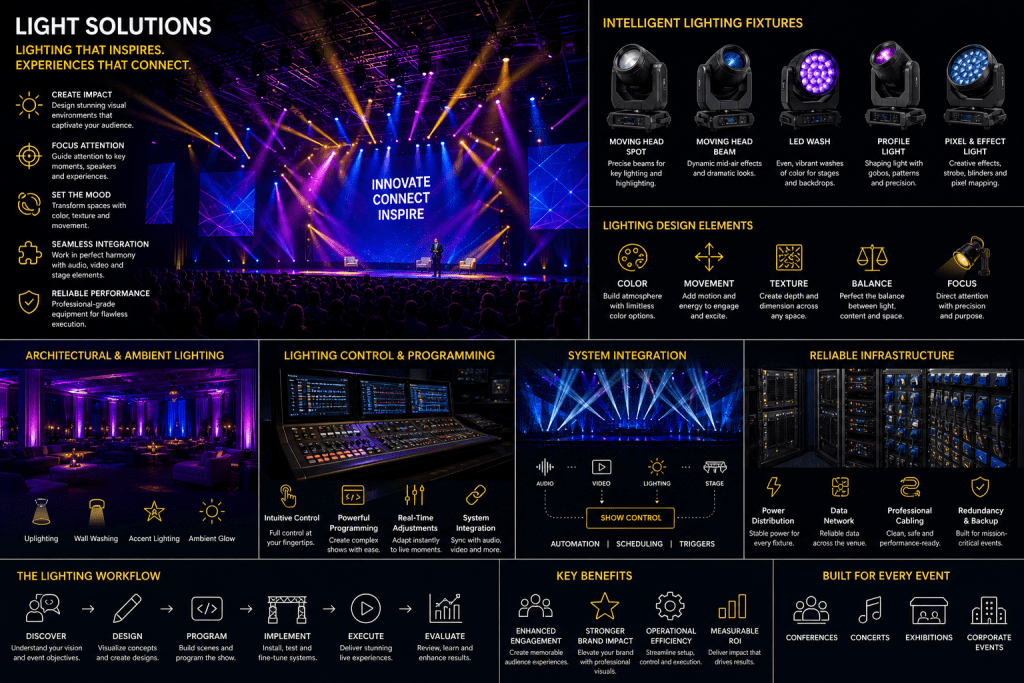
Lighting fixtures are the primary output devices. Different types serve distinct purposes:
- Wash lights for broad, even illumination
- Spotlights for focused beams and highlighting speakers
- Beam lights for dynamic effects and aerial visuals
- LED fixtures for energy-efficient, color-flexible output
Modern fixtures are often intelligent (moving heads), capable of pan, tilt, color mixing, and pattern projection.
Control Systems and Consoles
Lighting control consoles act as the central interface for programming and operating lighting systems.
They enable:
- Scene creation and sequencing
- Real-time adjustments during live events
- Integration with timecode and show control systems
Advanced consoles support network-based protocols, allowing distributed control across large venues.
Dimming and Power Systems
Dimmers regulate intensity for traditional fixtures, while LED systems often use direct digital control.
Power distribution systems ensure stable operation across complex setups, particularly in large-scale productions.
Networking and Protocols
Lighting systems rely on communication protocols such as:
- DMX (Digital Multiplex) for fixture control
- Art-Net and sACN for network-based lighting data
These protocols enable synchronization across multiple fixtures and systems.
System Architecture: From Programming to Execution
Lighting systems operate through a structured pipeline:
- Lighting scenes are programmed in control software
- Commands are transmitted via control protocols
- Fixtures interpret and execute instructions
- Output is synchronized with audio, video, and stage elements
This architecture allows precise timing and coordination.
Integration with Event Technology Ecosystems
Lighting is deeply integrated with other event systems.
Synchronization with Audio and Video
Lighting cues are often synchronized with audio tracks, video playback, and stage automation. This creates cohesive experiences where all elements operate in unison.
Interaction with Control and Orchestration Systems
Show control systems coordinate lighting with other technologies, enabling automated sequences and real-time adjustments based on event flow.
Data-Driven and Interactive Lighting
Sensors and data inputs can influence lighting behavior. For example:
- Audience movement can trigger lighting changes
- Environmental data can adjust intensity or color
- Real-time analytics can inform dynamic сценography
Experience Design: Shaping Perception and Engagement
Lighting plays a critical role in how events are experienced.
It can:
- Direct attention to speakers or key areas
- Create mood and atmosphere
- Enhance visual storytelling
- Define spatial boundaries within venues
Dynamic lighting transitions can signal changes in sessions, energy levels, or narrative flow.
In immersive environments, lighting becomes part of the content itself, interacting with projections, screens, and physical elements.
Operational and Business Impact
Lighting solutions influence both operational efficiency and audience perception.
For attendees, well-designed lighting enhances visibility, comfort, and engagement. For organizers, it enables flexible use of space and rapid transitions between sessions or scenes.
From a business perspective, lighting contributes to brand perception and event differentiation. High-quality lighting design can elevate the perceived value of an event.
Technical Challenges
Lighting systems must address several challenges:
- Power and infrastructure requirements for large setups
- Heat management and energy efficiency
- Complexity in programming and operation
- Coordination with other systems to avoid conflicts
Environmental factors, such as venue layout and ambient light, also impact performance.
Future Outlook: Intelligent and Adaptive Lighting
The future of event lighting lies in intelligent, adaptive systems.
AI-driven lighting control will enable:
- Automated scene generation based on content
- Real-time adaptation to audience behavior
- Predictive adjustments for energy optimization
Integration with XR and spatial computing will further expand possibilities, enabling lighting to interact with digital environments.
Advances in LED technology will continue to improve efficiency, color accuracy, and flexibility.
Conclusion: Engineering Light as a System
Lighting solutions in events are no longer مجرد visual enhancements—they are integral systems that shape how environments are perceived and experienced.
By combining hardware, software, and real-time control, lighting systems enable dynamic, responsive, and immersive event environments.
For event technology leaders, investing in advanced lighting solutions is essential to creating impactful, cohesive, and future-ready event experiences.