


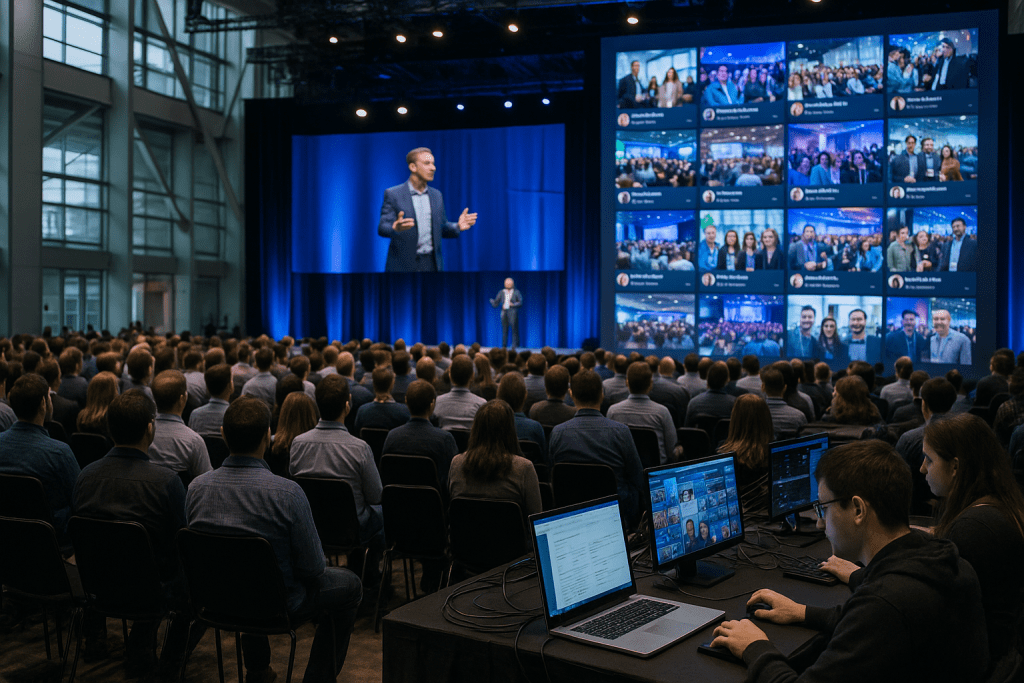
User-generated content (UGC) from events is increasingly being treated as more than a momentary social media stream. As attendees post in real time from conferences, trade shows and hybrid experiences, that material is becoming part of a longer-term content strategy rather than a short-lived on-site activation.
This shift is pushing event organisers and technology providers to look beyond traditional social walls and towards more structured “content engagement systems” that manage UGC before, during and after an event. Platforms such as Walls.io are positioning themselves around this broader lifecycle, moving from simple display tools to infrastructure for capturing, curating and repurposing attendee content across multiple channels.
Background: from hashtag walls to strategic assets
Social media walls have been a staple of corporate events and exhibitions for more than a decade, typically aggregating posts tagged with an event hashtag and displaying them on venue screens or virtual platforms. These installations helped drive on-site engagement, encourage sharing and provide a visual pulse of attendee activity.
However, as marketing and communications teams adopt more data-driven approaches, the idea of UGC as a temporary activation is being challenged. Organisations are under pressure to extend the lifespan of event content, support year-round communities and demonstrate measurable return on investment for both in-person and online experiences.
At the same time, the volume and variety of content created by participants has grown substantially. Posts no longer live solely on one network; attendees are sharing short-form video, images, commentary and live reactions across Instagram, LinkedIn, X, TikTok and embedded community spaces. Managing this fragmented output manually has become increasingly difficult for event teams.
These trends are prompting a re-evaluation of how UGC is captured, moderated, analysed and reused. Rather than being treated as an ad-hoc feed, it is starting to be incorporated into structured content operations, with designated workflows and technology support.
Key development: UGC as a lifecycle managed process
Vendors like Walls.io are responding by reframing their products as content engagement systems that span the entire UGC lifecycle rather than focusing solely on display features. In practice, this involves several stages: collecting content from multiple channels, moderating and tagging it, distributing it to various surfaces and repurposing it for future campaigns.
Collection now typically begins in pre-event campaigns, with organisers encouraging posts around registration, speaker announcements or agenda reveals. During the event, content can be sourced from social platforms, event apps, live polling tools and direct uploads. Post-event, follow-up discussions, feedback posts and recap stories become additional inputs.
Moderation tools then allow event teams to filter content by relevance, language, compliance requirements or brand guidelines. Structured tagging and categorisation enable content to be organised by session, topic, sponsor, region or audience segment, improving discoverability and reuse.
On the distribution side, content engagement systems go beyond a single wall in the main hall. Curated streams of UGC can be embedded on event websites, virtual platforms, sponsor microsites, internal communications channels and digital signage across the venue. Some implementations also feed content into mobile apps or networking platforms to support peer-to-peer discovery.
Finally, archived content can be repurposed into highlight reels, testimonial assets, themed galleries or evergreen community spaces. This staged approach aims to turn UGC into a reusable, multichannel resource rather than an ephemeral projection on a screen.
Industry impact: changing expectations for event tech
The move towards lifecycle-based UGC management is subtly reshaping expectations for event technology platforms. Event organisers are beginning to look for integrations between social aggregation tools, registration systems, mobile apps, community platforms and marketing automation software.
Vendors that once positioned themselves primarily as visual engagement solutions are now being evaluated on their ability to support data structure, compliance and analytics. Features such as consent management, content rights tracking and performance metrics across channels are becoming more relevant, particularly for larger corporate and association events.
For the broader event technology ecosystem, this development reinforces a trend towards continuous engagement rather than single-date experiences. UGC is one of the more tangible ways this continuity plays out, connecting live moments with ongoing digital communities and content marketing efforts.
Hybrid and virtual event formats have accelerated this dynamic. When audiences are distributed, social and community content often serves as a connective layer, and organisers are more likely to treat those contributions as part of their core content library. This has implications for how platforms prioritise APIs, data exports and interoperability with content management systems and CRM tools.
Why this matters for event professionals and technology providers
For event organisers, treating UGC as part of a content engagement system can change how teams plan, staff and measure events. Content capture and management may be built into the agenda design, with specific prompts or experiences created to encourage shareable moments. Dedicated roles for social moderation and content curation can become standard in the event operations mix.
This structured approach also supports more granular reporting. Instead of simply tracking hashtag volume, teams can evaluate which types of sessions generate the most reusable content, how sponsor-branded posts perform across channels, or how attendee contributions support lead generation and community retention.
For marketers, a managed UGC lifecycle extends the value of event budgets. Content captured on-site can feed into campaigns months after the event, from speaker quote graphics to attendee testimonial clips and case studies. This can help justify investment in in-person experiences and provide a bridge between annual flagships and smaller touchpoints.
Technology providers, meanwhile, face both an opportunity and a set of challenges. On the one hand, demand is growing for platforms that simplify multi-channel collection, moderation and reuse. On the other, providers must address issues around privacy, consent, intellectual property and content governance, particularly in regulated sectors or global deployments.
Vendors that can demonstrate secure handling of user content, clear audit trails and flexible integration options may be better positioned as UGC becomes part of broader digital experience strategies rather than a standalone novelty
Conclusion: towards more strategic UGC operations
The rethinking of event user-generated content from social walls to full content engagement systems reflects a broader professionalisation of event technology. As organisations seek to connect live experiences with ongoing digital engagement, ad-hoc social feeds are giving way to more deliberate, lifecycle-based approaches.
Platforms like Walls.io, and others in the space, are evolving to support this shift by providing tools that help capture, structure and reuse attendee content across multiple touchpoints. For event professionals and technology providers alike, the implication is clear: UGC is no longer a side effect of attendee enthusiasm, but a component that can be planned for, governed and leveraged as part of an integrated content strategy.
How effectively the industry adapts to this model will influence not only on-site engagement, but also the long-term value organisations can extract from the experiences they create.