


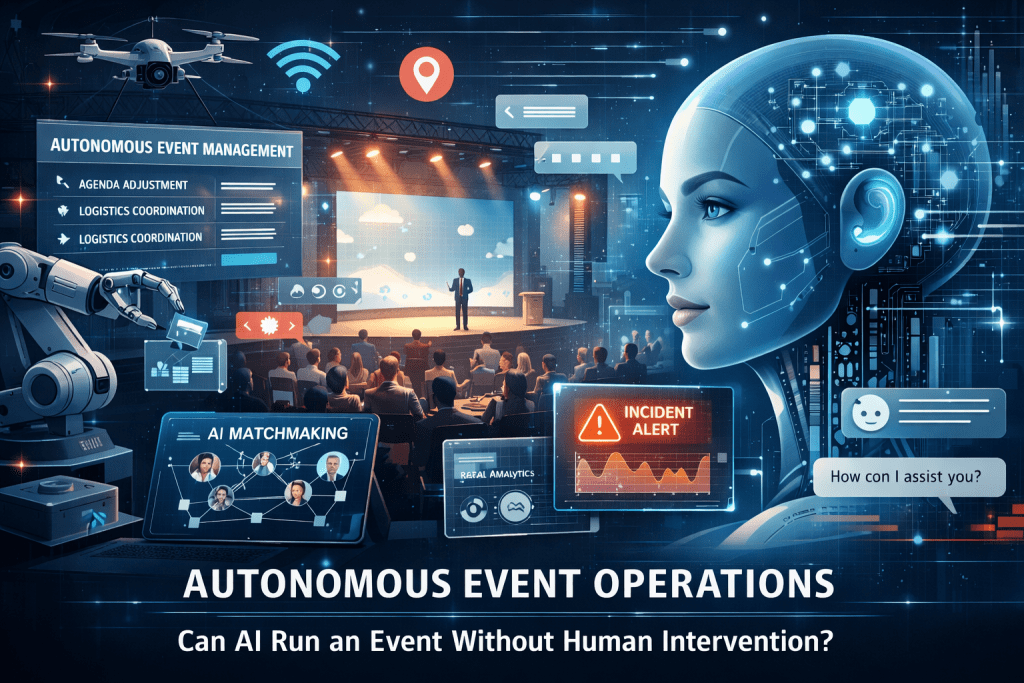
Introduction: From Assisted Automation to Autonomous Orchestration
The event technology ecosystem has evolved from digitizing manual workflows to enabling intelligent automation across the event lifecycle. Registration platforms, mobile apps, matchmaking engines, and analytics dashboards have already reduced operational overhead for organizers. The next frontier—autonomous event operations—raises a more complex question: can artificial intelligence (AI) independently plan, execute, and optimize events without human intervention?
This concept goes beyond isolated automation. It involves interconnected AI systems capable of decision-making across logistics, attendee engagement, content delivery, and real-time problem resolution. While elements of autonomy already exist in pockets—such as AI-driven networking or dynamic agenda recommendations—the idea of a fully self-operating event requires a deeper examination of technical feasibility, system architecture, and operational constraints.
This article explores whether current and emerging event technologies can support fully autonomous event operations, and what it would take to get there.
Defining Autonomous Event Operations
Autonomous event operations refer to a system in which AI agents manage end-to-end event functions with minimal or no human oversight. These functions include:
-
Event planning and scheduling
-
Vendor coordination and logistics management
-
Attendee onboarding and personalization
-
Real-time engagement and networking facilitation
-
Incident detection and response
-
Post-event analytics and reporting
Unlike traditional automation, which executes predefined workflows, autonomy requires adaptive decision-making based on dynamic inputs. This involves continuous data ingestion, contextual understanding, and predictive reasoning.
Core Technology Stack Enabling Autonomy
1. Data Infrastructure and Event Data Models
At the foundation of any autonomous system lies a unified data layer. Events generate heterogeneous data streams:
-
Registration and CRM data
-
Behavioral data from mobile apps and platforms
-
IoT signals from venue infrastructure (RFID, BLE beacons, sensors)
-
Content interaction data (sessions attended, questions asked)
To enable autonomy, these data sources must be normalized into a common event data model. This often involves:
-
Real-time data pipelines (e.g., Kafka-based streaming architectures)
-
Event-driven architectures (EDA) to trigger AI workflows
-
Data lakes or warehouses for historical analysis
Without a robust data backbone, AI systems cannot maintain situational awareness.
2. AI Decision Engines and Multi-Agent Systems
Autonomous event operations rely on multiple specialized AI agents working in coordination. These may include:
-
Scheduling agents optimizing session timing and room allocation
-
Engagement agents personalizing attendee journeys
-
Logistics agents managing inventory, staffing, and vendor coordination
-
Support agents handling attendee queries via conversational interfaces
These agents must operate within a shared decision framework. Multi-agent systems (MAS) are increasingly being explored, where:
-
Agents communicate via APIs or message brokers
-
Decisions are coordinated through a central orchestration layer
-
Reinforcement learning models optimize outcomes over time
The challenge is not individual intelligence, but collective coordination.
3. Integration Layer and API Ecosystem
Autonomy requires seamless integration across platforms:
-
Registration systems
-
Event apps
-
CRM and marketing automation tools
-
Venue management systems
-
Payment gateways
An API-first architecture is essential. Key considerations include:
-
Standardized data schemas
-
Webhook-driven event triggers
-
Low-latency communication between services
Middleware platforms or integration hubs often act as the glue, enabling AI agents to interact with disparate systems in real time.
4. Edge Computing and IoT Integration
Physical events introduce complexity that digital environments do not. AI systems must interpret real-world signals:
-
Crowd density via sensors
-
Session attendance via RFID or QR scans
-
Environmental data (temperature, lighting, noise levels)
Edge computing enables localized processing of these signals, reducing latency and enabling immediate responses, such as:
-
Redirecting attendees to less crowded sessions
-
Adjusting room conditions dynamically
-
Triggering alerts for safety concerns
5. Conversational Interfaces and Natural Language Processing
Autonomous systems must interact with humans in intuitive ways. Conversational AI plays a critical role in:
-
Attendee support (chatbots, voice assistants)
-
Speaker coordination
-
Vendor communication
Advanced NLP models enable:
-
Context-aware responses
-
Multilingual support
-
Sentiment analysis for real-time feedback
These interfaces act as the human-facing layer of an otherwise machine-driven operation.
System Architecture for Autonomous Events
A typical architecture for autonomous event operations can be conceptualized in four layers:
Data Layer
-
Real-time ingestion (streaming + batch)
-
Unified data model
-
Storage (data lake/warehouse)
Intelligence Layer
-
Machine learning models (prediction, classification, recommendation)
-
Reinforcement learning for optimization
-
Multi-agent coordination framework
Orchestration Layer
-
Workflow engines
-
Decision orchestration
-
API gateway and integration middleware
Experience Layer
-
Event apps
-
Chat interfaces
-
Dashboards for monitoring (if human oversight is retained)
This layered architecture ensures modularity and scalability while enabling real-time responsiveness.
Real-World Applications and Partial Autonomy
While fully autonomous events are not yet mainstream, several use cases demonstrate partial autonomy:
Dynamic Agenda Optimization
AI systems can adjust session schedules based on:
-
Real-time attendance patterns
-
Engagement metrics
-
Speaker availability
For example, under-attended sessions can be merged or rescheduled automatically.
Intelligent Crowd Management
Using sensor data, AI can:
-
Predict congestion نقاط
-
Suggest alternative routes or sessions
-
Trigger notifications to attendees
This has been piloted in large-scale conferences and exhibitions.
Automated Networking and Matchmaking
AI-driven matchmaking engines analyze:
-
Attendee profiles
-
Behavioral signals
-
Interaction history
They can autonomously schedule meetings, suggest connections, and even adjust recommendations in real time.
Incident Detection and Response
Autonomous systems can identify anomalies such as:
-
Equipment failures
-
Delays in session start times
-
Safety risks
AI agents can trigger corrective actions, such as reallocating resources or notifying stakeholders.
Operational and Business Impact
Efficiency Gains
Autonomous systems reduce manual coordination, enabling:
-
Lower staffing requirements
-
Faster decision-making
-
Reduced human error
Scalability
AI-driven operations can scale across multiple events simultaneously, particularly for organizations managing global event portfolios.
Personalization at Scale
Autonomy enables hyper-personalized experiences without proportional increases in operational complexity.
Data-Driven Optimization
Continuous learning systems improve performance over time, leading to better ROI and attendee satisfaction.
Challenges and Constraints
Data Quality and Fragmentation
Autonomous systems are only as good as the data they consume. Inconsistent or incomplete data can lead to suboptimal decisions.
Interoperability Issues
Many event technology platforms lack standardized APIs, making integration complex and brittle.
Trust and Accountability
Delegating critical decisions to AI raises questions:
-
Who is accountable for failures?
-
How are decisions audited?
Explainability and transparency become essential.
Ethical and Privacy Concerns
Autonomous systems rely on extensive data collection, including behavioral and location data. Compliance with regulations and ethical standards is non-negotiable.
Edge Cases and Unpredictability
Events are inherently dynamic. Unexpected situations—weather disruptions, speaker cancellations, technical failures—require nuanced judgment that AI may struggle to replicate fully.
Future Outlook: Towards Hybrid Autonomy
Fully autonomous events—without any human intervention—remain unlikely in the near term. However, a hybrid model is emerging:
-
AI handles routine, data-driven decisions
-
Humans oversee strategic, ethical, and high-stakes decisions
Advancements that will accelerate autonomy include:
-
More robust event data standards
-
Improved multi-agent coordination frameworks
-
Better integration between physical and digital event systems
-
Advances in explainable AI
The concept of “human-on-the-loop” rather than “human-in-the-loop” is gaining traction, where humans supervise rather than directly control operations.
Conclusion: Autonomy as Augmentation, Not Replacement
The question is not whether AI can run an event entirely on its own, but whether it should. Autonomous event operations offer significant efficiency and scalability benefits, but they also introduce complexity, risk, and ethical considerations.
In practice, the most effective model is one where AI augments human capabilities—handling data-intensive, repetitive, and time-sensitive tasks—while humans provide oversight, creativity, and contextual judgment.
As event technology continues to mature, autonomy will become an integral component of event operations. However, complete human absence is neither necessary nor desirable. The future lies in intelligent collaboration between humans and machines, not in full replacement.