


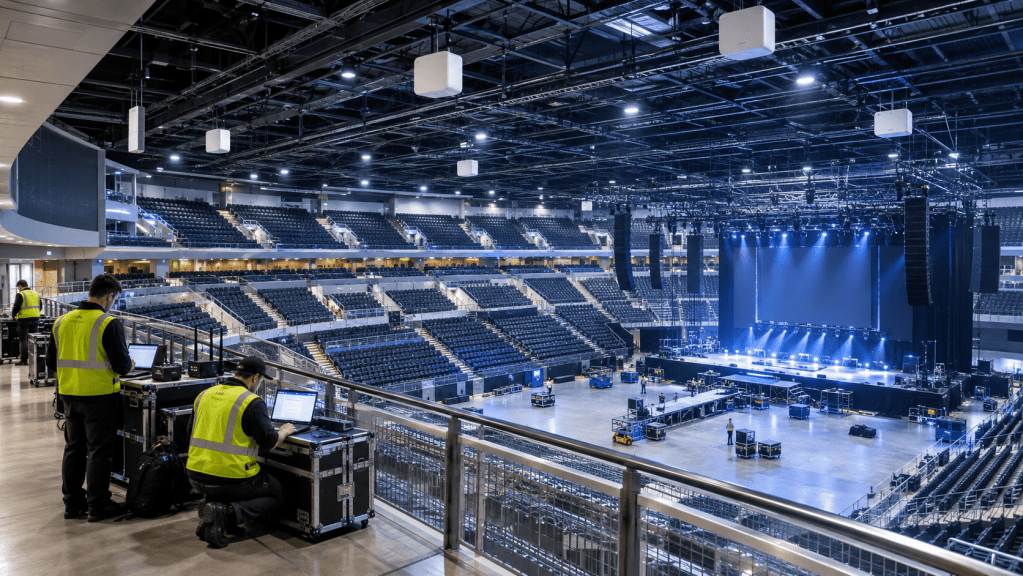
Vodafone Business has entered a new technology partnership with Manchester arena Co-op Live, deploying dedicated 5G and 4G coverage across the venue to bolster mobile connectivity for visitors and event operations.
The upgrade is designed to deliver stronger and faster mobile performance inside what is billed as the UK’s next-generation live entertainment arena, supporting large audiences and data-intensive event experiences.
Technology Partnership between Vodafone Business and Co-op Live Arena
The collaboration sees Vodafone Business, the enterprise arm associated with VodafoneThree, take responsibility for enhancing the arena’s mobile infrastructure. The agreement focuses on providing robust, high-capacity connectivity tailored to the demands of large-scale live events.
Under the partnership, Co-op Live gains access to dedicated 5G and 4G networks installed throughout the building. The deployment aims to ensure more reliable coverage and increased data throughput in all key areas of the venue, including bowl seating, concourses, hospitality zones, and operational spaces.
Deployment of Dedicated 5G and 4G Coverage throughout Venue
The installation of venue-wide dedicated 5G and 4G is intended to address the connectivity challenges commonly associated with high-density live entertainment environments. With thousands of attendees simultaneously using mobile devices, arenas place considerable strain on traditional public networks.
By implementing dedicated infrastructure within Co-op Live, Vodafone Business and Co-op Live intend to offer a more consistent service level when the arena is at capacity. The system is designed to support activities such as real-time content sharing, mobile ticket access, digital payments, and app-based services used by visitors during events.
The enhanced network is also expected to improve connectivity for the arena’s own teams and partners. In-venue operations that may rely on mobile communications, cloud-based tools, and connected devices stand to benefit from the strengthened signal and increased bandwidth.
Support for Visitor Experience and Event Operations
As the arena positions itself as a next-generation live entertainment destination, the connectivity upgrade is framed as a core component of the overall visitor experience. Reliable mobile access underpins a wide range of touchpoints, from entry to post-event engagement.
For attendees, dedicated 5G and 4G coverage can enable smoother use of digital tickets and passes on arrival, reducing friction at access points. Once inside, guests are better placed to share photos and video, interact with event-related content, and stay connected with companions across the venue.
Stronger connectivity also supports cashless and contactless services, which are increasingly embedded in arena food, beverage, and merchandise operations. Point-of-sale systems that depend on consistent mobile data can be more resilient when backed by infrastructure designed specifically for the venue environment.
For production teams, technical crews, and venue management, the network investment offers additional capacity for communications and coordination. Whether used for production logistics, security and safety communications, or integration with digital signage and control systems, reliable mobile infrastructure can contribute to the smooth running of large events.
Co-op Live Arena Position in UK Live Entertainment Market
Co-op Live is positioned as a next-generation live entertainment arena in Manchester, designed to host concerts, shows, and large-scale events. The venue is part of a broader wave of investment in arena infrastructure, where digital services and mobile connectivity are viewed as integral to operations.
The collaboration with Vodafone Business aligns the arena with an enterprise-grade connectivity partner focused on meeting the needs of business and venue clients. This includes the requirement to handle surges in traffic during peak event moments and to support emerging digital services that rely on high-speed, low-latency connections.
While specific performance metrics for the newly installed network are not disclosed, the emphasis on dedicated 5G and 4G suggests a move beyond relying solely on external public networks. Instead, Co-op Live gains a tailored mobile environment built with live events and crowd density in mind.
Role of Vodafone Business in Venue Connectivity
Vodafone Business provides enterprise connectivity solutions across a range of sectors, including venues and live event environments. Its involvement at Co-op Live extends this activity into one of the UK’s prominent new arenas.
The partnership highlights a continuing trend in the live events and venue technology space, where operators seek closer engagement with connectivity providers to address specific operational and audience needs. For Vodafone Business, the project demonstrates how dedicated infrastructure can be applied to arenas that host frequent, large-scale gatherings.
Within Co-op Live, the deployment is focused on delivering mobile coverage that can scale with audience size and event complexity. This approach reflects the growing expectation that connectivity should be an embedded feature of the live experience rather than an external afterthought.
Implications for Event Organiser and Attendee Connectivity
As live events increasingly incorporate digital components, the availability of reliable 5G and 4G coverage has become a key consideration for organisers and promoters selecting venues. Co-op Live’s network enhancement provides an additional selling point for event planners seeking to integrate connected experiences into their shows.
For attendees, the strengthened infrastructure is intended to reduce the likelihood of dropped connections or slow data speeds in busy periods, such as pre-show build-up, interval breaks, and post-show departures. In practice, this can influence overall satisfaction with both the venue and the event itself.
The partnership between Vodafone Business and Co-op Live therefore sits at the intersection of telecommunications and event technology, illustrating how targeted network investment can support both the operational backbone of an arena and the expectations of connected audiences.

