


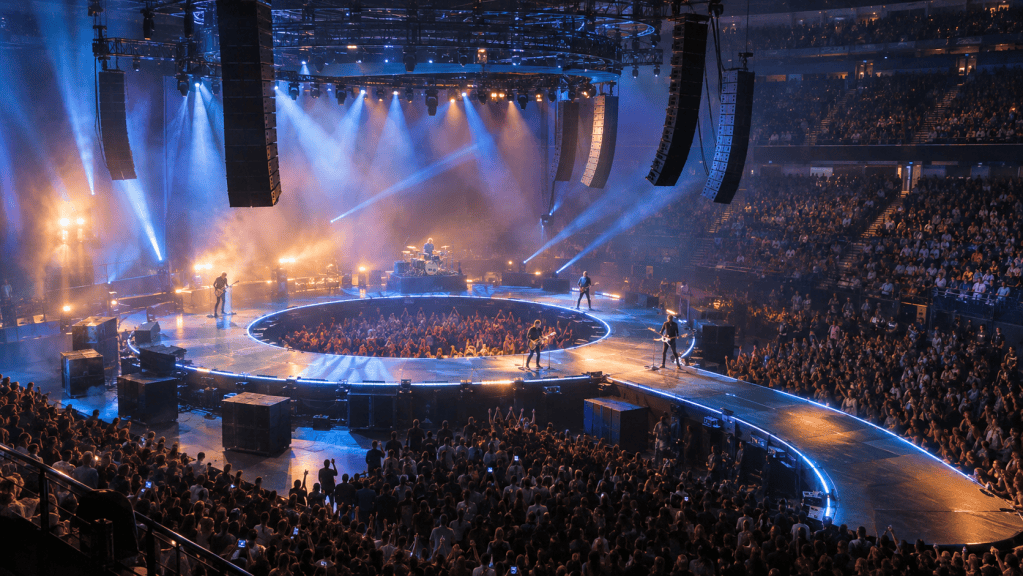
L-Acoustics K Series system follows Ring Stage around Global Tour
5 Seconds of Summer’s Everyone’s a Star! World Tour is putting an unconventional 75-foot ring stage and a VIP pit at the center of its sound strategy, with UK Certified Provider Adlib deploying a flexible L-Acoustics K Series system and early access to Source Intelligence processing to maintain clarity and coverage across arenas and amphitheatres worldwide.
The tour, which opened at the SSE Arena Belfast on 26 March and runs through December, spans UK and European arenas, North American arenas and amphitheatres, and dates in South America, Australia, New Zealand and Asia. Capacities range from 8,000 to 20,000, demanding a touring sound system that can scale without compromising the mix or the fan experience.
Stage geometry reshapes sound system design brief
The show’s stage departs from a conventional rectangular layout. The 75-foot-wide structure forms a ring, with the band performing on the upstage half against a curved video wall. The downstage half becomes a curved thrust that arcs out into the room, terminating in a second drum kit on an automated lift.
Inside that ring sits a VIP pit, placing part of the audience within the performance space itself. At the same time, all four band members trade lead vocals as they move along the thrust, while an acoustic drum kit at full volume anchors the mainstage. The production also ruled out a centre cluster to protect sightlines to the video wall, forcing the sound design to deliver immersive coverage without a traditional central hang.
Adlib audio systems engineer Billy Bryson, who has toured with 5 Seconds of Summer since 2020, responded by treating the VIP pit as an acoustic environment of its own. The system is engineered so that the pit receives the high-energy impact of a small, intimate club, while coverage along the thrust and out into the bowl remains controlled and distinct, limiting spill between zones.
L-Acoustics platform and Specialist Systems Engineer partnership
Front of house engineer Sebastien Teti mixes the tour, having joined the camp after previously working with the band’s drummer, Ashton Irwin, on a solo project in Los Angeles. When production management consulted him on the choice of sound system, Teti focused as much on people as on product.
He cites the sonic character of the L-Acoustics platform as a key factor, describing it as musical, natural and transparent, with system processing that does not fight against his mix. Just as important was the presence of a dedicated Systems Engineer with deep experience on the brand’s ecosystem. The collaboration with Bryson, who specializes in L-Acoustics deployments, underpins daily consistency as the show moves between venue formats and countries.
Source Intelligence manages four roaming Lead Vocal channel
The complexity of the ring stage and moving performers also made the tour an early adopter of L-Acoustics Source Intelligence. The technology, which officially launched in May 2026, was already running on the show during its design phase and early dates.
Source Intelligence applies a machine learning source separation algorithm directly to vocal channels in real time. It reduces crowd noise, instrument bleed and PA spill around the vocal by up to 40 dB, enabling clearer, more intelligible speech and singing in challenging acoustic conditions.
On Everyone’s a Star!, four simultaneous instances of Source Intelligence are deployed, mirroring the band’s four roaming lead vocals as they move along the thrust in front of an exceptionally loud acoustic drum kit. For Teti, the combination of Source Intelligence with Adlib’s L-Acoustics rig has fundamentally changed how he manages vocal clarity compared with previous workflows.
K Series system scales between Arena and Amphitheatre venue
A key design goal was to keep the system’s sonic character consistent as the tour shifts between indoor arenas and outdoor amphitheatres. Bryson used L-Acoustics Soundvision modelling and the modularity of the K Series family to ensure the overall architecture remains familiar while box counts and settings adapt to each room.
The main hangs can comprise up to 14 K1 and four K2 per side. K2 Panflex fins are configured to minimise energy spilling onto the thrust, preserving definition for both the band and the audience inside the ring. Up to eight K1-SB per side fly directly behind the mains, with both quantity and low-frequency steering updated show by show so that sub coverage is tailored to each venue’s geometry.
Side hangs of up to 16 K2 per side extend coverage out to approximately 180 degrees, ensuring that seats far around the bowl maintain tonal consistency with the main system.
Dedicated coverage for VIP Pit and Ring Stage perimeter
To serve the VIP pit and the inner ring area, Bryson specified a dedicated in-fill and nearfield network. A hang of four Kara II per side, flown inboard of the mains, delivers stereo coverage into the pit, again with Panflex used to keep energy away from the thrust and mainstage.
Low-frequency reinforcement is handled by eighteen KS28 mounted on Adlib’s custom touring dollies. These subs are typically deployed in end-fired arrays at the outer edges of the circle, with four KS28 placed centrally to energise the VIP pit. Two A15 boxes travel on the same dollies as additional out-fills, supplemented by two X12 loudspeakers for utility roles.
Closer to the audience, ten X8 units provide front-fill from the downstage lighting shelf into the VIP pit. A further eight X8 on custom brackets line the outside of the thrust, delivering nearfield imaging and intimacy during B-stage segments when performers move deeper into the audience.
Amplification and Processing backbone supports daily consistency
In larger venues that require it, the tour adds system delays using four hangs of six K2 with a flown LARAK II, extending coverage to the back of expansive arenas or amphitheatres. Teti monitors his mix on two X8 and an SB18 powered by an LA4X, mirroring the L-Acoustics tonal profile experienced by the audience.
Overall system power is provided by thirty-two LA12X amplifiers housed largely in Adlib’s triple-wide touring racks positioned each side of the stage. Another LARAK II under the stage drives VIP and thrust fills. Core processing is handled by five P1 processors and an L-ISA Processor II, which hosts the Source Intelligence engine.
For Bryson, the integrated L-Acoustics toolset, from Soundvision modelling to amplification and processing, directly translates into day-to-day reliability. The approach enables fine-tuning for each room while preserving a consistent tonal signature as the production transitions between indoor and outdoor environments in markets such as the US.
Festival deployment shows Mix translation across K Series rig
The robustness of the system design and mix approach was tested on festival stages where Adlib’s touring rig was not in play. Two festival dates required the production to work on resident L-Acoustics configurations, including a K2 deployment and a large K1, K2 and K-Sub system on the main stage at Lollapalooza in Chicago.
Those shows were run on rigs specified by the festival rather than by Adlib, as is standard for all artists on that site. Nonetheless, Teti reports that his front of house mix translated smoothly from the touring system to these festival infrastructures, reinforcing the value of staying within the same loudspeaker family and control environment.
As the Everyone’s a Star! World Tour continues, feedback from the band, management and fans has highlighted the reliability, clarity and consistency of the L-Acoustics and Adlib solution, even in some of the most acoustically demanding rooms on the itinerary.

