


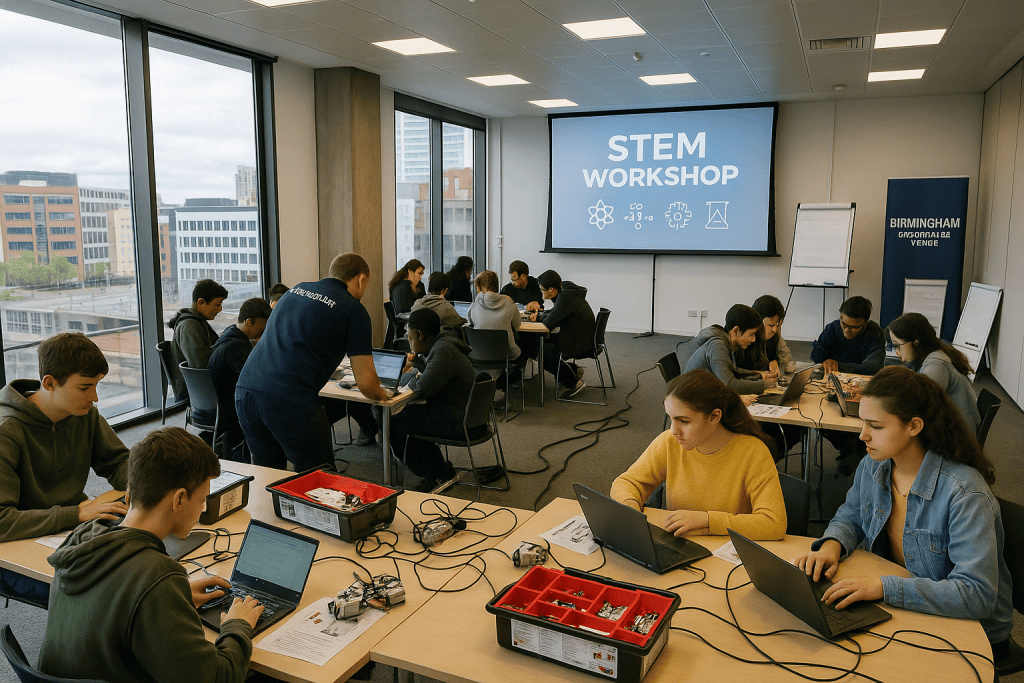
Millennium Point in Birmingham has concluded a multi-week STEM-focused summer camp that brought together 122 young people from across the West Midlands. The programme, delivered by Digital Innovators and supported by Veolia UK, was designed to help participants develop confidence, teamwork and problem-solving skills through hands-on activities hosted at the city-centre venue.
Running over four weeks, the initiative demonstrates how event and conference venues are increasingly being used as platforms for skills development and community engagement, particularly around science, technology, engineering and mathematics (STEM). The camp forms part of an ongoing drive to expose young people to practical learning experiences in professional environments, rather than purely classroom-based settings.
Background: venues as learning environments
Event venues have been broadening their role beyond traditional conferences and exhibitions, with many now incorporating education, skills and outreach programmes into their annual calendars. In the UK, this trend is particularly visible in city-centre venues linked to science and technology, which are increasingly hosting hackathons, coding clubs, innovation labs and youth-focused workshops.
Millennium Point, known for its mix of public, commercial and educational spaces, has been part of this shift by providing facilities and support for STEM-related activity. The summer camp reflects a wider industry push to make event infrastructure more accessible to local communities while helping address regional skills gaps. For the West Midlands, where advanced manufacturing, engineering and digital industries are key economic drivers, initiatives that introduce young people to STEM pathways are seen as strategically important.
Key developments from the summer camp
The summer camp at Millennium Point was structured as a series of sessions over four weeks, enabling the 122 participants to work in groups, tackle challenges and build soft skills alongside technical understanding. While full programme details have not been publicly itemised, organisers positioned the camp around three core outcomes: building confidence, improving teamwork and enhancing problem-solving abilities.
Digital Innovators, which led the delivery, specialises in programmes that connect young people with real-world challenges and project-based learning. Its involvement suggests the camp likely combined practical tasks with collaborative projects and presentations, using the venue’s facilities to simulate workplace-style environments. Veolia UK’s support points to potential thematic links around sustainability, resource management or environmental STEM topics, although specific project briefs have not been disclosed.
Hosting the camp within a professional event setting provided access to larger spaces, AV capabilities and flexible rooms more commonly used for conferences and exhibitions. This kind of environment can help young attendees become more familiar with the types of spaces used for industry events, corporate training and tech showcases, reinforcing the connection between their learning experience and future professional contexts.
Industry impact for venues and organisers
For the events sector, programmes like this summer camp highlight a growing intersection between venue operations, corporate partners and education providers. By opening doors to youth-focused STEM activities, venues can demonstrate social value and support regional skills strategies, while also diversifying their event portfolios.
From an operational viewpoint, running structured, multi-week camps during quieter periods can help venues optimise usage outside of peak conference seasons. It also encourages partnerships with organisations such as training providers, universities, local authorities and private-sector sponsors. For suppliers and technology providers, these initiatives can create new demand for hardware, software and interactive tools that support experiential learning.
There is also a reputational dimension. Venues associated with long-term STEM and skills initiatives can strengthen their brand with corporate clients that have their own ESG (environmental, social and governance) commitments. Sponsors and partners, in turn, gain visibility within local communities and among future talent pools, reinforcing their positioning around innovation and sustainability.
Why this matters for event professionals and tech providers
Event professionals planning conferences, trade shows or hybrid gatherings in STEM-related fields are increasingly expected to demonstrate impact beyond the event itself. Youth camps and skills programmes illustrate one way venues and organisers can extend their influence, building pipelines of future attendees, speakers and employees.
For planners, the Millennium Point summer camp model underscores several opportunities:
- Legacy and community engagement: Embedding youth or education strands into venue calendars can help events leave a tangible legacy in host regions, particularly when aligned with local industry priorities.
- Content development: Insights from youth programmes can feed into conference agendas, panel themes or innovation showcases, especially around future workforce and skills topics.
- Partnership models: Collaborations between venues, delivery partners like Digital Innovators and corporate supporters such as Veolia UK provide a framework for shared funding, resourcing and impact measurement.
Technology providers supplying event platforms, engagement tools or interactive installations can also benefit. Programmes focused on problem-solving and teamwork rely on tools for collaboration, ideation and presentation, from simple AV setups to immersive digital environments. The same infrastructure used for professional events can be adapted for education-focused experiences, creating an additional use case and demonstrating versatility to venue clients.
As hybrid and in-person events continue to evolve, integrating educational components that appeal to younger demographics may become more common. For technology partners, this means designing solutions that are intuitive for first-time users, robust enough for repeated use over several weeks, and flexible across corporate and educational formats.
Conclusion
The STEM summer camp at Millennium Point, delivered by Digital Innovators with support from Veolia UK, showcases how an established event venue can play a direct role in youth development and skills building. By hosting 122 young people over four weeks, the Birmingham site has demonstrated the potential for event infrastructure to support structured learning experiences alongside its core conference and exhibition activities.
For the broader event technology and venue community, the initiative offers a practical example of how spaces, partners and programmes can be combined to address regional STEM skills needs while creating new event formats and revenue streams. As more venues explore similar collaborations, the line between traditional events, education and community engagement is likely to continue to blur, opening up new opportunities for organisers and technology providers focused on long-term impact.