


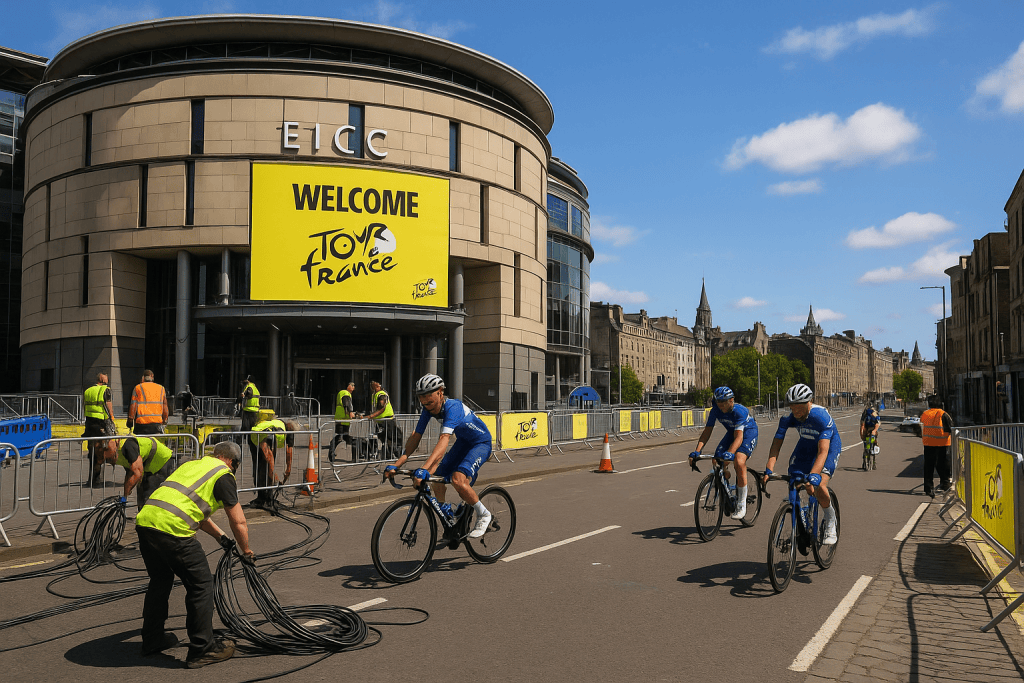
Edinburgh is set to take a prominent place on the global sporting stage in 2027 as the Tour de France makes its first ever start in Scotland, with the Edinburgh International Conference Centre (EICC) confirmed to play a key operational role in supporting the event.
The world-renowned cycling race, widely considered the biggest annual sporting event by audience reach, will begin in Edinburgh before continuing through other UK locations. As part of the host city’s infrastructure, the EICC will be used as a central hub in the delivery of race operations, bringing a major international sports footprint into a venue best known for conferences, exhibitions, and business events.
Background and industry context
The Tour de France has a long history of starting outside its home nation, using overseas “Grand Départ” stages to strengthen international visibility and economic impact. Previous starts have taken place in cities such as London, Düsseldorf, Brussels, and Copenhagen, where local authorities and venues have had to adapt their event infrastructure to handle a high volume of media, teams, sponsors, and support services.
For destination cities, hosting the initial stages of the race goes far beyond sport. It involves complex planning across transportation, security, hospitality, and media operations, often requiring large, flexible venues capable of handling accredited personnel, broadcast facilities, command centres, and stakeholder meetings. For venues that typically focus on conferences and exhibitions, these events provide an opportunity to showcase their operational resilience and technology stack in a different context.
Edinburgh’s selection as the first Scottish starting point marks a significant moment for both the city and the UK events sector. It highlights growing convergence between business events infrastructure and large-scale leisure and sporting events, where the same capabilities that support global congresses—broadcast connectivity, delegate management systems, and resilient venue operations—are increasingly redeployed for sports and citywide festivals.
Key developments and the 2027 announcement
The EICC has confirmed that it will support the operational delivery of the 2027 Tour de France when the race arrives in the UK. While detailed plans are still to be fully disclosed, the venue is expected to be integrated into the event’s logistical and organisational setup, providing space and services for core race-related functions.
Typical roles for a major venue in this context can include:
- Accreditation and registration areas for teams, media, officials, and partners
- Operational headquarters or temporary command centres for race organisers and local agencies
- Media and broadcast workspaces, including press rooms, interview zones, and content production areas
- Stakeholder, sponsor, and VIP hospitality functions
- Meeting and planning rooms for security, transport, and medical coordination
As a purpose-built conference and events venue, the EICC brings an established infrastructure for connectivity, hybrid event support, and technical production. These capabilities are increasingly important for internationally broadcast sports events where real-time communication, content distribution, and multi-stakeholder coordination are critical.
The announcement also reinforces Edinburgh’s status as a host city able to support complex, large-scale events that operate across multiple venues and public spaces. With the Tour de France attracting extensive global media coverage and significant spectator numbers, the city’s event ecosystem – including hotels, transport links, temporary structures, and digital platforms – is expected to play a central role in overall delivery.
Industry impact for venues and host cities
For the business events and venue technology community, the EICC’s involvement in the 2027 Tour de France underlines a wider trend: convention centres are increasingly being used as multi-purpose infrastructure for high-profile, citywide projects. Their experience in handling international audiences, high volumes of data, and multi-day programmes makes them natural partners for sports organisers looking for robust, tech-enabled bases of operation.
Hosting responsibilities for events of this scale often catalyse investment in connectivity, wayfinding, digital signage, security systems, and crowd management tools — all of which can then benefit future conferences and trade shows. Similar past events in other cities have led to upgrades in broadcast networks, streaming capabilities, and media production spaces within venues, blurring the lines between traditional conference centres and live production hubs.
Edinburgh’s role in the 2027 race is also likely to encourage closer collaboration between city authorities, transport providers, hospitality partners, and the local events industry. Coordinating road closures, fan zones, hospitality packages, and media operations requires integrated planning and the ability to share data and schedules across multiple organisations. Venues such as the EICC typically sit at the centre of that coordination, using their operational expertise and technology platforms to align stakeholders.
Why this matters for event professionals and technology providers
For event planners, production agencies, and technology suppliers, the 2027 Tour de France start in Edinburgh highlights several important considerations:
- Cross-sector opportunities: Business events professionals and suppliers may find new roles in sports and citywide event delivery, from accreditation systems and mobile apps to broadcast support and VIP experiences.
- Scalability of event tech: Platforms designed for conferences – registration tools, attendee management systems, live streaming, and analytics – are increasingly being tested at city scale, supporting tens of thousands of stakeholders and global audiences.
- Operational resilience: The ability of venues to maintain connectivity, security, and clear communication during high-profile events is becoming a differentiator when bidding for major international projects.
- Legacy benefits: Investments made to support the Tour de France, whether in venue infrastructure, transport coordination, or digital wayfinding, can strengthen Edinburgh’s long-term attractiveness for future congresses and exhibitions.
- Hybrid content potential: The media footprint of a global race offers opportunities to experiment with hybrid formats, complementary conferences, partner events, and fan engagement initiatives that combine in-person and digital elements.
Technology providers that already service the conference and exhibition sector may see the 2027 race as a showcase for their platforms, whether through enhanced Wi-Fi and networking, media management systems, or real-time data dashboards for event control teams.
Conclusion
The decision to start the 2027 Tour de France in Edinburgh, with the EICC playing a substantive role in operations, signals a notable intersection of elite sport and the business events sector. It demonstrates how established conference venues can support complex, high-visibility projects beyond their traditional remit, leveraging existing infrastructure and expertise to meet the demands of a global sporting audience.
As planning progresses, the event is likely to serve as a case study in how destination cities and their venues can integrate technology, operations, and stakeholder management at scale. For event professionals and suppliers, it reinforces the importance of adaptable infrastructure, cross-sector collaboration, and robust digital capabilities when competing for and delivering the next generation of major international events.

