


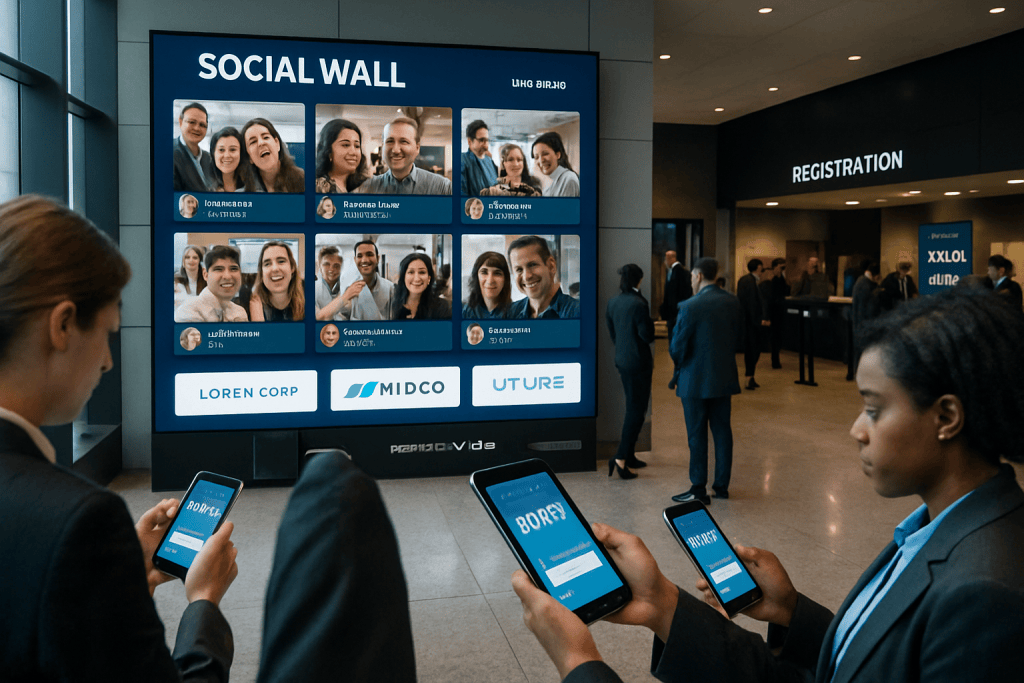
EventMobi has announced a new integration with social wall provider Walls.io, enabling organisers to surface attendee-generated content directly within EventMobi’s mobile event app and digital signage. The move is designed to make social feeds more visible and contextual by embedding them alongside programme information, sponsor messaging and real-time event updates.
While social media has long played a role in conferences, trade shows and corporate events, organisers are increasingly seeking ways to connect on-site and remote participants in a single, curated content layer. By linking EventMobi’s engagement tools with Walls.io’s aggregation and display capabilities, organisers can now showcase live posts, photos and reactions on the same screens attendees already rely on during an event.
Background and industry context
Event technology platforms have evolved from basic scheduling and registration tools into multi-layer engagement environments, particularly as hybrid and virtual formats have expanded. Attendees expect to participate in conversations across multiple channels, from in-app chat and Q&A to public social media platforms like X, LinkedIn and Instagram.
At the same time, event organisers are under pressure to demonstrate engagement metrics to sponsors and stakeholders, while maintaining control over the content surfaced at their events. Social walls – curated displays that aggregate posts using event hashtags, handles or specific sources – have become a standard feature at many conferences and exhibitions, often shown on large-format screens, stage displays or in expo halls.
Historically, social walls and event apps have sometimes operated as separate systems, each with its own interface and management workflows. This separation can mean additional setup effort for organisers and a fragmented experience for attendees, who may not immediately see how their posts contribute to the live event narrative. Integrations between event platforms and social wall providers aim to close this gap by centralising content flows and moderation processes.
Key developments in the integration
The integration between EventMobi and Walls.io connects Walls.io’s live social wall functionality directly into EventMobi’s Mobile Event App and its Live Display product. In practice, this allows organisers to:
- Embed a real-time social wall inside the EventMobi mobile app, giving attendees a dedicated space to view and contribute to the event’s social conversation.
- Display attendee posts, images and reactions on EventMobi’s Live Display screens, which are commonly used for agendas, room changes, sponsor rotations and on-site announcements.
- Highlight content from multiple social networks – and potentially in-app submissions, where supported – within a single visual feed curated by the organiser.
By unifying this content inside the app and on shared displays, the integration is intended to amplify attendee voices without requiring participants to switch between separate systems or interfaces. Posts using the designated event hashtag or configured social sources can appear alongside practical information such as session start times or sponsor campaigns.
For organisers, the connection is designed to streamline setup and reduce manual work. Instead of configuring a standalone social wall and then separately configuring in-app content blocks or display loops, the integration allows Walls.io’s feed to be dropped into existing EventMobi layouts. Moderation and curation workflows remain under organiser control, enabling them to approve, filter or remove posts as needed.
Potential industry impact
As events continue to blend in-person and digital experiences, the ability to surface real-time attendee commentary across touchpoints is becoming a differentiator. Integrations of this type could influence how organisers plan content strategies, design venue layouts and measure engagement.
For sponsors and exhibitors, the presence of integrated social walls within the main event app and on key venue screens offers additional visibility. Sponsored hashtags, contests or calls-to-action can be tied directly to the live feed, creating a feedback loop where participant activity fuels on-screen content, which in turn encourages more contributions.
From a data perspective, consolidating social interactions into the wider event technology stack can give organisers a more holistic view of engagement. While details on analytics in this specific integration are not fully disclosed, many event platforms use similar connections to correlate session attendance, app usage and social activity. This can help organisers understand which topics drive the most discussion, when peaks in interaction occur and how different audience segments respond.
The integration also reflects a broader trend of event platforms partnering with specialist providers rather than building every feature in-house. By connecting to a dedicated social wall platform, EventMobi can offer more advanced aggregation and display capabilities while focusing its own development effort on core event management and engagement tools.
Why this matters for event professionals and technology providers
For event organisers, especially those managing large conferences, trade fairs or multi-track corporate meetings, consolidating tools can simplify operations. An integrated social wall removes the need for separate procurement, setup and on-site support for that component, reducing the risk of disconnected experiences for attendees.
Key considerations for planners evaluating this type of integration include:
- Audience visibility: Positioning social walls within the primary event app and on prominent displays increases the likelihood that attendees will see – and interact with – the live conversation.
- Content control: Curated feeds with moderation capabilities help maintain brand standards and mitigate the risk of inappropriate or off-topic content appearing on large screens.
- Engagement design: Organisers can incorporate calls-to-share into session formats, gamification elements or networking activities, knowing that contributions can be surfaced across multiple channels.
- Hybrid alignment: Remote participants can still contribute via social platforms, with their content appearing in the same feeds as on-site attendees, supporting a unified event narrative.
For technology providers, the announcement underlines the importance of interoperability within the event tech ecosystem. Platforms that expose APIs or build structured integrations can become part of a broader workflow, increasing their relevance to organisers who prioritise automation and centralised management.
Vendors on both sides of such partnerships benefit from extended reach: event app providers can offer richer feature sets without diluting focus, while specialist tools such as social walls gain access to installed user bases through pre-built connections.
Conclusion
The integration of Walls.io’s social wall capabilities into EventMobi’s mobile app and Live Display products is another step in the ongoing convergence of event engagement tools. By bringing attendee posts and reactions into the same environment as schedules, sponsor messages and operational updates, organisers can present a more cohesive and participatory experience.
As events continue to evolve with hybrid formats and demand for measurable engagement, streamlined connections between core platforms and specialised tools are likely to play a growing role. For planners, the development offers an additional option to highlight attendee voices across the event footprint, while maintaining control over how and where that content appears.