


Introduction
Product demonstrations remain one of the most influential activities on an exhibition floor. Whether showcasing industrial equipment, medical devices, consumer electronics, luxury goods, or emerging technologies, exhibitors depend on demonstrations to convert curiosity into meaningful sales conversations. Yet physical demonstrations have inherent limitations. Products may be too large to transport, too fragile for repeated handling, still in development, or incapable of revealing their internal components and operating principles without disassembly.
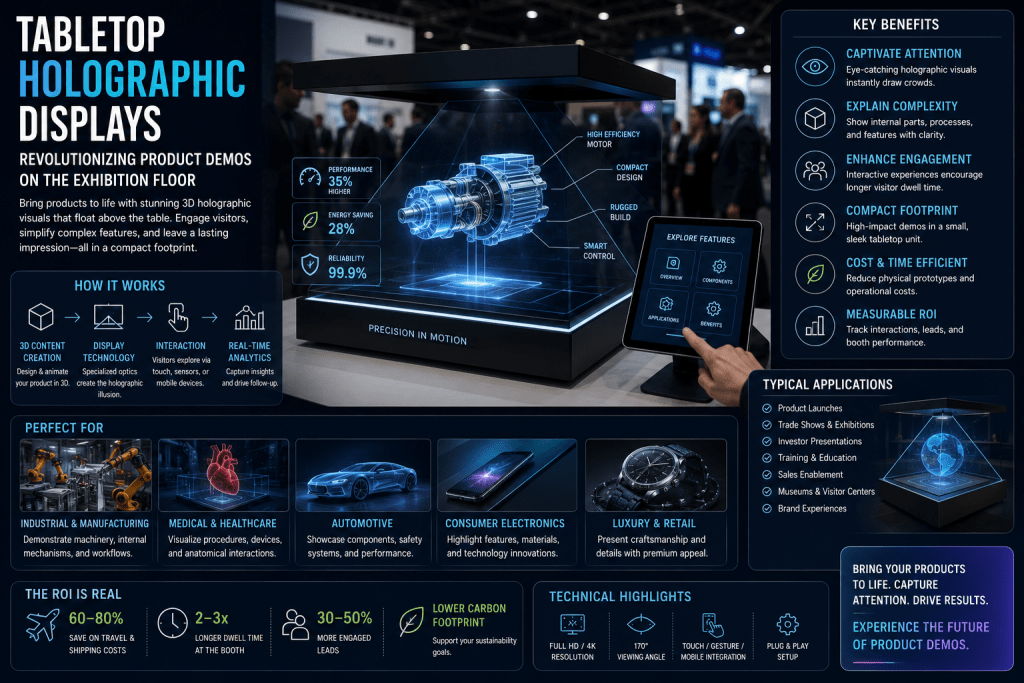
Tabletop holographic displays offer a compelling solution by creating the illusion of three-dimensional digital objects floating above a compact display unit. Although most commercial systems do not produce true holograms in the scientific sense, they use carefully engineered optical techniques—including reflective pyramids, holographic films, transparent displays, or volumetric visualization—to present products in a way that appears spatially realistic. These systems enable exhibitors to demonstrate products dynamically while maintaining a small exhibition footprint.
For event technology professionals, tabletop holographic displays represent more than an eye-catching attraction. They provide a practical platform for interactive storytelling, technical visualization, multilingual product education, and lead generation without requiring extensive booth construction or oversized AV infrastructure. As exhibition strategies increasingly emphasize engagement quality over booth size, tabletop holography is becoming an effective tool for delivering memorable demonstrations in compact spaces.
Why Traditional Product Demonstrations Fall Short
Physical demonstrations remain valuable because they establish authenticity and allow visitors to inspect products directly. However, they often struggle to communicate complex engineering, hidden mechanisms, manufacturing processes, or configurable product options.
Printed graphics can supplement demonstrations but remain static. Large monitors deliver rich multimedia but separate digital information from the product itself, forcing visitors to divide their attention. Live presenters provide valuable context but cannot continuously explain every feature to every attendee throughout the day.
Tabletop holographic displays combine several advantages into a single presentation surface. They visualize products in three dimensions, support continuous automated demonstrations, and allow complex information to appear directly alongside or seemingly within the product representation. This creates a more cohesive learning experience while reducing reliance on lengthy verbal explanations.
Understanding Tabletop Holographic Displays
Commercial tabletop holographic systems generally rely on optical illusion rather than true light-field holography. The most common designs use transparent reflective surfaces arranged in pyramid or prism configurations that reflect specially formatted video content from hidden displays beneath the unit.
To attendees, the reflected image appears suspended within the display enclosure, creating the impression of a floating three-dimensional object. Modern systems may also incorporate transparent OLED panels, holographic projection films, or rotating LED technologies depending on the desired effect.
Typical capabilities include:
- 360-degree product visualization
- Rotating product models
- Exploded component views
- Animated feature demonstrations
- Interactive product selection
- High-resolution branding
- Touch or gesture interaction
Because these systems occupy relatively little space, they integrate easily into exhibition counters, reception desks, and premium product showcases.
Technical Architecture
Delivering a convincing holographic demonstration requires more than the display itself. Successful deployments combine several coordinated technologies.
Display Hardware
The enclosure contains the reflective optics or transparent display technology responsible for producing the holographic illusion. Commercial systems range from compact desktop units suitable for jewelry or electronics to larger freestanding kiosks designed for industrial products.
Selection depends on viewing distance, booth layout, lighting conditions, and expected attendee traffic.
Content Engine
Dedicated media players or embedded computing platforms manage the animation sequences displayed inside the unit.
Typical content includes:
- Product rotation
- Assembly animations
- Feature callouts
- Internal cross-sections
- Configuration options
- Promotional messaging
Because the illusion relies on precise perspective, content must be created specifically for holographic presentation rather than repurposed from conventional marketing videos.
Interactive Controls
Many exhibitors increase engagement by allowing attendees to control the demonstration through:
- Touchscreens
- Gesture sensors
- RFID product tags
- NFC-enabled badges
- QR code activation
- Mobile applications
Interactive exploration encourages visitors to spend more time at the booth while tailoring demonstrations to individual interests.
High-Value Exhibition Applications
Tabletop holographic displays deliver the greatest value when physical products alone cannot fully communicate their capabilities.
Industrial Equipment
Large machinery manufacturers often face transportation challenges. Holographic displays allow them to present detailed digital models showing moving components, maintenance procedures, internal mechanisms, and installation workflows without transporting full-scale equipment.
Medical Devices
Medical technology companies can demonstrate implant positioning, diagnostic workflows, anatomical interactions, and surgical procedures while protecting sensitive equipment and maintaining clean exhibition environments.
Consumer Electronics
Manufacturers can visualize circuit boards, wireless connectivity, battery systems, software interfaces, and internal cooling mechanisms that would otherwise remain invisible during standard demonstrations.
Luxury Products
Watchmakers, jewelry brands, and premium consumer goods manufacturers use tabletop holography to emphasize craftsmanship, material details, and manufacturing precision while minimizing direct handling of valuable merchandise.
Enhancing Attendee Engagement
The effectiveness of tabletop holography depends not only on visual novelty but also on how it structures the visitor experience.
Guided Storytelling
Rather than presenting all information simultaneously, demonstrations can unfold progressively. A product may begin with an exterior overview before revealing internal architecture, manufacturing techniques, sustainability credentials, and customer applications. This narrative approach maintains visitor attention while avoiding information overload.
Self-Service Learning
Busy exhibition stands cannot guarantee immediate access to sales representatives. Holographic displays allow visitors to explore products independently while waiting for staff availability. Basic product education occurs automatically, enabling booth personnel to focus on higher-value conversations.
Personalized Demonstrations
When integrated with registration systems or CRM platforms, holographic displays can present customized content based on visitor industry, language preference, geographic region, or purchasing interests. Personalized demonstrations improve relevance while creating a more premium visitor experience.
Integration with the Event Technology Ecosystem
Tabletop holographic displays become significantly more valuable when connected to broader event systems.
Lead Capture Integration
Visitor interactions—including feature selections, product comparisons, QR scans, or demo completions—can synchronize with CRM platforms, enabling sales teams to prioritize post-event follow-up based on demonstrated interest.
Mobile Event Applications
Displays can encourage attendees to continue exploring products by transferring technical documents, videos, or configuration tools directly to their smartphones through QR codes or NFC interactions.
Analytics Platforms
Modern systems generate measurable engagement data, including:
- Visitor counts
- Interaction duration
- Most-viewed products
- Feature selection frequency
- Repeat visits
- Demo completion rates
These insights help exhibitors evaluate ROI while optimizing future demonstrations.
Operational Considerations
Although compact, tabletop holographic displays require careful planning.
Lighting conditions significantly influence image quality. Bright exhibition halls may reduce contrast, making controlled booth lighting essential. Displays should be positioned at comfortable viewing heights with sufficient surrounding space to prevent crowding.
Content design is equally important. Clean backgrounds, restrained animation, and concise text produce stronger holographic illusions than visually dense presentations. Because the display area is relatively compact, information hierarchy should emphasize key selling points rather than exhaustive specifications.
Staff training also matters. Booth personnel should understand how to transition naturally between automated demonstrations and personal conversations without allowing technology to dominate the visitor experience.
Challenges and Limitations
Despite their advantages, tabletop holographic displays are not appropriate for every product or event.
Viewing angles may be limited depending on the optical technology used, requiring careful placement within the booth. Bright ambient lighting can reduce visibility, while larger products may exceed the practical display volume available.
Content production often requires specialized three-dimensional modeling and animation expertise, increasing initial development costs. However, once created, these assets can be reused across exhibitions, retail environments, sales presentations, and digital marketing campaigns.
Finally, exhibitors should avoid treating holography as a novelty. The technology delivers its greatest value when it explains products more effectively than traditional presentation methods rather than simply attracting attention.
Future Trends
Advances in transparent displays, spatial computing, artificial intelligence, and real-time rendering are expected to expand the capabilities of tabletop holographic systems.
Future deployments may incorporate voice interaction, multilingual AI presenters, gesture recognition, and real-time product customization driven by visitor preferences. Integration with digital twins could allow exhibitors to visualize live operational data from industrial equipment, while mixed reality technologies may extend holographic demonstrations onto attendees’ mobile devices.
As production costs decline and content creation tools become more accessible, tabletop holographic displays are likely to move from premium showcase technology to a mainstream component of exhibition booth design.
Conclusion
Tabletop holographic displays are redefining how exhibitors communicate complex products by combining physical presence with immersive digital visualization in a compact, interactive format. They enable organizations to demonstrate hidden features, explain technical concepts, personalize visitor experiences, and generate measurable engagement without requiring large-scale staging or oversized display systems. When integrated with CRM platforms, event applications, and analytics tools, these displays become more than visual attractions—they become valuable components of the exhibition technology ecosystem. For exhibitors seeking to maximize engagement within limited booth space, tabletop holographic displays provide a practical and increasingly accessible way to deliver memorable, information-rich product demonstrations.