


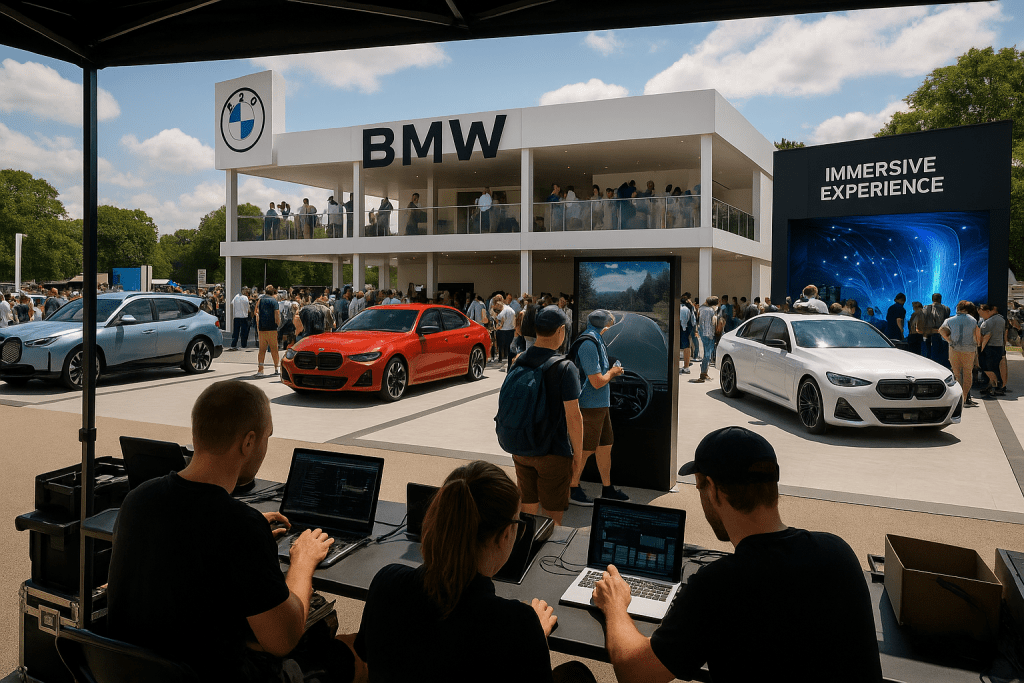
Experiential agency TRO, part of Omnicom, is piloting a data-led approach to measuring live brand experiences through a new activation for BMW at this year’s Goodwood Festival of Speed. The initiative uses emotion analytics to track how visitors respond to the experience in real time, reflecting a wider push in the events sector to quantify the impact of experiential marketing beyond traditional metrics like footfall and social reach.


The BMW installation at Goodwood serves as a live testbed for combining audience insight, experience design and creative technology with biometric and behavioural data. TRO’s aim is to better understand how people emotionally engage with branded experiences on site and use that information to inform future event and brand strategies.
Background: growing demand for measurable live experiences
As experiential budgets come under increasing scrutiny, brands and agencies are seeking more robust ways to evaluate the effectiveness of physical and hybrid events. While digital campaigns routinely benefit from granular performance analytics, measurement in live environments has been slower to evolve, often relying on qualitative feedback, simple attendance counts and post-event surveys.
In recent years, event organisers and sponsors have begun to test more sophisticated tools, including RFID tracking, beacon technology, computer vision, and AI-driven sentiment analysis of social content. Emotion analytics represents another step in this evolution, attempting to capture how people actually feel during an experience rather than only what they say about it afterwards.
The Goodwood Festival of Speed, one of the automotive sector’s key public showcases, provides a high-traffic environment where automotive brands invest heavily in live experiences. Against this backdrop, BMW’s activation offers TRO an opportunity to trial new methods of data capture across a diverse audience of car enthusiasts, families and technology-focused visitors.
Key developments at the Goodwood activation
TRO’s BMW experience at Goodwood has been designed from the outset with measurement in mind. Rather than treating analytics as an add-on, the agency has integrated data capture points into the journey, allowing behaviour and response to be monitored as visitors move through the space.
The activation combines several elements:
- Audience insight and pre-planning: TRO has used existing research on BMW’s target audiences and Goodwood visitor profiles to shape the experience and decide which emotional and behavioural markers to track.
- Creative technology on site: Interactive installations and digital touchpoints are configured to capture how guests engage with the content – for example, which features attract longer dwell times or repeated interactions.
- Real-time measurement: Data is collected during the event and processed to build a live picture of audience response. TRO positions this as an evolution from static reporting towards continuous feedback, allowing teams to understand performance while the event is underway.
- Emotion analytics layer: Within the parameters of event privacy and consent, the agency is applying emotion analytics techniques to assess shifts in visitor sentiment. This can include measuring indicators such as excitement, curiosity or surprise at key moments within the activation.
While detailed technical specifications have not been publicly disclosed, the initiative is framed as an experiment in linking physical engagement with emotional response, with the goal of providing BMW and other brand clients with a clearer view of experiential return on investment.
Potential impact on event and experiential strategy
If successful, the Goodwood project could encourage wider use of emotion analytics across automotive and other consumer-facing sectors that rely heavily on live experiences. For sponsors investing in large-scale activations, the ability to measure not only how many people attend but how deeply they connect with the brand story is increasingly important.
For agencies, data captured through experiences like the BMW activation can feed into multiple strategic areas:
- Experience optimisation: Understanding where visitors are most engaged can inform layout changes, content sequencing and staffing decisions for future iterations of the event.
- Creative validation: Emotion data can help assess whether key moments in the narrative deliver the intended emotional response, supporting more evidence-based creative decisions.
- Longer-term brand insight: When combined with other data sources, emotion-led metrics can contribute to a more nuanced picture of brand perception, complementing surveys and market research.
The approach also reflects a broader trend of aligning experiential activity with the analytics frameworks that marketing and C-level stakeholders use in other channels, helping live engagement compete more directly for investment.
Why this matters for event professionals and technology providers
For event organisers, brand experience teams and venue operators, the BMW Goodwood activation highlights several emerging considerations.
1. Integration of measurement from the outset
Projects like TRO’s underline the need to build analytics into the initial design and planning phases rather than treating them as post-event add-ons. This has implications for how agencies brief technology partners, configure infrastructure on site and train staff to manage data-led experiences.
2. Balancing data, creativity and privacy
Emotion analytics introduces new sensitivities around consent, transparency and data handling. Event professionals and tech vendors implementing similar solutions will need clear policies on what is being measured, how information is anonymised, and how insights are shared with clients. Ensuring that the technology supports, rather than overshadows, the creative concept is also essential.
3. Demand for interoperable tools
As more brands test live analytics, technology providers will face growing pressure to integrate sensors, interactive hardware, analytics dashboards and CRM or marketing automation platforms into coherent ecosystems. Projects like this may serve as early case studies demonstrating where integrations work well and where gaps remain.
4. New skills for experiential teams
Working with emotion data and real-time behavioural insights requires capabilities that sit at the intersection of event production, UX, data science and behavioural research. Agencies and in-house teams may need to adapt recruitment and training strategies to meet this demand.
Conclusion
The emotion analytics initiative at BMW’s Goodwood Festival of Speed activation positions TRO among a group of experiential agencies seeking to quantify the impact of live events more precisely. By merging creative technology, audience insight and real-time measurement, the project aims to move beyond simple visitor counts towards a deeper understanding of how people feel in the moment.
For the wider event technology ecosystem, the experiment underscores a clear direction of travel: future experiential programmes are likely to be judged not just on spectacle and attendance, but on measurable emotional engagement. As brands, agencies and solution providers continue to test and refine these tools, Goodwood’s high-profile environment offers a useful proving ground for what emotion-driven analytics can – and cannot – yet deliver in live settings.