


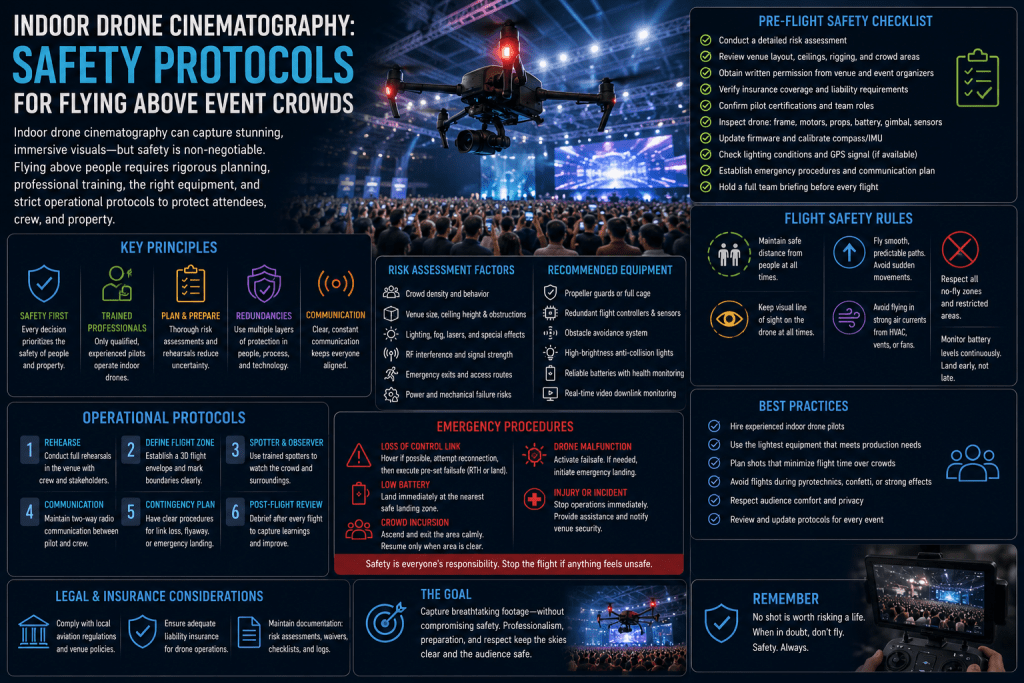
Drone cinematography has transformed event production by enabling dynamic aerial perspectives that were once achievable only through expensive cranes, cable camera systems, or helicopters. Indoor drones are now capturing keynote entrances, concert performances, exhibition walkthroughs, product launches, sporting competitions, and corporate celebrations with cinematic precision. Their ability to produce immersive footage from within event spaces has made them a valuable addition to modern audiovisual production.
However, operating drones indoors presents unique challenges. Unlike outdoor environments, indoor venues contain confined spaces, complex lighting rigs, suspended trusses, LED walls, moving crowds, radio frequency interference, and numerous physical obstacles. More importantly, flying above large groups of attendees introduces significant safety responsibilities.
At high-profile events, safety must always take precedence over visual impact. A single equipment failure, navigation error, or operational oversight can endanger attendees, damage property, disrupt productions, and expose organizers to substantial legal and financial risks.
In 2026, successful indoor drone operations rely on comprehensive safety protocols that combine regulatory compliance, technical preparation, risk assessment, trained personnel, and intelligent flight management. Drone technology continues to advance rapidly, but safe deployment depends on disciplined operational planning rather than equipment alone.
Why Indoor Drone Operations Are More Complex
Indoor environments eliminate many variables associated with outdoor aviation, such as wind and changing weather, but they introduce a different set of operational risks.
Common indoor hazards include:
- Low ceilings
- Rigging structures
- Hanging lighting systems
- LED displays
- Audio equipment
- Suspended banners
- Moving cameras
- Dense crowds
Unlike open airspace, indoor venues provide little margin for navigation errors.
Pilots must operate with exceptional precision while maintaining constant awareness of changing environmental conditions.
Understanding Risk Assessment
Every indoor drone operation should begin with a formal risk assessment.
The objective is to identify potential hazards before flight operations begin.
Venue Evaluation
Production teams should inspect:
- Ceiling height
- Structural obstacles
- Lighting trusses
- Speaker arrays
- Emergency exits
- Audience seating
- Stage configurations
The inspection helps define safe operating areas.
Crowd Analysis
Not every event presents the same level of operational risk.
Considerations include:
- Audience density
- Crowd movement
- Standing versus seated attendees
- VIP locations
- Performer movement
- Restricted zones
These factors directly influence flight planning.
Environmental Conditions
Indoor venues often contain unexpected influences such as:
- Air conditioning airflow
- Smoke effects
- Laser systems
- Confetti cannons
- Pyrotechnics
- RF interference
Each should be evaluated before approving flight operations.
Selecting the Right Drone Platform
Equipment selection plays a major role in operational safety.
Lightweight Aircraft
Smaller drones reduce kinetic energy and potential injury risk.
For indoor environments, lightweight aircraft are generally preferable to larger cinema drones whenever production requirements allow.
Propeller Protection
Many professional indoor drones use:
- Full propeller guards
- Protective cages
- Enclosed rotor systems
These features reduce injury risk if accidental contact occurs.
Redundant Flight Systems
Professional aircraft increasingly include redundant:
- Flight controllers
- Inertial measurement units
- Vision sensors
- Power management systems
Redundancy improves operational reliability.
Establishing Safe Flight Zones
Clearly defined operational boundaries are essential.
Flight Corridors
Pilots should establish predetermined flight paths that avoid unnecessary movement over densely populated areas.
Where possible, drones should operate:
- Above designated production zones
- Along controlled corridors
- Outside audience reach
rather than directly over attendees.
No-Fly Areas
Restricted zones may include:
- Backstage operations
- Control rooms
- Emergency exits
- Performer preparation areas
- Technical equipment zones
These boundaries should be communicated to all production staff.
Safe Takeoff and Landing Areas
Dedicated launch zones should remain isolated from attendee movement.
Only authorized personnel should access these areas.
Pilot Qualifications and Crew Coordination
Professional indoor operations require more than skilled pilots.
Certified Drone Operators
Pilots should possess:
- Appropriate certifications
- Indoor flight experience
- Emergency procedure training
- Equipment familiarity
Experience in confined environments is particularly important.
Visual Observers
Most professional productions assign trained observers to monitor:
- Crowd behavior
- Obstacle clearance
- Flight path integrity
- Unexpected hazards
Observers provide an additional layer of situational awareness.
Production Communication
Pilots, camera directors, stage managers, security personnel, and event operations teams should maintain continuous communication throughout flight activities.
Reliable communication reduces operational uncertainty.
Pre-Flight Safety Procedures
Every flight should follow standardized preparation protocols.
Equipment Inspection
Teams should verify:
- Propeller condition
- Battery health
- Motor performance
- Camera stabilization
- Sensor calibration
- Firmware status
Any defects should be resolved before launch.
Flight Simulation
Whenever possible, rehearsal flights should occur before attendees enter the venue.
These rehearsals validate:
- Camera movements
- Obstacle clearance
- Signal reliability
- Lighting conditions
Early testing reduces operational surprises.
Battery Planning
Indoor productions often require multiple flights.
Battery management plans should include:
- Rotation schedules
- Charging procedures
- Reserve capacity
- Emergency replacement protocols
Managing Radio Frequency Interference
Large events generate significant wireless activity.
Potential interference sources include:
- Wi-Fi networks
- Bluetooth devices
- Wireless microphones
- Private 5G systems
- Video transmission equipment
RF surveys help identify potential communication risks before flight operations begin.
Emergency Response Planning
No flight operation should proceed without contingency procedures.
Loss of Signal
Pilots should establish predefined responses for communication failures.
Depending on venue conditions, these may include:
- Controlled hovering
- Automated landing
- Return-to-home alternatives
- Manual recovery procedures
Equipment Failure
Emergency landing locations should be identified before takeoff.
Crew members should understand their responsibilities if technical problems occur.
Crowd Incidents
If attendees unexpectedly enter operational areas, flights should be suspended immediately until safe conditions are restored.
Safety always overrides production objectives.
Legal and Insurance Considerations
Indoor flights may not always fall under the same regulations as outdoor drone operations, but organizers remain responsible for maintaining safe environments.
Key considerations include:
- Venue authorization
- Insurance coverage
- Local aviation regulations
- Liability management
- Risk documentation
Legal responsibilities vary by jurisdiction and should be reviewed during event planning.
Emerging Technologies Improving Indoor Safety
Drone technology continues advancing rapidly.
Several innovations are improving operational safety.
AI Obstacle Avoidance
Artificial intelligence enables drones to detect and avoid:
- Structural obstacles
- Lighting equipment
- Temporary installations
- Unexpected movement
in real time.
Computer Vision Navigation
Vision-based positioning systems provide accurate indoor navigation where GPS signals are unavailable.
This improves flight stability.
Digital Twin Flight Planning
Digital twins allow production teams to simulate flights within virtual venue models before arriving on-site.
Potential hazards can be identified during planning rather than during live operations.
Autonomous Safety Monitoring
AI platforms increasingly monitor flight telemetry continuously, identifying abnormal behavior before failures occur.
The Future of Indoor Event Drone Operations
Indoor drone cinematography is becoming increasingly integrated into broader event production ecosystems.
Future developments are expected to include:
- Fully autonomous camera paths
- AI-assisted pilot decision support
- Swarm cinematography
- Predictive maintenance systems
- Advanced collision avoidance
- Smart venue integration
- Automated flight authorization workflows
These technologies will improve efficiency while maintaining strong safety standards.
Conclusion
Indoor drone cinematography offers extraordinary creative possibilities for modern events, but its success depends on rigorous safety planning rather than advanced hardware alone. Comprehensive risk assessments, qualified pilots, structured flight procedures, intelligent equipment selection, and coordinated production workflows are essential for protecting attendees while achieving cinematic results.
As artificial intelligence, computer vision, digital twins, and autonomous flight technologies continue evolving, indoor drone operations will become increasingly precise and reliable. Nevertheless, technology cannot replace disciplined operational practices.
For event organizers, production companies, and venue operators, the ultimate objective remains clear: capture exceptional visual content without compromising the safety of attendees, staff, performers, or property. In professional event production, the most successful drone flight is not simply the one that captures the best footage—it is the one that concludes without incident while remaining virtually invisible to the audience.