


Background and context
The inaugural Enhanced Games, a new and contentious sports competition, took place recently in Las Vegas, positioning itself at the intersection of sport, entertainment, and television spectacle. While much of the public conversation has focused on the event’s concept and rules, its staging also offers a window into how non-traditional sports properties are being built for both in-venue audiences and broadcast viewers from day one.
Van Wagner, a company known for live production and venue services across major sports and entertainment events, was brought in to help shape the Las Vegas experience. The assignment covered venue layout, in-venue presentation, and the technical delivery of the broadcast product.
For event professionals, the project illustrates how production teams are adapting standard sports workflows to new formats that place heavy emphasis on storytelling, visual identity, and broadcast-ready infrastructure, even for a first-time event.
Key announcement
Van Wagner’s role at the inaugural Enhanced Games centered on turning a non-traditional sports concept into a coherent live and broadcast event. This included designing the competition environment, specifying production systems, and integrating the needs of on-site spectators with those of remote viewers.
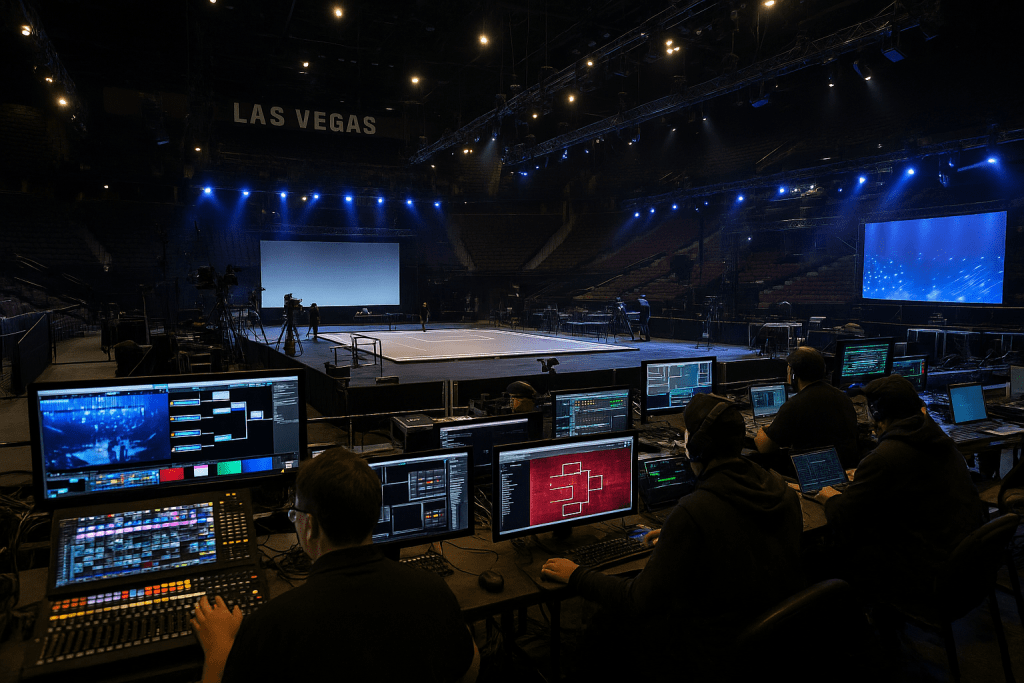
The company worked on venue configuration to support multiple disciplines within a single footprint, building out camera positions, lighting design, and content zones suited to both competition and programming elements such as athlete profiles and analysis. Production workflows were set up to capture and package live action for broadcast, with attention to pacing and format more commonly associated with entertainment television than conventional multi-day sports tournaments.
According to Van Wagner’s publicly available case descriptions on its official website, the firm’s broader services typically span in-venue show control, creative content, technical direction, and broadcast integration, and those capabilities were applied to the Enhanced Games to help define its first-year look and feel.
Industry impact
The Las Vegas event reflects a broader trend in the sports and live events sector: new properties are being conceived with media distribution and digital storytelling as core design requirements, rather than later add-ons. For production partners, this means building flexible technical setups capable of serving multiple platforms, from television to social media highlights.
By treating the Enhanced Games as both a sports meet and a made-for-broadcast show, the production model leaned on tools familiar to event technologists—multi-camera control rooms, real-time graphics, LED displays, and integrated audio systems—but applied them to a property still shaping its identity. This kind of project highlights the importance of modular infrastructure that can evolve rapidly as formats are refined.
It also underlines how cities such as Las Vegas continue to serve as testbeds for experimental sports and entertainment concepts, thanks in part to existing venue capabilities, experienced local crews, and a market accustomed to high-production-value events.
Why this matters
For event technology professionals, the Enhanced Games project offers a case study in how production teams can support controversial or unconventional formats while remaining focused on execution: audience experience, visual clarity, and technical reliability.
As more organizers explore new sports concepts, hybrid competitions, or content-first events, demand is likely to grow for partners who can design venues around storytelling, integrate broadcast-grade systems from the outset, and deliver consistent experiences across physical and digital channels.
The Las Vegas staging of the Enhanced Games suggests that even first-edition events are expected to launch with the polish of an established property. For vendors, producers, and technical directors, that expectation places a premium on adaptable workflows, cross-disciplinary planning, and early collaboration between creative, operations, and broadcast teams.