


Background and context
North Point Community Church in Alpharetta, Georgia, one of the largest churches in the United States, has overhauled the main auditorium sound system at its central campus. The non-denominational church serves just under 44,000 people weekly across eight locations in the Atlanta area, making uniform coverage and speech intelligibility a significant technical challenge.
The new installation continues a long-running relationship with systems integrator Clark, which has handled audio upgrades at North Point since the Alpharetta campus opened in 1999. For this latest project, the church moved from a traditional left-right PA to an immersive system based on L-Acoustics’ L-ISA platform.
In addition to adopting object-based mixing for music and spoken word, North Point has become the first house of worship to implement L-Acoustics’ Source Intelligence technology, a real-time voice-separation tool designed to improve vocal clarity in complex stage environments.
Key announcement
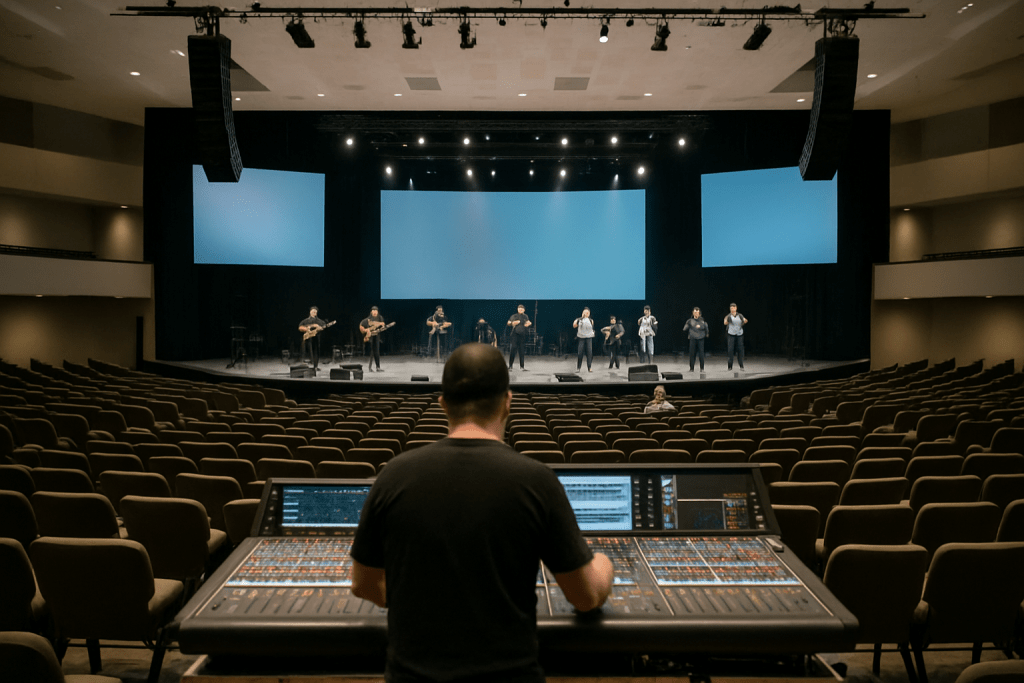
The main auditorium now features an L-ISA Hyperreal Sound configuration built around five L2D arrays forming the central scene system. These are supported by four A10i Focus extension arrays, two flown on each side, to extend coverage laterally across the wide room.
Low-frequency energy is provided by nine KS28 subwoofers in three cardioid flown arrays behind the center L2D hang, supplemented by 17 SB15m subwoofers distributed in an arc under the curved stage. Front-fill for the first rows is handled by 17 compact X6i coaxial loudspeakers placed along the stage edge and steps.
To reach the outer seating areas, two out-fill arrays of six Kara IIi elements each are flown between the main L Series clusters, with X8 loudspeakers addressing the front corners of the room. Additional X12 cabinets provide coverage for the rear balcony corners. Amplification is managed by LA7.16i controllers for mid/high elements and LA12X units for the subwoofers.
At the control end, an L-ISA Processor II handles object-based mixing and is integrated with a DiGiCo Quantum5 console at front of house. A P1 processor and LS10 Milan-AVB switches complete the audio network backbone.
Source Intelligence, running as a licensed application on the L-ISA Processor II, analyzes microphone signals in real time to distinguish the primary voice from other acoustic content. It reduces bleed from drums, PA spill, and room reverberation, allowing engineers to increase vocal level before feedback without significantly changing tonal balance. The process operates with under 8.5 ms of end-to-end latency over MADI and is designed to function without continuous parameter adjustment.
Industry impact
North Point’s system highlights how large worship venues are increasingly turning to immersive audio to deal with challenging room geometries. The main auditorium is notably wide relative to its depth, a layout that can be difficult for conventional stereo arrays. According to the integrator, more than 80 percent of seats now fall within the immersive “sweet spot,” with a limited number of fills used to reach edge locations.
The project also represents one of the first visible deployments of Source Intelligence outside of entertainment venues, bringing AI-driven voice enhancement into weekly worship services. In a setting with multiple vocalists, live bands, and pastors often using headset microphones while moving across the stage, maintaining gain-before-feedback and intelligibility has direct impact on both music and spoken content.
For L-Acoustics, the installation at North Point provides a high-profile reference for L-ISA and Source Intelligence in the house of worship segment, an area where demand for more immersive experiences has been growing. More technical information on the platform is available via the manufacturer’s official site at l-acoustics.com.
Why this matters
For AV teams working in worship and live event environments, the North Point project underscores several trends. First, immersive object-based systems are moving beyond flagship performance venues into large churches that prioritize consistent coverage and localization of sound to the stage.
Second, the adoption of real-time voice-separation indicates growing interest in tools that address stage bleed and feedback at the system level rather than relying solely on console processing and microphone technique. The ability to increase usable vocal level, particularly with headset mics in front of the PA, is likely to appeal to other churches and conference venues facing similar acoustical and operational constraints.
Finally, the installation demonstrates how integrators are combining immersive processing, networked audio, and high-density amplification to manage complex loudspeaker deployments in wide auditoriums. As large worship spaces continue to adopt production standards closer to touring shows and broadcast facilities, projects like North Point’s are likely to serve as templates for future system designs in the sector.