


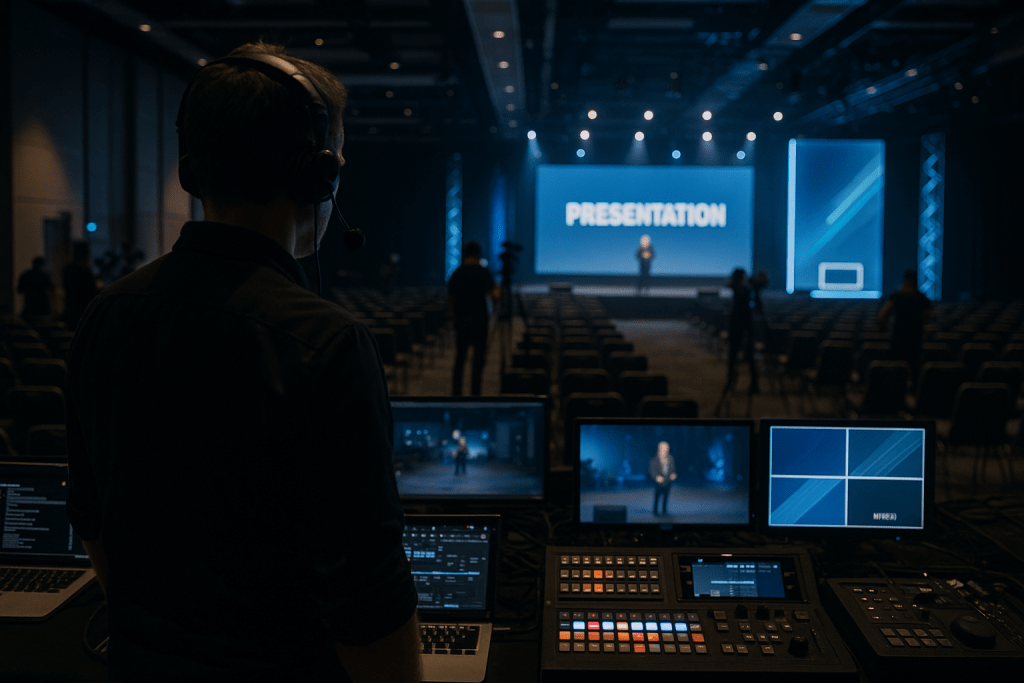
Creative and technical production in live events is undergoing rapid change as audiences demand richer experiences and clients expect broadcast-level reliability. Industry practitioners increasingly sit at the intersection of performance, staging and media technology, drawing on diverse backgrounds to meet those expectations.
In a recent industry discussion, Ross Wheeler, a senior figure in live event production, reflected on how a journey that began in the performing arts has evolved into leading large-scale, technology-centric shows. His experience illustrates how disciplines such as dance, theatre and broadcast are converging to shape the next generation of corporate, cultural and experiential events.
Background and industry context
Live events have become more complex as organisations blend in-person, hybrid and fully virtual formats. Corporate town halls, conferences and brand experiences now frequently require multi-camera broadcast setups, robust connectivity and integrated digital platforms alongside traditional staging and show control.
At the same time, audiences have grown accustomed to the polish of streamed entertainment and sports coverage. This has raised expectations around audio-visual quality, storytelling and interactivity, even for internal or B2B-facing events. Production teams are expected to deliver performances that feel cinematic while retaining the immediacy of a physical gathering.
These shifts have opened the door for professionals with backgrounds in performance and choreography to influence how content is structured, staged and captured. A grounding in timing, movement and audience perspective is increasingly valuable when designing event environments that must work simultaneously for the room and for remote viewers.
Key developments and themes from Wheeler’s career
Wheeler described starting his professional life in ballet and theatre, before transitioning into live production roles that required a deeper engagement with technical systems. That progression from performer to producer and technical collaborator has informed his approach to designing shows that balance narrative, aesthetics and reliability.
One of the recurring themes he highlighted is the role of collaboration between creative teams and technical specialists. As events have become more reliant on complex AV, networking and streaming infrastructure, production leaders must act as translators between artistic intent and engineering constraints. Understanding the language of both sides, he suggested, is critical to achieving consistent results in high-pressure environments.
Wheeler also touched on the increasing expectation that events be “broadcast ready”. Even when content is intended primarily for an in-room audience, many organisations now capture or stream sessions for later distribution. This has implications for set design, lighting, camera placement and show calling, encouraging teams to think of events as live television productions as much as stage shows.
Another development he discussed is the need for resilience and redundancy. High-profile streams, internal announcements and major brand activations cannot afford downtime. Production workflows have therefore shifted toward fully resilient systems, with backup paths for audio, video and connectivity, and contingency planning integrated into every show design.
Industry impact of evolving production practices
The convergence of performance disciplines and broadcast technology is reshaping skill requirements across the sector. Technical directors are increasingly expected to understand storytelling and audience journey, while creatives must be comfortable designing within the constraints of cameras, encoding, network capacity and platform capabilities.
For venues and organisers, this shift has practical consequences. Investment decisions now extend beyond traditional staging and rigging to include IP-based video, low-latency switching, remote contribution tools and monitoring systems that ensure streams remain stable under load. The need for end-to-end resilience influences everything from venue selection to show schedules and rehearsal time.
Wheeler’s experience points to another industry-wide change: the growing importance of pre-production. As live events adopt complex technical stacks, more time is spent modelling show flows, mapping content to screens and planning how sessions will be captured and distributed. Rehearsal processes increasingly mirror those of broadcast studios, with detailed run-throughs to test failover, graphics, intercom and audience engagement tools.
These developments also impact supply chains. Service providers specialising in live and hybrid production are being asked to integrate closely with event agencies, in-house corporate comms teams and digital platform providers. Clear communication between these stakeholders is essential to ensure that creative concepts remain achievable within the limits of infrastructure and budget.
Why this matters for event professionals and technology providers
For event organisers, the trends highlighted by Wheeler underscore the need to build teams that bridge creative and technical thinking. Producers who can read a stage plot, understand camera sightlines and discuss encoding profiles with equal confidence are well positioned to lead complex programmes.
Agencies and brands planning high-stakes events should consider the following implications:
- Programming for both room and remote: Sessions designed solely for an in-person audience may not translate well on screen. Structuring content for dual consumption is becoming standard practice.
- Early technical engagement: Bringing technical partners into the planning process at an earlier stage can prevent costly redesigns and ensure that creative ambitions align with available infrastructure.
- Rehearsal discipline: Treating key segments as live broadcasts, with full technical rehearsals, helps surface potential points of failure before the event goes live.
- Skills development: Training programmes that expose production staff to both performance principles and emerging technologies can help organisations keep pace with audience expectations.
For technology providers, Wheeler’s perspective reinforces the market demand for solutions that prioritise reliability without limiting creativity. Systems that integrate seamlessly with existing event workflows, offer robust redundancy and minimise operator complexity are particularly valuable in environments where failure is not an option.
Vendors that can articulate how their products support both the narrative and the technical integrity of a show are likely to find receptive audiences among producers who must justify investments to stakeholders focused on risk, brand perception and audience experience.
Conclusion
Ross Wheeler’s trajectory from ballet to large-scale live production illustrates a broader narrative within the event sector: the boundaries between stagecraft, storytelling and broadcast engineering are narrowing. As live, hybrid and virtual formats continue to blend, the need for multidisciplinary expertise and resilient technology will only increase.
For event professionals, the message is clear. Success in the current landscape demands more than creative concepts or technical proficiency in isolation; it requires integrated thinking, rigorous planning and a willingness to draw on diverse backgrounds to deliver experiences that resonate in the room and across the network.
Technology providers, in turn, have an opportunity to support this evolution by developing tools and services that acknowledge the realities of live performance while meeting the operational standards of modern broadcast. The ongoing dialogue between practitioners like Wheeler and the wider ecosystem will help define how the next generation of events is imagined, produced and delivered.