


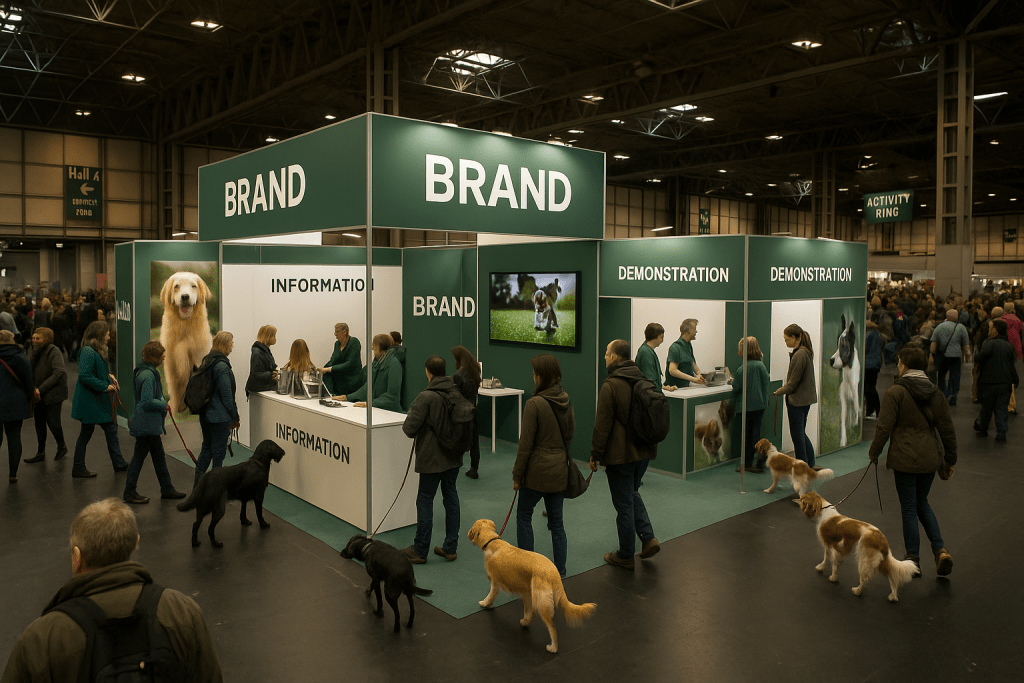
Exhibitors are rethinking how they show up at trade shows and consumer events, moving away from treating each stand as an isolated project. Instead, many brands are seeking consistent, connected experiences that span multiple events and blend physical and digital touchpoints. Tecna, a UK-based modular stand and event solutions provider, is among the companies positioning itself around this shift, using a recent deployment at Crufts to demonstrate how a stand can sit within a wider brand world rather than act as a one-off centrepiece.
Background: from single shows to annual experience journeys
Visitor expectations at exhibitions and live events have changed as audiences move fluidly between online and in-person interactions. Attendees are accustomed to omnichannel journeys in retail, streaming, and digital services, and increasingly expect similar continuity when engaging with brands at events.
This change is prompting exhibitors to reassess the traditional model of commissioning a bespoke stand for each individual show. Instead, planners are asking how physical assets, messaging, and engagement tools can work together across an entire calendar of events. The aim is to create an experience that feels tailored to each audience and venue while still clearly belonging to a single, coherent brand environment.
Suppliers like Tecna, which has a background in modular stand systems and reusable structures, are adapting their offer to support this longer-term, ecosystem-based approach. Rather than designing for a single exhibition in isolation, the company works with clients to map out the role of each event within a broader programme of marketing and customer engagement.
Key development: Tecna’s brand world approach at Crufts
Within this strategic shift, Tecna highlights its work at Crufts as an example of how an exhibition stand can operate as one element of a wider brand world. Crufts, one of the UK’s best-known dog shows, brings together exhibitors, sponsors, breeders, and consumers in a large, high-traffic environment where consistency of brand presence is critical.
At the event, Tecna was involved in creating a connected experience that extended beyond the footprint of a single stand. While specific design details and brand names were not disclosed, the project was positioned as part of a coordinated series of touchpoints. These included physical structures, graphics, and engagement areas configured to support the exhibitor’s objectives across different zones and activities at the show.
The emphasis was on ensuring that visitors encountered a continuous narrative – from initial approach, through time spent on the stand, to follow-up interactions after the event. Tecna’s modular systems and planning process were used to maintain visual and structural coherence, while still allowing the presentation to be adapted to Crufts’ layout and audience profile.
Rather than viewing the Crufts presence as a standalone build, Tecna framed it as one chapter in a year-round programme. Assets and learnings from the show were intended to be repurposed and refined for subsequent events, contributing to a more sustainable and cost-efficient model of exhibiting.
Industry impact: exhibition stands as part of wider ecosystems
The move towards connected event ecosystems has several implications for organisers, exhibitors, and the suppliers that serve them:
- Longer planning cycles: Brands are increasingly looking at 12- to 24-month horizons for event activity, rather than commissioning stand builds show by show. This encourages more strategic alignment between marketing, sales, and events teams.
- Modular and reusable infrastructure: Systems that can be reconfigured and redeployed across multiple events gain value, as they support both brand consistency and operational flexibility.
- Integrated content and messaging: Narratives, visuals, and interactive elements need to be designed with re-use and adaptation in mind, so they can be tailored to different audiences while remaining recognisably part of the same brand story.
- Measurement across events: When events are viewed as a connected ecosystem, performance metrics can be tracked across an entire programme rather than in isolation. This shapes decisions about where to allocate budget and how to refine experiences over time.
The Crufts project illustrates how suppliers like Tecna are responding to these pressures by positioning their services around ecosystem thinking rather than individual stand builds.
Why this matters for event professionals and technology providers
For event organisers, exhibitors, and technology vendors, the shift away from stand-centric thinking has practical consequences:
- Organisers: As exhibitors seek more integrated experiences, organisers may need to provide clearer frameworks for multi-location activations, sponsor zones, and digital extensions around their shows. This can range from consistent wayfinding and branding guidelines to data-sharing structures that help exhibitors track visitor interactions.
- Exhibitors and brands: Treating each event as part of a broader journey encourages closer collaboration between events teams and digital marketing. Decisions about stand design, on-site activations, and post-event nurturing need to be made together, with a view on how physical and digital interactions support each other.
- Technology providers: Platforms for lead capture, content distribution, audience analytics, and hybrid engagement are more valuable when they can operate across multiple events. Integration with CRM and marketing automation systems becomes essential to maintain continuity across the event calendar.
- Design and build partners: Suppliers like Tecna are under pressure to offer solutions that go beyond fabrication. Strategic input, planning, data-informed iteration, and support for sustainable reuse are now part of the competitive landscape.
In this context, the type of work Tecna showcases at Crufts points to a broader trend: exhibitors want stands that can evolve into platforms for ongoing engagement rather than one-time installations.
Conclusion
The role of the exhibition stand is changing as visitor expectations and brand strategies evolve. Instead of being the singular focal point of an event presence, the stand is becoming one component in a wider, interconnected brand world spanning multiple shows, channels, and touchpoints.
Tecna’s approach, demonstrated through its involvement at Crufts, reflects this transition. By emphasising modularity, consistency, and long-term planning, the company is aligning its services with exhibitors that view events as continuous, year-round experiences. For event professionals and technology providers, this reinforces the need to think beyond individual shows and design infrastructure, content, and data flows that support connected event ecosystems.

