


Introduction: From Passive Audiences to Interactive Participation
Traditional events were designed around one-way communication. Speakers presented information while audiences listened with limited opportunities for immediate interaction. As event experiences evolve toward engagement-driven models, this passive structure is rapidly changing.
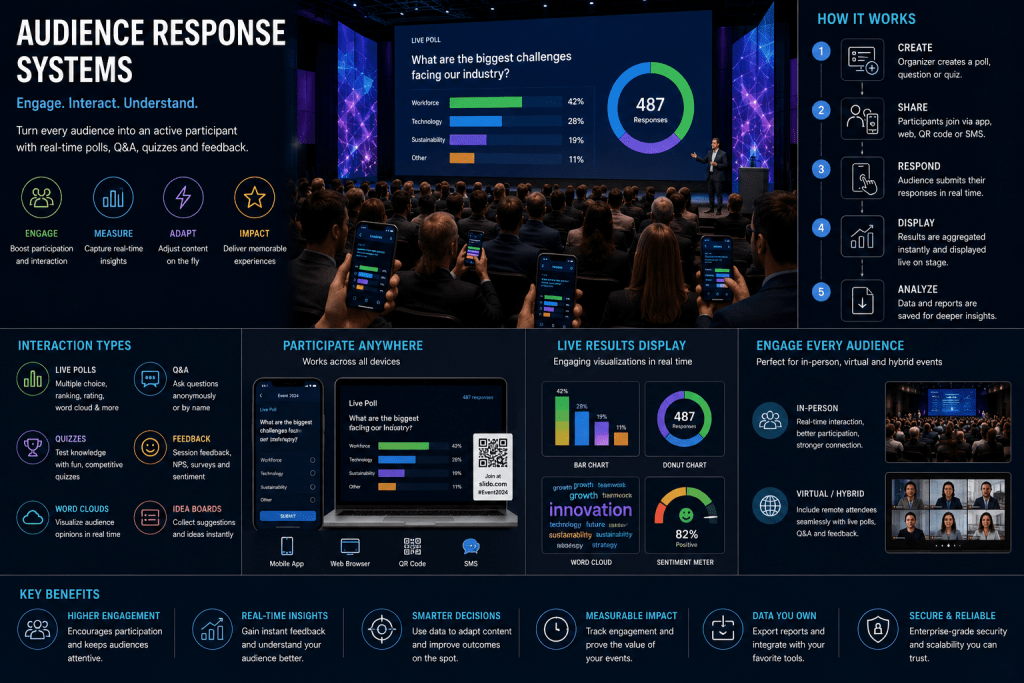
Audience Response Systems (ARS) enable real-time participation by allowing attendees to interact directly with speakers, content, and event platforms through live polls, voting, Q&A, quizzes, and feedback mechanisms.
In modern event ecosystems, audience response technology serves as both an engagement tool and a data collection infrastructure. It transforms audiences from passive listeners into active participants while providing organizers with immediate behavioral insights.
Understanding Audience Response Systems
Audience Response Systems are digital platforms that collect, process, and display participant input in real time.
These systems typically support:
- Live polling and voting
- Q&A sessions
- Surveys and feedback collection
- Gamification and quizzes
- Sentiment analysis and engagement tracking
Responses are usually submitted through:
- Mobile applications
- Web browsers
- Dedicated handheld devices
- SMS or QR-code-based interfaces
Core Components of Audience Response Systems
Participant Input Interfaces
Attendees interact with the system through user-facing interfaces.
These may include:
- Event mobile apps
- Browser-based participation portals
- Touchscreen kiosks
- Dedicated clicker devices in legacy setups
Modern systems prioritize mobile-first accessibility.
Presentation and Display Layer
Audience responses are visualized in real time through:
- LED screens and presentation displays
- Speaker dashboards
- Live analytics interfaces
Dynamic visualization increases audience engagement and encourages participation.
Backend Processing Engine
The backend infrastructure handles:
- Response collection and validation
- Real-time aggregation
- Data analysis and visualization generation
Scalability is critical, especially for large audiences generating simultaneous responses.
Analytics and Reporting Systems
Audience response data is integrated into analytics platforms to generate insights such as:
- Participation rates
- Sentiment trends
- Session engagement levels
- Knowledge retention metrics
These insights support both operational and strategic decision-making.
System Architecture: Real-Time Engagement Pipeline
Audience response systems typically operate through a real-time interaction architecture.
- The presenter launches a poll or interaction
- Participants submit responses through connected interfaces
- Backend systems process and aggregate responses
- Results are visualized in real time
- Data is stored for analytics and reporting
Low latency is essential to maintain engagement and conversational flow.
Types of Audience Interaction Models
Live Polling and Voting
Participants respond to questions instantly during presentations.
Common applications include:
- Opinion gathering
- Decision-making sessions
- Session feedback
Real-time polling increases attentiveness and participation.
Q&A Systems
Attendees submit questions digitally, often anonymously.
Features may include:
- Upvoting popular questions
- Moderation controls
- AI-assisted categorization
This improves accessibility and reduces barriers to participation.
Gamification and Quizzes
Interactive quizzes and competitions increase engagement and retention.
Gamification elements may include:
- Leaderboards
- Points and rewards
- Timed challenges
These are widely used in training sessions and educational events.
Sentiment and Feedback Collection
Continuous feedback systems allow attendees to express reactions during sessions.
Examples include:
- Session ratings
- Mood indicators
- Real-time satisfaction tracking
This enables organizers to adjust experiences dynamically.
Integration with Event Technology Ecosystems
Audience response systems are increasingly integrated with broader event infrastructures.
Event Apps and Registration Platforms
Participation can be linked to attendee profiles for personalized experiences and analytics.
Video and Streaming Platforms
In hybrid and virtual events, audience response systems integrate directly into streaming interfaces.
This enables simultaneous participation from physical and remote audiences.
Analytics and Event Data Platforms
Audience interaction data contributes to broader behavioral analytics and engagement scoring.
AI and Personalization Systems
AI systems can analyze response patterns to:
- Recommend content
- Adapt session flows
- Identify engagement trends in real time
Operational and Experience Impact
For Attendees
Audience response systems create:
- Higher engagement levels
- Greater inclusion and participation
- More interactive and memorable experiences
Attendees feel more connected to speakers and content.
For Speakers
Presenters gain immediate insight into:
- Audience understanding
- Opinions and preferences
- Engagement levels
This allows dynamic adjustment of presentation style and content.
For Organizers
Organizers benefit from:
- Real-time event intelligence
- Quantifiable engagement metrics
- Improved session evaluation and optimization
Technical Challenges
Network Reliability
Large-scale live interactions require stable and scalable network infrastructure.
Latency and Synchronization
Delays in displaying results can disrupt session flow and reduce engagement.
Participation Accessibility
Interfaces must remain intuitive and accessible across devices and user groups.
Data Privacy and Moderation
Systems handling audience-generated content must ensure moderation, security, and compliance.
Future Trends: Intelligent Participation Systems
AI-Augmented Interaction
AI will increasingly support:
- Automatic question summarization
- Sentiment analysis
- Personalized interaction recommendations
Voice and Gesture-Based Participation
Future systems may support interaction through voice commands or gesture recognition.
Predictive Engagement Analytics
Machine learning models will anticipate disengagement and recommend interventions in real time.
Immersive Participation in XR Environments
Audience interaction systems will extend into virtual and mixed reality event spaces.
Conclusion: Transforming Audiences into Active Participants
Audience Response Systems are reshaping events by enabling real-time interaction, feedback, and participation at scale.
By combining mobile technology, analytics, visualization, and cloud infrastructure, these systems create more dynamic and inclusive event experiences.
For event technology leaders, audience response platforms are not simply engagement tools—they are strategic systems for building participatory, data-driven, and adaptive event environments.