


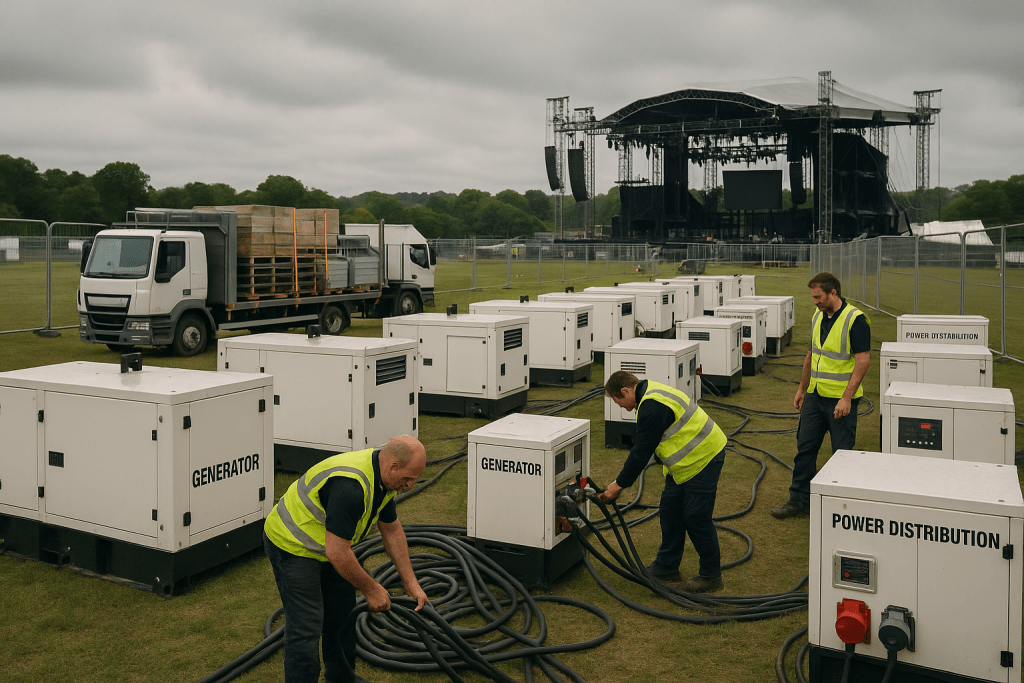
Camfaud Group, best known as the UK’s largest concrete pumping operator, has acquired Essex-based temporary power specialist Templant, in a deal that broadens Camfaud’s footprint beyond construction and deeper into live events and temporary infrastructure. Templant will join the Camfaud Group portfolio, which is owned by US-listed Concrete Pumping Holdings, Inc. (NASDAQ: BBCP).
The move positions Templant for accelerated expansion of its rental fleet, transport and service operations, and supports plans to build a multi-depot network across the UK. For event organisers, festival producers and temporary venue operators, the acquisition underlines growing consolidation in the market for mission-critical power services.
Background: power as critical infrastructure for events
Temporary power has become a strategic issue for the events sector as shows, exhibitions and outdoor productions increase in scale and complexity. From large-scale festivals and sports events to trade shows and corporate experiences, reliable power is central to everything from staging and lighting to broadcast feeds, catering, ticketing and on-site connectivity.
Vendors like Templant typically supply diesel and hybrid generators, distribution systems, cabling, fuel management and on-site support teams. In recent years, event organisers have also faced mounting pressure to improve resilience, reduce emissions and manage costs in the face of energy price volatility and tightening sustainability requirements.
At the same time, the UK market has seen a blurring of lines between construction, infrastructure and events. Equipment rental companies with roots in construction are increasingly active in temporary event environments, bringing national fleets, logistics expertise and 24/7 service models that had traditionally been associated more with long-term building projects than short-term cultural or corporate events.
Key developments in the Camfaud–Templant deal
While detailed financial terms of the acquisition have not been disclosed, several strategic elements of the deal are clear from the announcement:
- Integration into Camfaud Group: Templant will operate under the Camfaud Group umbrella, which benefits from the backing of Concrete Pumping Holdings, a publicly traded US company with a nationwide footprint in North America and extensive UK operations.
- Investment in rental fleet: Camfaud has indicated that the acquisition will unlock further capital for Templant to upgrade and expand its generator and distribution fleet. For events, this is likely to mean access to a broader range of capacities, more modern equipment and better redundancy options.
- Enhanced transport and service: Additional investment is planned in logistics and service capability, including transport vehicles, engineering resources and support infrastructure. This could support faster deployment, tighter installation windows and improved responsiveness for time-critical events.
- Multi-depot expansion: One of the key growth drivers flagged by both parties is the development of a UK-wide multi-depot network. Moving beyond a single-base or regional model would allow Templant to support events more efficiently across multiple locations, reduce travel times and offer more competitive pricing in distant regions.
Bringing Templant into a larger group also gives the business access to shared back-office systems, health and safety frameworks and cross-sector expertise, particularly from Camfaud’s experience servicing high-risk, highly regulated construction environments.
Industry impact: consolidation and capability
The acquisition adds to a pattern of consolidation across the event services and temporary infrastructure markets, where scale is increasingly seen as an advantage for handling complex requirements, mitigating risk and investing in new technology.
For the UK events sector, the deal may have several practical implications:
- Wider geographic coverage: A multi-depot strategy could translate into more consistent service for organisers working across multiple regions, including touring productions, sports series, and national conference programmes.
- Higher equipment availability: A larger, better-capitalised fleet can reduce bottlenecks during peak seasons, when demand for generators and distribution equipment often spikes around major festivals and summer events.
- Potential for integrated services: As Camfaud balances its construction heritage with events and temporary works, there may be opportunities for bundled offerings that combine power, plant and logistics support for large-scale builds such as temporary arenas, fan zones and overlay structures.
- Pressure on smaller providers: Independent power suppliers may face increased competitive pressure on pricing, coverage and service levels as larger groups leverage economies of scale and centralised operations.
However, the deal does not remove the need for specialist knowledge in event power design, particularly in complex environments such as broadcast-led productions, hybrid events with significant IT demands, or venues with strict noise and emissions constraints.
Why this matters for event professionals and technology providers
For event professionals, the acquisition highlights the importance of treating power as a strategic procurement category rather than a last-minute line item. As larger infrastructure players enter or expand within the event market, organisers will have access to suppliers with greater capacity and geographic reach, but they will still need to manage:
- Technical specification: Ensuring that power designs are closely aligned with audio-visual, staging, broadcast, catering and connectivity requirements, particularly for data-heavy or hybrid events.
- Resilience and redundancy: Building in sufficient backup to avoid single points of failure, using larger fleets and multi-depot systems to secure contingency options.
- Sustainability objectives: Working with suppliers to transition towards lower-emission solutions, fuel-efficient generators, hybrid systems and smarter monitoring, which can be more feasible for providers with the capital to refresh and diversify their fleets.
- Service-level expectations: Clarifying response times, on-site technician availability and fault resolution processes, particularly for live broadcasts and high-profile corporate events where downtime is not acceptable.
Technology vendors in areas such as event management platforms, power monitoring, IoT sensor systems and sustainability reporting may also find new partnership opportunities with larger infrastructure groups looking to digitise their operations, track performance and prove compliance to clients and regulators.
As Camfaud integrates Templant, there may be scope for more data-driven approaches to power planning, such as real-time load monitoring, remote diagnostics and usage analytics — all of which could help organisers make more informed decisions about capacity, cost and environmental impact.
Conclusion
Camfaud Group’s acquisition of Templant signals a notable shift in the UK’s temporary power and event infrastructure landscape. Backed by Concrete Pumping Holdings, the deal gives Templant access to capital, logistics and a national network that could significantly enhance its ability to serve large and geographically dispersed events.
For the wider events ecosystem, the move underscores the growing convergence between construction-grade infrastructure providers and the live events industry. As demand increases for resilient, sustainable and technically sophisticated power solutions, event organisers and technology providers will need to engage more closely with these evolving supply chains.
How effectively Camfaud and Templant translate construction-scale capabilities into event-ready services will be closely watched by promoters, production companies and venue operators preparing for the next cycle of large-scale live events in the UK.