


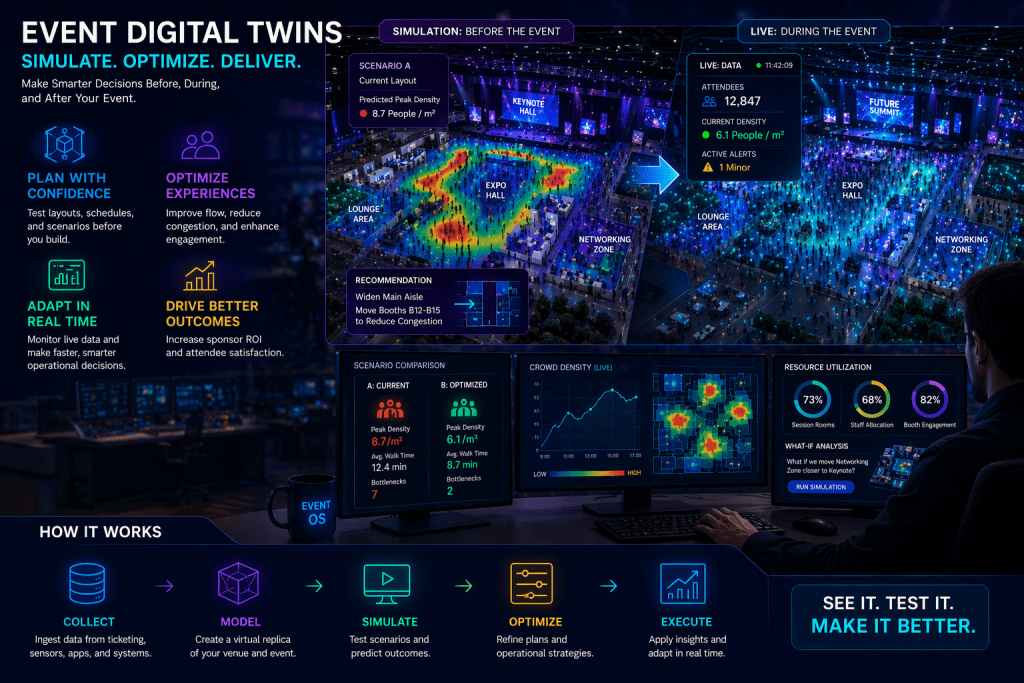
Introduction: From Planning to Simulation
Event planning has traditionally relied on experience, static layouts, and incremental improvements based on past outcomes. Floor plans are designed, schedules are created, and logistics are coordinated using assumptions about attendee behavior and operational conditions. While data has improved decision-making, most planning processes remain predictive at best and reactive at worst.
As events grow in complexity—featuring hybrid formats, dynamic attendee flows, and real-time interactions—these approaches struggle to keep pace. The gap between planned scenarios and actual outcomes introduces inefficiencies, risks, and missed opportunities.
Event digital twins offer a fundamentally different model. By creating a dynamic, virtual replica of the event environment, organizers can simulate scenarios, test strategies, and optimize decisions before and during the event. This transforms planning from a static exercise into a continuous, data-driven process.
Defining the Event Digital Twin
A digital twin is a virtual representation of a physical system that is continuously updated with real-world data. In the context of events, this includes:
- Venue layouts and spatial configurations
- Attendee movement and behavior patterns
- Session schedules and capacity constraints
- Operational systems and resource allocation
The digital twin is not مجرد a visual model. It is a computational system that reflects the state of the event in real time, enabling simulation, analysis, and optimization.
This distinction is critical. While 3D models provide visualization, digital twins provide intelligence—linking data, behavior, and outcomes in a unified framework.
Core Architecture: Building the Twin
Event digital twins are built on a layered architecture that integrates spatial modeling, data pipelines, and simulation engines.
Spatial Model and Environment Representation
The foundation of the digital twin is a detailed representation of the event environment. This includes floor plans, room configurations, pathways, and physical constraints.
Spatial data is often derived from architectural models, CAD files, or LiDAR scans. The level of detail depends on the intended use cases, with higher fidelity required for precise simulations such as crowd movement.
This spatial layer defines the boundaries within which all simulations and analyses occur.
Data Integration and Real-Time Synchronization
The digital twin is continuously updated באמצעות data streams from event systems. These include:
- Registration and attendance data
- Location tracking and movement patterns
- Session participation and engagement metrics
- Environmental sensors and operational telemetry
Streaming architectures ensure that the twin reflects the current state of the event. This synchronization enables real-time analysis and decision-making.
Event data platforms often serve as the central hub, feeding structured data into the twin.
Simulation and Modeling Engine
At the core of the digital twin is the simulation engine. This component models how the event behaves under different conditions.
Agent-based models are commonly used to simulate attendee behavior. Each attendee is represented as an agent with defined characteristics and decision rules. These agents interact with the environment and each other, producing emergent patterns such as crowd flows and congestion.
Other models simulate system-level dynamics, such as session capacity, queue formation, and resource utilization.
The ability to run multiple scenarios allows organizers to evaluate the impact of different decisions before implementation.
Visualization and Interaction Layer
The outputs of the digital twin are presented through visualization tools that allow operators to explore and interact with the model.
These interfaces may include:
- 2D and 3D visualizations of the venue
- Heatmaps of crowd density and movement
- Scenario comparison dashboards
Visualization is not مجرد presentation; it is a tool for understanding complex dynamics and making informed decisions.
Pre-Event Optimization: Designing for Outcomes
One of the most powerful applications of digital twins is in pre-event planning. By simulating different scenarios, organizers can optimize layouts, schedules, and resource allocation.
For example, simulations can identify potential congestion points based on expected attendee flows. Organizers can then adjust pathways, redistribute sessions, or modify schedules to mitigate these issues.
Capacity planning becomes more precise. Instead of relying on estimates, simulations can model how different room sizes and session timings affect attendance and movement.
Sponsor placement can also be optimized. By analyzing simulated traffic patterns, organizers can position booths in areas with high visibility and engagement potential.
This proactive approach reduces risk and improves overall event performance.
Real-Time Operations: Adaptive Event Management
During the event, the digital twin evolves into a real-time operational tool. As data flows into the system, the twin reflects current conditions, enabling continuous monitoring and adjustment.
If unexpected congestion occurs, the twin can simulate alternative scenarios and recommend interventions. These may include rerouting attendees, adjusting schedules, or deploying additional resources.
Integration with orchestration systems allows these recommendations to be executed automatically, creating a feedback loop between simulation and action.
This capability transforms event management from reactive to adaptive, enabling real-time optimization.
Integration with Event Technology Ecosystems
Digital twins serve as a central intelligence layer that integrates with other event technologies.
Behavioral intelligence systems provide inputs for modeling attendee behavior, improving the accuracy of simulations. Real-time personalization engines use twin data to align recommendations with current conditions.
Spatial computing systems enhance visualization, allowing operators to interact with the twin in immersive environments. Edge computing supports low-latency data processing, ensuring responsiveness.
Event operating systems can incorporate digital twins as part of their control framework, using simulations to inform decision-making and orchestration.
Operational and Business Impact
The adoption of digital twins has significant implications for event outcomes.
Operationally, it improves efficiency by enabling better planning and resource allocation. Issues can be identified and addressed before they occur, reducing disruptions.
From an experience perspective, it enhances attendee satisfaction. Optimized layouts, reduced congestion, and better scheduling contribute to smoother experiences.
For sponsors, it increases value by improving visibility and engagement opportunities. Data-driven placement and interaction strategies lead to better results.
Strategically, digital twins enable continuous improvement. Insights gained from simulations and real-time operations can be applied to future events, creating a cycle of optimization.
Challenges and Constraints
Implementing digital twins involves several challenges. Data accuracy is critical; inaccurate inputs can lead to misleading simulations.
Modeling complexity is another concern. Capturing the nuances of human behavior and system interactions requires sophisticated models and expertise.
Computational requirements can be significant, particularly for large-scale simulations. Efficient algorithms and scalable infrastructure are essential.
Integration with existing systems adds complexity, requiring robust data pipelines and interoperability standards.
Future Outlook: Toward Predictive and Autonomous Event Systems
The evolution of digital twins points toward increasingly predictive and autonomous capabilities. As models improve, systems will be able to anticipate issues and recommend actions before problems arise.
Integration with AI-driven orchestration will enable automated responses, reducing the need for manual intervention. Events may operate as self-optimizing systems, continuously adapting to changing conditions.
Advances in visualization, particularly through spatial computing, will make digital twins more accessible and intuitive, enabling deeper interaction and understanding.
Conclusion: Simulating the Future of Events
Event digital twins represent a shift from planning based on assumptions to planning based on simulation and data. By creating a dynamic representation of the event environment, they enable more informed decisions, better outcomes, and continuous optimization.
This approach transforms events into systems that can be modeled, tested, and refined before and during execution. It bridges the gap between design and reality, providing a foundation for more intelligent and adaptive event management.
As event technology continues to evolve, digital twins will play a central role in shaping how events are planned, executed, and improved—bringing simulation and reality closer than ever before.

