


Introduction: The Need for a Central Control Plane
Table of Contents
ToggleEvent technology has evolved into a dense ecosystem of specialized tools—registration systems, engagement platforms, analytics engines, access control infrastructure, content delivery networks, and more. While each system performs its function effectively, the overall architecture often lacks cohesion. Data is fragmented, workflows are disconnected, and operational decisions are distributed across multiple interfaces.
As events become more dynamic and real-time in nature, this fragmentation creates a structural limitation. Coordinating complex operations—crowd management, session orchestration, personalization, and security—requires a unified view and centralized control.
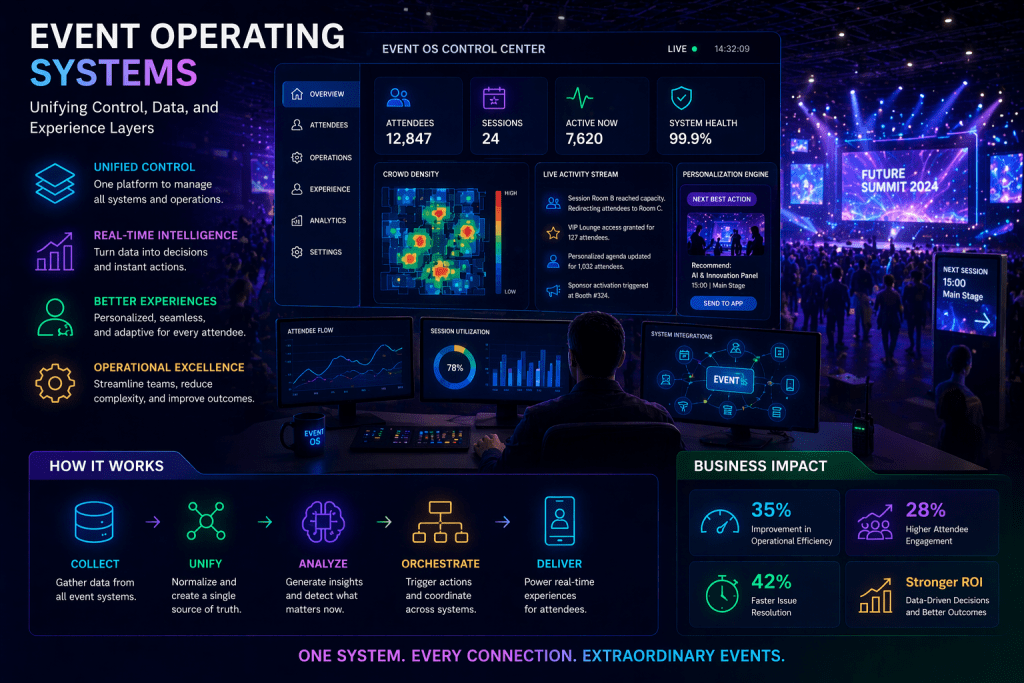
Event Operating Systems (Event OS) emerge as a response to this challenge. They function as a control plane that integrates data, orchestrates systems, and enables real-time decision-making across the entire event environment. Rather than replacing existing tools, an Event OS connects them into a cohesive, intelligent system.
Defining the Event Operating System
An Event Operating System is not a single application but a foundational layer that sits above individual event technologies. It provides a unified interface for managing operations, data flows, and experiences.
Conceptually, it mirrors operating systems in computing. Just as an OS manages hardware resources and software processes, an Event OS manages event infrastructure and digital services. It abstracts complexity, enabling operators to interact with the system at a higher level.
The Event OS performs three primary functions:
- Aggregating and normalizing data from multiple sources
- Orchestrating workflows and system interactions
- Providing a control interface for real-time monitoring and decision-making
This triad transforms event management from a collection of tools into an integrated system.
Architectural Model: Layers of the Event OS
The architecture of an Event OS is inherently layered, with each layer responsible for a distinct set of capabilities.
Data Layer: The Unified Event State
At the foundation lies the data layer, which consolidates information from across the event ecosystem. This includes registration data, behavioral signals, spatial information, and system telemetry.
Unlike traditional data warehouses, this layer operates in real time. It maintains a continuously updated representation of the event’s state, enabling immediate insights and actions.
Event data platforms and streaming pipelines are central to this layer, ensuring that data is both consistent and accessible.
Integration Layer: Connecting Distributed Systems
The integration layer acts as the connective tissue between systems. Through APIs, event streams, and middleware, it enables communication between disparate components.
This layer handles:
- Data transformation and normalization
- Event routing and synchronization
- Interoperability between vendors and platforms
By abstracting integration complexity, it allows the Event OS to operate across heterogeneous environments.
Orchestration Layer: Coordinating Actions
The orchestration layer is where decisions are translated into actions. It coordinates workflows across systems, ensuring that operations are aligned with real-time conditions.
For example, if a session reaches capacity, the orchestration layer can trigger actions such as updating availability in the event app, redirecting attendees, and notifying staff. These actions occur seamlessly, without manual intervention.
This layer often incorporates rule-based logic and AI-driven decision systems, enabling both predefined and adaptive responses.
Experience Layer: Delivering Interactions
The experience layer interfaces directly with attendees and staff. It includes mobile apps, digital signage, wearable devices, and other touchpoints.
The Event OS ensures that these interfaces are consistent and context-aware. Information delivered to users reflects the current state of the event, enabling personalized and timely interactions.
This layer is where the impact of the Event OS becomes visible, translating system intelligence into user experience.
Control Interface: Monitoring and Governance
The control interface provides operators with a centralized view of the event. Dashboards display real-time metrics, system status, and operational insights.
Operators can monitor performance, identify issues, and intervene when necessary. The interface also supports governance, allowing administrators to define policies, manage access, and configure system behavior.
This centralized control is essential for managing complex events at scale.
Real-Time Operations: From Observation to Action
One of the defining characteristics of an Event OS is its ability to operate in real time. Traditional event management relies on observation followed by manual action. The Event OS compresses this cycle, enabling immediate response.
When data is ingested, it is processed and interpreted instantly. The system identifies patterns, detects anomalies, and evaluates potential actions. These actions are then executed through the orchestration layer, creating a continuous feedback loop.
This capability is particularly valuable in scenarios such as crowd management, where delays can lead to safety risks, or in personalization, where timing is critical for relevance.
Integration with Emerging Event Technologies
The Event OS serves as a unifying layer for emerging technologies discussed across modern event ecosystems.
Behavioral intelligence systems feed into the data layer, enriching the understanding of attendee intent. Real-time personalization engines leverage this data to deliver adaptive experiences. Autonomous networking systems integrate with orchestration layers to coordinate interactions.
Spatial computing and digital twin systems provide additional context, enabling the Event OS to operate with a more comprehensive view of the environment. Edge computing supports low-latency processing, ensuring responsiveness.
This integration transforms the Event OS into a central intelligence hub that connects and enhances all other systems.
Operational and Business Impact
The adoption of an Event OS has significant implications for both operations and business outcomes.
Operationally, it reduces complexity. Instead of managing multiple systems independently, teams interact with a unified interface. This improves efficiency and reduces the risk of errors.
From a strategic perspective, it enables more proactive management. Decisions are informed by real-time data and executed automatically, allowing organizations to optimize outcomes as events unfold.
For attendees, the impact is seen in smoother experiences, more relevant interactions, and fewer disruptions. For sponsors, it translates into better targeting and higher engagement.
Ultimately, the Event OS enables events to function as coordinated systems rather than fragmented processes.
Challenges and Considerations
Implementing an Event OS is a complex undertaking. Integration remains a primary challenge, particularly in environments with legacy systems and diverse vendors.
Data governance is critical. Ensuring data consistency, quality, and security across multiple sources requires robust policies and infrastructure.
Scalability must be considered, especially for large events with high data volumes and real-time requirements.
There is also the question of organizational readiness. Adopting an Event OS requires a shift in mindset, from managing tools to managing systems. This often involves changes in processes, roles, and skill sets.
Future Outlook: Toward Autonomous Event Systems
The evolution of Event Operating Systems points toward increasing autonomy. As AI capabilities advance, the system will take on more responsibility for decision-making and execution.
Operators will move from direct control to supervisory roles, defining objectives and constraints while the system manages day-to-day operations.
Integration with broader digital ecosystems will further expand capabilities, enabling events to connect with enterprise systems, smart infrastructure, and external data sources.
Over time, the Event OS may become the foundation for fully autonomous event environments, where planning, execution, and optimization are continuously integrated.
Conclusion: The Event OS as the Backbone of Modern Events
Event Operating Systems represent a critical step in the maturation of event technology. By unifying data, control, and experience layers, they provide the infrastructure needed to manage complex, real-time environments.
This approach transforms events from collections of tools into cohesive systems, enabling greater efficiency, adaptability, and intelligence.
For event technology leaders, the Event OS is not just an architectural choice—it is a strategic foundation. It enables the integration of emerging technologies, supports real-time operations, and positions events for future innovation.
As the industry continues to evolve, the ability to operate events through a unified system will become a defining capability.